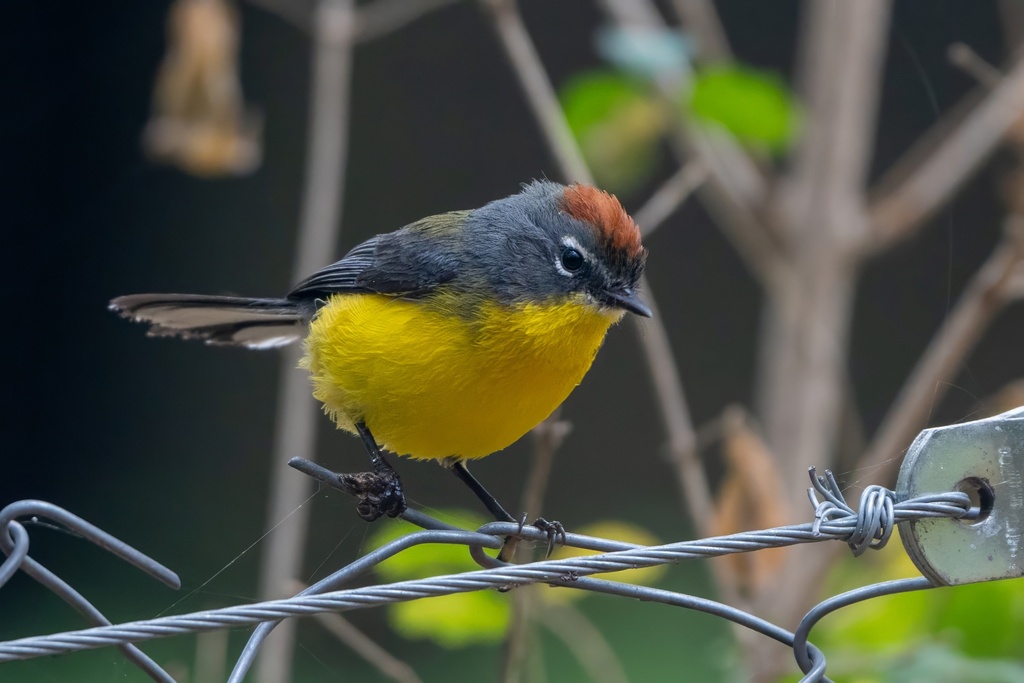
Brown-capped Whitestart
Photo © Gonzalo González Mora
Photo © Gonzalo González Mora — CC BY 4.0 — Source: iNaturalist photo #397966294Identification
The brown-capped whitestart is a small warbler measuring about 13 cm in length and weighing between 8.5 and 11 grams. Both males and females share identical plumage, making field identification straightforward. The species is characterized by a mostly gray head crowned with a distinctive rufous cap, which gives it its common name. Look for a whitish stripe above the lores and striking white crescents above and below each eye, creating a bold facial pattern. The upperparts and wings are predominantly gray with an olive-tinged mantle, while the tail is black with conspicuous white on the outer feathers—a useful field mark for spotting birds in flight or perched at a distance.
The throat and underparts are bright yellow, contrasting sharply with white undertail coverts. The bird has a dark iris, blackish bill, and dark legs and feet. Juveniles appear duller overall, with a brownish-gray head and upperparts, a buffy-brown throat and breast, and paler yellow belly, so they require more careful observation in the field.
Range & Habitat
The brown-capped whitestart is endemic to Argentina and Bolivia, with a notably disjunct distribution. The larger population inhabits the eastern slope of the Andes, ranging from central Bolivia's La Paz Department southward into northern Argentina as far as La Rioja Province. A separate, smaller population occurs further south in the Sierras de Córdoba. The species favors forest and woodland edges and clearings, and is also found in gardens. In Bolivia, it primarily inhabits dry deciduous forests, whereas in Argentina it shows greater flexibility, occupying native forest during breeding season and shifting to plantations of non-native species at lower elevations during the non-breeding season.
Elevationally, the brown-capped whitestart typically occurs between 1,400 and 3,200 meters, though it locally reaches 3,800 meters in Bolivia. In Argentina, it is most abundant between 1,400 and 1,700 meters but descends to as low as 400 meters during the non-breeding season.
Behaviour & Diet
This warbler feeds exclusively on invertebrates, gleaning adult and larval insects, spiders, and other arthropods from the forest understory and middle levels. Unlike most of its relatives in the genus Myioborus, the brown-capped whitestart seldom uses the characteristic tail-flicking behavior that other whitestarts employ to startle prey into view. It is a social forager that sometimes joins mixed-species feeding flocks, increasing foraging efficiency.
The brown-capped whitestart makes elevational movements in Argentina, breeding at higher elevations and descending to lower altitudes after the breeding season, with documented movements of up to 10 kilometers. It breeds between September and January, constructing a distinctive ball-shaped nest with a side entrance from decaying plant matter, straw, and grass, lined with finer materials. The nest is well concealed on the ground or within a small hollow in an earthen bank. The incubation period lasts about 16 days and fledging occurs approximately 12 days after hatching.
Best Time & Places to See It
The brown-capped whitestart is considered common throughout its range, making it a reliable species for travelers visiting the Andes region. The breeding season from September through January is an excellent time to locate birds, as they are more vocal and active. In Argentina, the higher elevations of the range (1,400–1,700 meters) offer the best opportunities during breeding season, while lower elevations in plantations become productive during the non-breeding season. In Bolivia, the eastern Andean slopes around La Paz Department are accessible localities.
The species' preference for forest edges, clearings, and gardens means it is often found in accessible locations rather than deep forest interior, making it suitable for travelers of varying expertise levels.
Photography Tips
The brown-capped whitestart's small size and tendency to forage in understory vegetation require patience and attention. Its bright yellow underparts and distinctive facial markings provide good contrast and make it visually striking in photographs. The rufous crown is particularly distinctive and should be a focus when composing shots. Early morning hours often provide the best lighting and increased activity levels.
Since the bird gleans insects from vegetation rather than making prominent flights, position yourself along forest edges and in clearings where you can anticipate its foraging movements. Its lack of the tail-flicking behavior shown by other whitestarts means you will need to rely on spotting it perched or moving through vegetation rather than waiting for conspicuous display behavior.
Los Cardones National Park
Argentina
+193 birds+6 mammals
Where the Andes descend into northwestern Argentina, Los Cardones National Park sprawls across nearly 1,200 square kilometres of one of South America's most distinctive high-altitude desert…
VIEW NATIONAL PARKEl Rey National Park
Municipio de Las Lajitas, Argentina
+317 birds+4 mammals
Where the eastern slopes of the Andes descend into northwestern Argentina's subtropical transition zone, El Rey National Park unfolds across 841 square kilometers of dramatically varied…
VIEW NATIONAL PARKCalilegua National Park
Municipio de Calilegua, Argentina
+288 birds+8 mammals
Where the eastern Andean slopes plunge into northwestern Argentina's humid subtropics, nearly 2,645 square kilometers of steep terrain and luxuriant forest compose one of South America's…
VIEW NATIONAL PARKBaritú National Park
Argentina
+81 birds+2 mammals
Where the eastern slopes of the Serranías del Hornocal descend into cloud forest and subtropical ravines, Baritú National Park protects one of northwestern Argentina's most biodiverse…
VIEW NATIONAL PARKNo community photos yet. Log in to add the first one.
No community observations of this species yet.