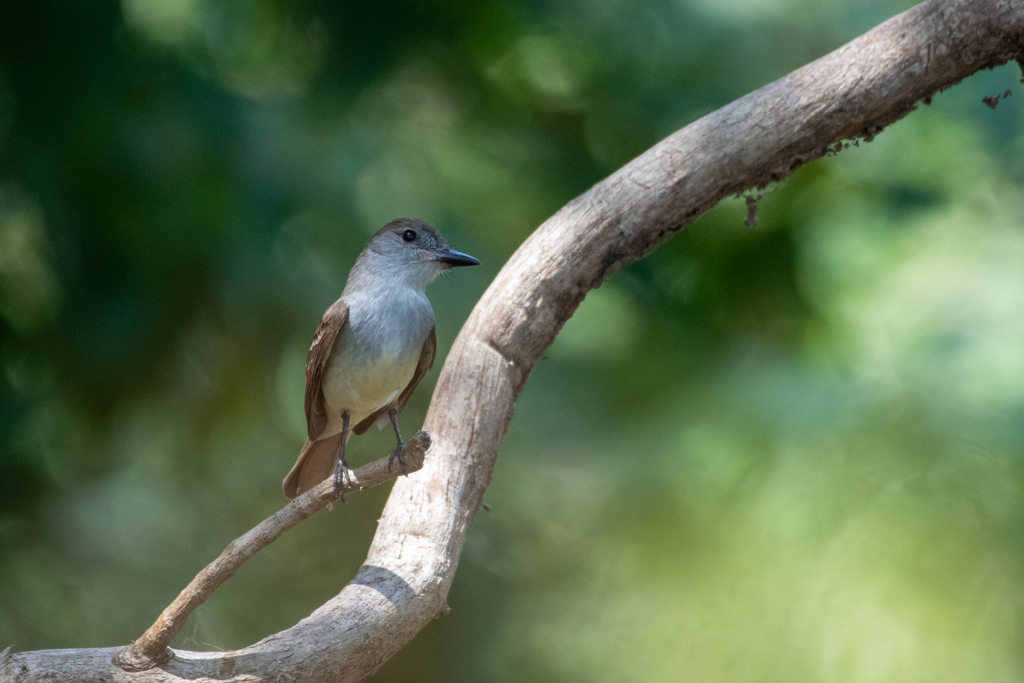
Brown-crested Flycatcher
Photo © Court Harding
Photo © Court Harding — CC BY 4.0 — Source: iNaturalist photo #279128363Identification
The brown-crested flycatcher is a medium-sized passerine measuring 18 to 23 cm in length, with northern subspecies notably larger than southern ones. The most distinctive feature is a bushy crest on the grayish-brown crown, whose feathers have darker shafts. The upperparts are light to dark olive-gray with often a rufous tinge on the uppertail coverts. The face is medium gray, and the wings are dark with rufous edges on most primaries and pale edges on secondaries, creating two visible wing bars. The tail is dark with rufous inner webs on most feathers. The throat and upper breast are light gray, while the lower breast, flanks, and belly are bright yellow with a light gray wash on the sides. Most individuals have a brown iris, black bill (sometimes with a paler base), and black legs.
Subspecific variation is considerable. Northern forms like M. t. magister and M. t. cooperi are larger and lighter; southern and island forms show darker crowns, browner upperparts, darker rufous tones, and paler bellies. Sexes are identical in plumage.
Range & Habitat
The brown-crested flycatcher's range is vast and complex, spanning from the southwestern United States through Mexico and Central America to Costa Rica, plus Caribbean islands (Aruba, Bonaire, Curaçao, Trinidad, and Tobago) and nearly every mainland South American country except Chile and possibly Ecuador. Different subspecies occupy disjunct distributions: M. t. magister ranges from southeastern California and Arizona south through western Mexico; M. t. cooperi inhabits southern Texas through eastern Mexico and into Honduras; island subspecies occupy specific Caribbean locations; and South American populations are found from the northern coasts through Venezuela, the Guianas, Brazil, Bolivia, Paraguay, and Argentina. The species has occasionally occurred as a vagrant in Louisiana and Florida.
Behaviour & Diet
The brown-crested flycatcher is a member of the tyrant flycatcher family, a group known for their active foraging and aggressive territorial behavior. Like other Myiarchus species, they are primarily insectivorous, gleaning prey from vegetation and catching insects in flight. They are cavity nesters, utilizing tree holes for breeding. Their behavior and ecology vary across their extremely large range, adapting to quite different landscapes from arid southwestern scrublands to humid tropical forests.
Best Time & Places to See It
The brown-crested flycatcher's breeding and year-round presence vary by subspecies and location. In the southwestern United States, M. t. magister is present during breeding season. In Mexico and Central America, timing depends on local subspecies and climate patterns. South American populations, including those on Caribbean islands, may be year-round residents. Habitat preferences vary significantly across the species' range, from desert scrub in the north to various woodland and forest types throughout its distribution.
Photography Tips
The bushy crest and bright yellow underparts make this flycatcher visually distinctive, particularly in profile shots that emphasize the crown. The contrast between the dark upperparts, rufous tail, and bright yellow belly provides excellent opportunities for color photography. Subspecific variation means that photographing multiple forms across the range yields visually interesting comparisons. Early morning activity and perching behavior typical of tyrant flycatchers offer good opportunities for capturing sharp, well-lit images without excessive waiting.
Amazônia National Park
Anavilhanas National Park
Arenal Volcano National Park
Bahuaja Sonene National Park
Baritú National Park
Big Bend National Park
Brasília National Park
Cabeza Prieta National Wildlife Refuge
Calilegua National Park
Nothing matches these filters.
No community photos yet. Log in to add the first one.
No community observations of this species yet.