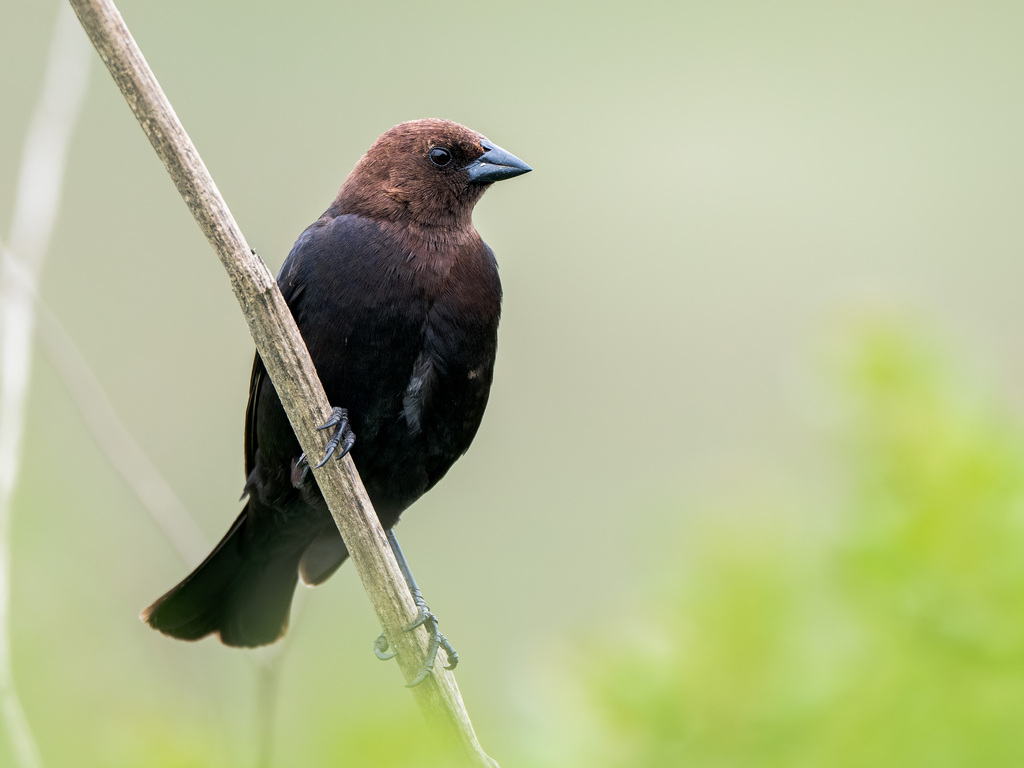
Brown-headed Cowbird
Photo © cello caruso-turiello
Photo © cello caruso-turiello — CC BY 4.0 — Source: iNaturalist photo #656878277Identification
The brown-headed cowbird is a small icterid with a distinctive appearance. Adult males are unmistakable: iridescent black plumage contrasts sharply with a rich brown head. Females are subtly different, appearing as dull grey overall with a pale throat and very fine streaking on the underparts. Both sexes have a finch-like head and beak, smaller and more delicate than typical icterids. Brown-headed cowbirds measure 16–22 cm in total length with an average wingspan of 36 cm. Males average 49 g, while females are slightly smaller at 38.8 g on average.
Range & Habitat
The brown-headed cowbird is native to temperate and subtropical North America, with three recognized subspecies spanning the continent from interior western Canada to northeast Mexico. Birds in southern parts of the range are permanent residents, while northern populations migrate south to the United States and Mexico in winter, returning to breeding grounds around March or April.
These birds favour open or semiopen country and often travel in flocks, sometimes mixing with red-winged blackbirds (particularly in spring) and bobolinks (particularly in fall), as well as common grackles or European starlings. Before European settlement, they followed bison herds across the prairies. The species expanded dramatically with forest clearing and the introduction of grazing animals by settlers, and is now commonly seen at suburban bird feeders.
Behaviour & Diet
The brown-headed cowbird is an obligate brood parasite—it does not build nests or raise its own young. Instead, females lay eggs in the nests of other small passerines, particularly species that build cup-like nests. Brown-headed cowbird eggs have been documented in nests of at least 220 host species, ranging from hummingbirds to raptors, with more than 140 species known to have successfully raised young cowbirds. A single female can lay up to 40 eggs in a season.
Host species respond to parasitism in various ways. Some, like grey catbirds, reject cowbird eggs more than 95% of the time. Others, such as blue-grey gnatcatchers, abandon their entire nests; American yellow warblers bury foreign eggs; and brown thrashers physically eject them. When cowbird eggs are removed, females have been observed engaging in "mafia behavior," returning to ransack host nests. Cowbirds forage on the ground, often following grazing animals like horses and cattle to catch insects. Their diet consists mainly of seeds and insects, with berries eaten rarely.
Best Time & Places to See It
Spring and fall migrations offer good opportunities to observe brown-headed cowbirds in flocks, particularly in open habitats and grasslands. Year-round residents can be found in southern portions of the range. Suburban areas with bird feeders attract them readily. Look for mixed flocks traveling with red-winged blackbirds in spring or bobolinks in fall. Since these birds often follow grazing animals, pastoral landscapes and farmland are reliable locations.
Photography Tips
The male's striking contrast between iridescent black body and brown head makes it highly photogenic, especially in good light that reveals the iridescence. Photograph males from angles that showcase both colors clearly. Females are more subtle and require careful exposure to render their pale throat and fine underpart streaking. Capture them foraging on the ground near cattle or in typical open-country habitats for behavioral interest. Mixed-species flocks in spring offer dynamic compositional opportunities.
Acadia National Park
Alaska Maritime National Wildlife Refuge
Algonquin Provincial Park
Alligator River National Wildlife Refuge
Arches National Park
Badlands National Park
Banff National Park
Bear River Migratory Bird Refuge
Bic National Park
Nothing matches these filters.
No community photos yet. Log in to add the first one.
No community observations of this species yet.