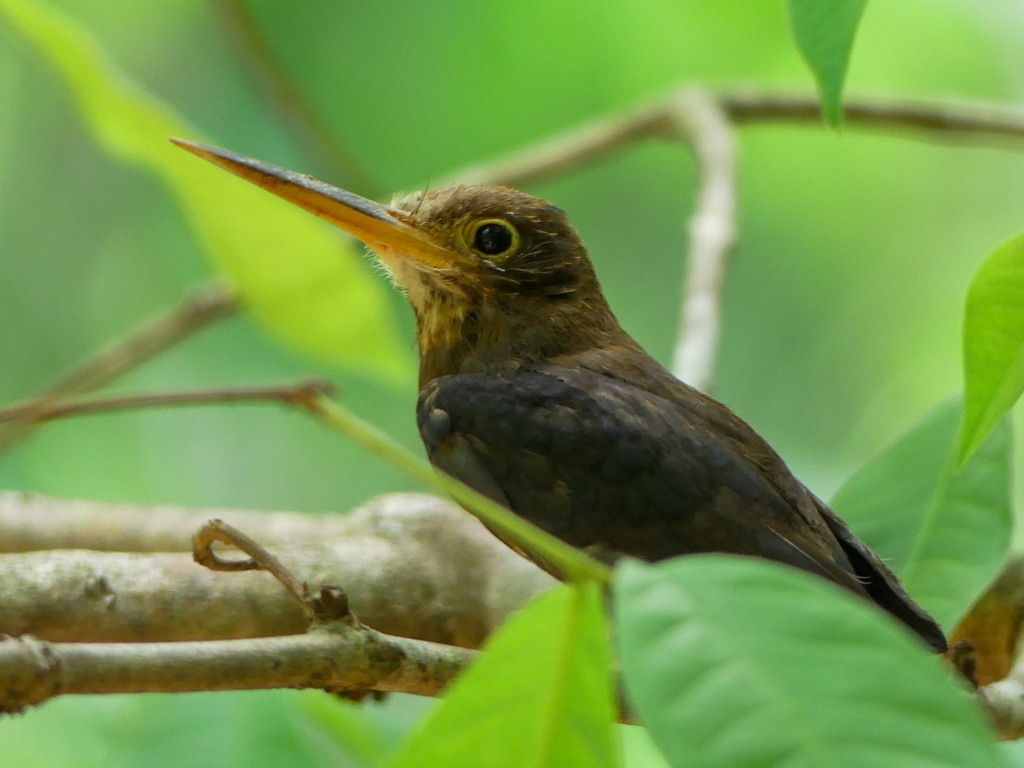
Brown Jacamar
Photo © inaturalista.com.br
Photo © inaturalista.com.br — CC BY 4.0 — Source: iNaturalist photo #332863010Identification
The brown jacamar is a small bird, measuring 14 to 18 cm in length and weighing just 16 to 23 grams. The nominate subspecies displays brown upperparts with a dark brown lower back glossed with greenish-black, while the wings are blackish with a distinctive blue sheen. The chin and throat are off-white, contrasting with reddish-brown breast and flanks, and an off-white or buff lower breast and belly. Among the seven recognized subspecies, plumage tones and intensities vary, particularly in the back and breast coloration, making field identification of subspecies challenging without detailed knowledge of their ranges.
Range & Habitat
The brown jacamar is found across three discontinuous regions in northern South America east of the Andes, spanning Bolivia, Brazil, Colombia, Ecuador, French Guiana, Guyana, Peru, Suriname, and Venezuela. The species shows remarkable habitat versatility, primarily inhabiting terra firme, várzea, and gallery forests in both primary and secondary growth. It frequents the canopy, forest edges, and shrubby clearings, and also occurs along watercourses in savanna habitats and on white sand soils in some areas. Altitudinally, it typically ranges from lowlands to 900 meters, though records from Venezuela extend to 1,500 meters.
Behaviour & Diet
The brown jacamar is an insectivore that employs a characteristic sallying technique, perching on exposed branches in pairs or small groups before launching out to snatch flying insects from the air. Breeding details remain incompletely documented, though nests are presumed to be burrows excavated in soil banks or cavities within arboreal termite nests. Records from Colombia indicate breeding activity in March through May. Vocally, this species is quite distinctive, producing a descending song rendered as "tick tick tick ti ti ti ti tit t t t" or "plee, plee, plee-plee-plee-ple'pe'pe'e'e'e," ending in a characteristic stutter. Sharp calls include a high "hilew" and a lower "chewee."
Best Time & Places to See It
The brown jacamar is uncommon to common throughout various portions of its range and occurs in several protected areas across the Amazon basin and adjacent regions. Its presence in multiple countries offers numerous opportunities for observation. The breeding season, spanning March through May based on Colombian records, may be a productive time for locating birds, as breeding activity often increases vocal output and visibility. Due to its canopy and edge-dwelling habits, observers should focus on clearings, forest margins, and watercourse corridors where exposed perches are available.
Photography Tips
Patience and positioning near suitable perches will reward photographers, as this species habitually returns to the same exposed branches. Early morning hours typically offer the best lighting for capturing the subtle blue sheen on the wings and the greenish-black gloss of the lower back. The bird's small size necessitates good optics or longer focal lengths; a telephoto lens of at least 300-400mm is recommended. Position yourself with backlighting or side-lighting to emphasize the wing coloration, and watch for the characteristic sallying behavior, which provides dynamic shooting opportunities. The stutter-like vocalizations can serve as an audio cue for locating birds before attempting photography.
Amacayacu National Park
Campos Amazónicos National Park
Chapada dos Guimarães National Park
Chapada dos Veadeiros National Park
Emas National Park
Encontro das Águas State Park
French Guiana Amazonian Park
Natural Sierra de la Macarena National Park
Pacaás Novos National Park
Nothing matches these filters.
No community photos yet. Log in to add the first one.
No community observations of this species yet.