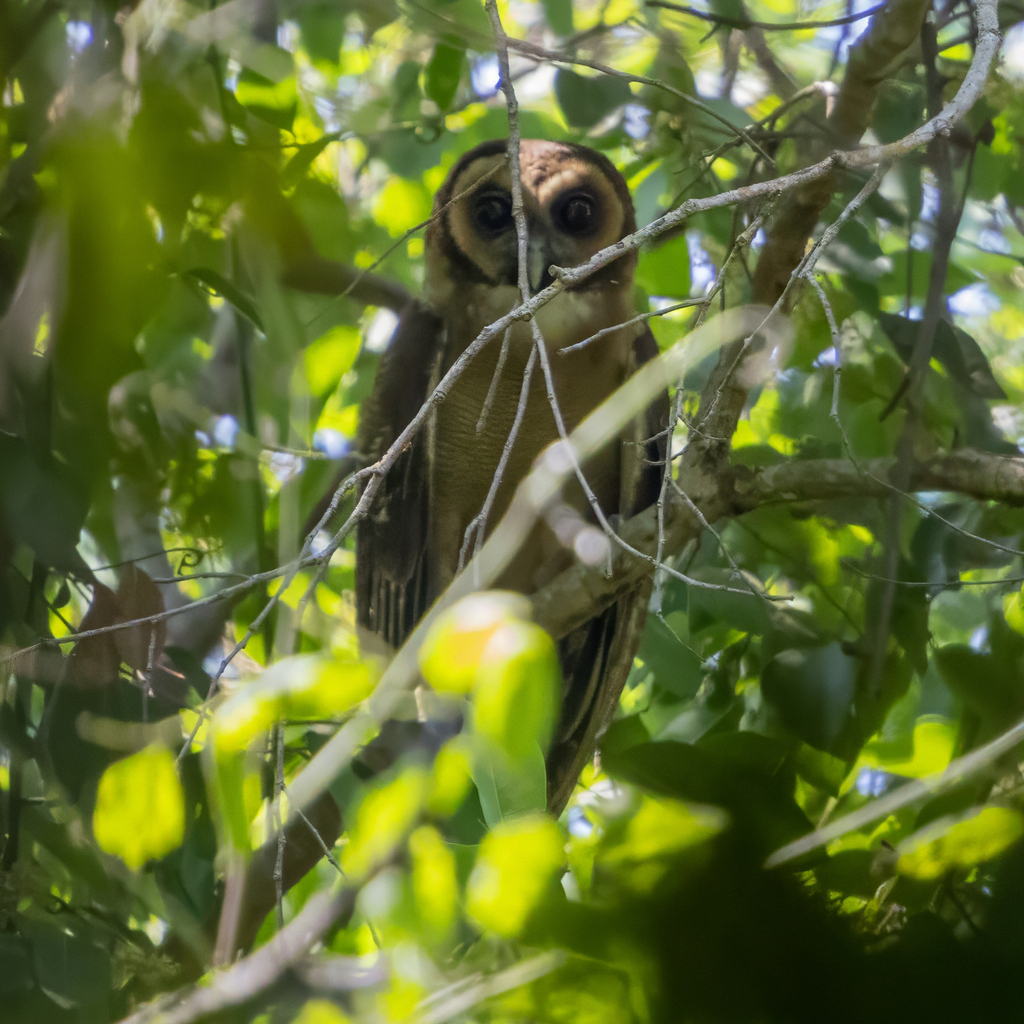
Brown Wood Owl
Photo © Dan Vickers
Photo © Dan Vickers — CC BY 4.0 — Source: iNaturalist #346356378Identification
The brown wood owl is a medium-large owl, measuring 45–57 cm in length. It belongs to the genus Strix, the earless owls, and lacks the prominent ear tufts seen in some other owl species. The upperparts are uniformly dark brown with faint white spotting on the shoulders, while the underparts are buff with brown streaking. The facial disc is brown or rufous, edged with white, and notably lacks the concentric barring found in some related species. A distinctive white neckband is present, and the eyes are dark brown. The sexes are similar in appearance, making field identification based on plumage alone difficult.
Range & Habitat
The brown wood owl is found across a wide range in Asia, including India, Bangladesh, Sri Lanka, Indonesia, Taiwan, and south China. It is a resident breeder throughout south Asia, meaning populations remain in their range year-round rather than migrating seasonally. This species is highly nocturnal and commonly inhabits dense forests across its range, where the thick vegetation provides shelter during daylight hours.
Behaviour & Diet
As a strictly nocturnal hunter, the brown wood owl is primarily active after dark, making direct observation challenging. However, birdwatchers can often locate roosting birds by following the alarm calls and mobbing behaviour of small birds that gather around the owl during daylight hours. The owl's diet consists mainly of small mammals, birds, and reptiles, which it hunts under the cover of darkness.
The brown wood owl is notably vocal, producing several distinctive calls. The typical call is a series of hoots described as "hoo hoo hoo HOO" or a deeper "goke-goke-ga-LOOO," and it may also produce a loud scream. The alarm call is a sharp bark, "wow-wow." Subspecific variation in vocalizations is pronounced; the northern Himalayan wood-owl subspecies group produces a soft, low "to-hooh" reminiscent of rock dove cooing, while Bartel's wood-owl from Java delivers a loud, forceful single "HOOH!" with long pauses between calls.
Best Time & Places to See It
Finding a brown wood owl requires patience and nocturnal effort. Dense forests throughout its Asian range offer the best opportunities, particularly in areas of India, Bangladesh, Sri Lanka, Indonesia, Taiwan, and south China. Since this species is strictly nocturnal and a resident breeder, it may be encountered year-round in suitable habitat. Listening for calls at night, particularly during breeding season, increases chances of detection. Alternatively, searching roosting sites during daylight and listening for the agitated calls of small birds that mob the owl can reveal its daytime location.
Photography Tips
Photographing the brown wood owl presents significant challenges due to its nocturnal habits and preference for dense forest cover. Night-vision or thermal imaging equipment may be necessary for any chance of capturing images in its natural state. Photographers should focus on locating roosting birds during the day by following mixed-species flocks of small birds and listening for alarm calls. Patience, stealth, and familiarity with local subspecies calls will greatly improve success rates in the field.
Lunugamvehera National Park
Sri Lanka
+204 birds+14 mammals
Dry scrubland and shallow wetlands converge in Sri Lanka's southeastern lowlands, where Lunugamvehera National Park anchors one of the island's most ecologically vital landscapes. The park's…
VIEW NATIONAL PARKSchleswig-Holsteinisches Wattenmeer National Park
Germany
+378 birds+49 mammals
Where the North Sea ebbs and flows across a vast expanse of exposed mud and sand, the Schleswig-Holsteinisches Wattenmeer National Park reveals one of Europe's most…
VIEW NATIONAL PARKKhangchendzonga National Park
Sakkyong, India
+290 birds+1 mammals
Where the eastern Himalayas surge toward their crowning peaks, Khangchendzonga National Park embraces a landscape of almost overwhelming vertical drama. Rising from subtropical river valleys into…
VIEW NATIONAL PARKEravikulam National Park
Devikulam, India
+192 birds+7 mammals
High in the Western Ghats of Kerala, where monsoon mists cling to slopes that rise above 2,000 metres, Eravikulam National Park preserves one of South India's…
VIEW NATIONAL PARKHat Noppharat Thara-Mu Ko Phi Phi National Park
Ao Nang, Thailand
+253 birds+9 mammals
Where limestone karsts rise dramatically from turquoise waters, Hat Noppharat Thara-Mu Ko Phi Phi National Park unfolds across a mosaic of beach, mangrove forest, and island…
VIEW NATIONAL PARKKhao Yai National Park
Prachantakham District, Thailand
+377 birds+46 mammals
Evergreen dipterocarp forest blankets the rolling terrain of this national park in eastern Thailand, where limestone hills rise abruptly from the forest floor and seasonal streams…
VIEW NATIONAL PARKMount Nanling Forest Park
Ruyang Forest Farm, China
+179 birds+3 mammals
Granite ridges and weathered peaks rise through a canopy of subtropical montane forest where Ruyang Forest Farm anchors one of southern China's most biodiverse landscapes. Across…
VIEW FOREST & JUNGLEKanha Tiger Reserve
Kanha Kisli F.V., India
+321 birds+23 mammals
Where sal forests give way to emerald meadows and crystalline streams carve through ancient valleys, one of India's finest wilderness reserves unfolds across the Maikal Range.…
VIEW NATIONAL PARKKaziranga National Park
Kohora, India
+422 birds+26 mammals
Dawn breaks over the floodplains of the Brahmaputra, where tall grasslands stretch endlessly beneath monsoon-heavy skies. This sprawling wilderness of northeastern Assam is a mosaic of…
VIEW NATIONAL PARKPeriyar National Park
Mlappara, India
+232 birds+4 mammals
Dawn breaks over mist-shrouded ridges where the Western Ghats tumble toward Kerala's spice-scented lowlands. Here, ancient tropical forests envelope a glittering artificial lake, creating a mosaic…
VIEW NATIONAL PARKPampadum Shola National Park
Vattavada, India
+258 birds+14 mammals
Where misty shola forests cling to the high plateaus of the Nilgiri Mountains, ancient evergreen remnants create a world apart. This 2,316-hectare reserve protects one of…
VIEW NATIONAL PARKNagarahole Tiger Reserve
Nalkeri Forest, India
+323 birds+23 mammals
Where granite escarpments rise above dense deciduous forests and the Kabini River carves through pristine wilderness, one of India's most biodiverse landscapes unfolds across the Western…
VIEW NATIONAL PARKTaman Negara National Park
Kampong Samas, Malaysia
+393 birds+48 mammals
Where ancient rainforest meets limestone peaks, one of Southeast Asia's oldest protected wilderness preserves sprawls across 4,343 square kilometers of primordial landscape. Dipterocarp giants tower overhead,…
VIEW NATIONAL PARKGunung Mulu National Park
Long Seridan, Malaysia
+280 birds+39 mammals
Where granite monoliths pierce the rainforest canopy of Sarawak, an ancient limestone karst landscape reveals one of Southeast Asia's most biodiverse strongholds. Soaring peaks cloaked in…
VIEW NATIONAL PARKKerinci Seblat National Park
Kerinci, Indonesia
+228 birds+16 mammals
Across nearly 67,000 square kilometres of Sumatra's spine, a mountainous realm of equatorial rainforest rises from steaming lowlands to volcanic peaks shrouded in cloud. Kerinci Seblat…
VIEW NATIONAL PARKWay Kambas National Park
Lampung Timur, Indonesia
+237 birds+20 mammals
Across the low swamplands of eastern Lampung, where freshwater wetlands merge into tidal mangrove forests along the Sunda Strait, sprawls one of Sumatra's most vital sanctuaries.…
VIEW NATIONAL PARKXishuangbanna National Nature Reserve
Xishuangbanna Dai Autonomous Prefecture, China
+173 birds+2 mammals
Where subtropical monsoon forests meet the margins of the Yunnan plateau, Xishuangbanna National Nature Reserve sprawls across a landscape of dramatic relief—deep river valleys carved by…
VIEW NATURE RESERVEGaoligong Mountain National Nature Reserve
Nujiang Lisu Autonomous Prefecture, China
+443 birds+13 mammals
VIEW NATURE RESERVENo community photos yet. Log in to add the first one.
No community observations of this species yet.