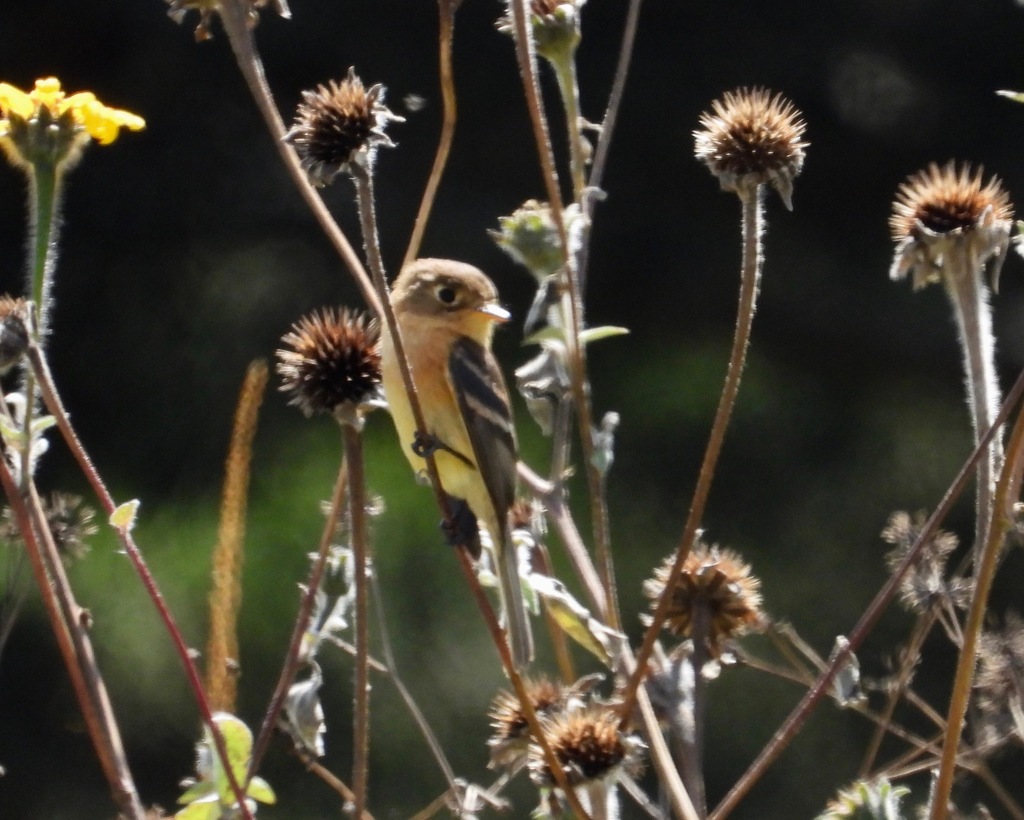
Buff-breasted Flycatcher
Photo © Grete Pasch
Photo © Grete Pasch — CC BY 4.0 — Source: iNaturalist #69167121Identification
The buff-breasted flycatcher is a diminutive member of the tyrant flycatcher family, measuring just 13 cm (5.1 in) in length and weighing 6.9–9.3 g. It ranks among the smallest flycatchers in its genus, particularly within the United States. Both sexes appear identical. The bird's most distinctive feature is its warm, peachy-buff coloration on the breast and underparts, which contrasts with dull buffy-greenish-brown upperparts. Look for a faint buff-white eye-ring and lores, a darker buffy-brown crown and nape, and two pale wing bars formed by whitish or buffy-gray tips on the wing coverts. The tail is grayish-brown with paler outer feathers. All birds display a deep chestnut-brown iris, black upper mandible, and yellow-orange lower mandible. Several subspecies show variations in overall coloration, from the nominate form's grayish tones to richer browns and cinnamon hues in southern populations.
Range & Habitat
This species has a disjunct distribution spanning from southeastern Arizona southward through Mexico to Honduras. The nominate subspecies occurs in northeastern Mexico (Tamaulipas), while E. f. pygmaeus—the form most familiar to birders in the United States—ranges from southeastern Arizona through northern Mexico, though it has retreated from former haunts in southwestern New Mexico. Other subspecies are distributed throughout Mexican highlands and into Central America, with populations in southern Guatemala, Chiapas, and Honduras.
The buff-breasted flycatcher favors wide mountain canyons with open pine, pine-oak, and oak forests featuring grassy understories interspersed with low bushes. The species often follows watercourses through these habitats. Elevation preferences vary by region: in Arizona it occurs between 1,950–2,850 m, while elsewhere in its range it inhabits elevations from 600–3,500 m. During the non-breeding season, some populations descend to lower-elevation thorn-scrub areas.
Behaviour & Diet
The buff-breasted flycatcher is an insectivore that forages primarily in the understory and mid-story levels of forest, though it readily descends to ground level to hunt. It employs a classic flycatcher strategy, hawking insects in mid-air from a perch or from bare ground and grass. During breeding season, birds typically forage in pairs; outside breeding season, they are solitary hunters. The species is a partial migrant: the Arizona population (E. f. pygmaeus) migrates southward after breeding, while southern populations are generally year-round residents, though some individuals move to lower elevations seasonally.
Breeding in Arizona occurs from mid-April through late June. The female builds an open cup nest from small rootlets and leaves bound with spiderweb, decorated externally with feathers, larger leaves, lichen, and bark. Nests are typically placed 2.7–12 m high in live trees, either on branches away from the trunk or in branch crotches, usually sheltered by overhanging foliage. Clutches contain three or four unmarked, creamy-white eggs. Only the female incubates (14–16 days) and broods, but both parents feed the young. Fledging occurs 15–17 days after hatching.
Best Time & Places to See It
For birders visiting the United States, southeastern Arizona is the primary location, though the species is uncommon and very local there. Key areas include Fort Huachuca and Coronado National Forest, where it can be found from mid-April through September during the breeding season. The species is more readily encountered farther south: it is fairly common in Guatemala and Honduras, making those countries better destinations for reliable sightings. Visit montane pine-oak canyons and forest edges during the breeding season (spring through early summer) for the best chances of locating this small flycatcher.
Photography Tips
The buff-breasted flycatcher presents challenges and rewards for patient photographers. Its small size, preference for shadowed understory perches, and cryptic coloration demand steady hands and appropriate equipment. A telephoto lens (400–600 mm) is essential for frame-filling images from a safe distance. Early morning light filtering through canopy gaps will illuminate the bird's warm buff tones and reveal the subtle two-toned facial pattern and wing bars. The species' habit of hawking from exposed perches provides fleeting opportunities for in-flight shots; fast shutter speeds (1/2000 s or faster) are necessary. Position yourself near open, shrubby canyon areas where the bird may perch between foraging bouts, and listen for its distinctive calls to locate individuals. Patience and persistence in suitable habitat will eventually reward observant photographers with this diminutive flycatcher's portraits.
Saguaro National Park
Rincon Valley, United States
+354 birds+40 mammals
Where the Sonoran Desert meets sky-island mountains, two geographically separated districts of Saguaro National Park sprawl across nearly two thousand square kilometers of Arizona's most iconic…
VIEW NATIONAL PARKParque Nacional Cerro de la Estrella
Mexico
+126 birds+4 mammals
Where volcanic peaks rise sharply above Mexico City's sprawling metropolis, Parque Nacional Cerro de la Estrella offers a rare glimpse of high-altitude terrain within one of…
VIEW NATIONAL PARKTutuaca
Tosanachi, Mexico
+147 birds+13 mammals
Where copper canyons plunge deeper than the Grand Canyon itself, Mexico's remote Sierra Madre Occidental unfolds in dramatic vertical relief. Tutuaca anchors this wilderness realm, a…
VIEW PROTECTED LANDSCAPEBarra del Colorado National Wildlife Refuge
Tortuguero, Costa Rica
+462 birds+36 mammals
Where the Caribbean's restless waters meet the Limón Province coastline, Barra del Colorado National Wildlife Sanctuary unfolds across a landscape of extraordinary ecological complexity. This equatorial…
VIEW WILDLIFE SANCTUARYNo community photos yet. Log in to add the first one.
No community observations of this species yet.