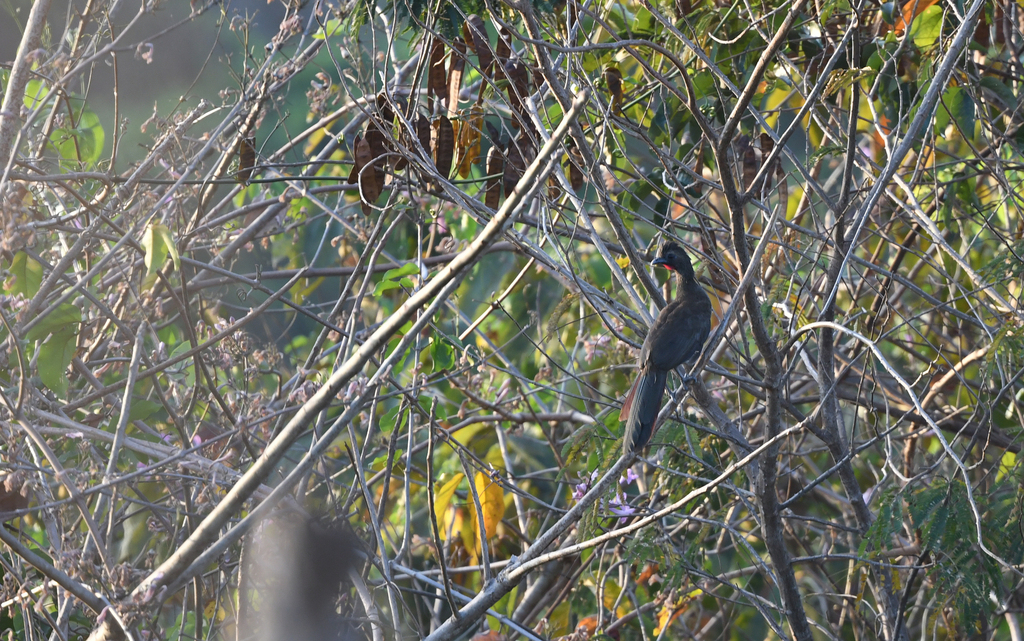
Buff-browed Chachalaca
Photo © Christoph Moning
Photo © Christoph Moning — CC BY 4.0 — Source: iNaturalist #246635093Identification
The buff-browed chachalaca is the smallest member of its genus, measuring just 42 to 46 centimetres in length. Its most distinctive feature is a prominent supercilium—a stripe above the eye—that ranges in colour from buffy white to pale cinnamon, making it unique among Ortalis species. The bird's plumage is relatively subtle: the crown, neck, and upper breast are gray, while the rest of the upperparts are brown. The lower breast and belly are tan. The tail is particularly striking, with central feathers displaying dark green-brown colouration tipped with chestnut, while the outer tail feathers are entirely chestnut. The facial skin is dark slate gray, providing contrast to the buff eyebrow.
Range & Habitat
This species is endemic to northeastern Brazil, found south of the Amazon River in parts of the states of Pará, Maranhão, Ceará, Tocantins, and Piauí. It is exclusively a lowland bird, showing a preference for scrublands and forest thickets. Notably, the buff-browed chachalaca is remarkably adaptable and can be found even in heavily degraded areas, making it a resilient inhabitant of disturbed landscapes.
Behaviour & Diet
Little formal research has documented the buff-browed chachalaca's diet, but observations indicate it feeds on palm fruits and flowers. The species has a distinctive voice; its vocalizations are typical of the Ortalis genus, characterised by higher-pitched calls that are considerably less raucous than those of the chestnut-headed chachalaca.
Breeding occurs primarily between December and February in the Pará region, though active nests have been recorded in other months as well. The bird constructs simple, flat nests made of twigs, leaves, and grasses, typically placing them in tree forks, atop tall grass, or within dense bushes. Clutch size is usually two or three eggs.
Best Time & Places to See It
The buff-broured chachalaca is found across northeastern Brazil, particularly in Pará, Maranhão, Ceará, Tocantins, and Piauí. The species' preference for lowland scrublands and thickets, including degraded habitats, means it may be encountered in a variety of disturbed environments rather than pristine forest. The December to February period is likely optimal for observing breeding birds, though the species is present year-round.
Photography Tips
Photographing this small chachalaca requires patience and attention to its subtle plumage details. The buff eyebrow stripe is the key identifying feature and should be a focus when composing images. The bird's tan underparts and chestnut-tipped tail offer good opportunities for colour in photographs. Since it inhabits scrublands and thickets, a longer lens will help you capture sharp images from a distance while minimising disturbance. Early morning hours are typically best for activity and calling, providing better opportunities for both observation and photography.
No community photos yet. Log in to add the first one.
No community observations of this species yet.