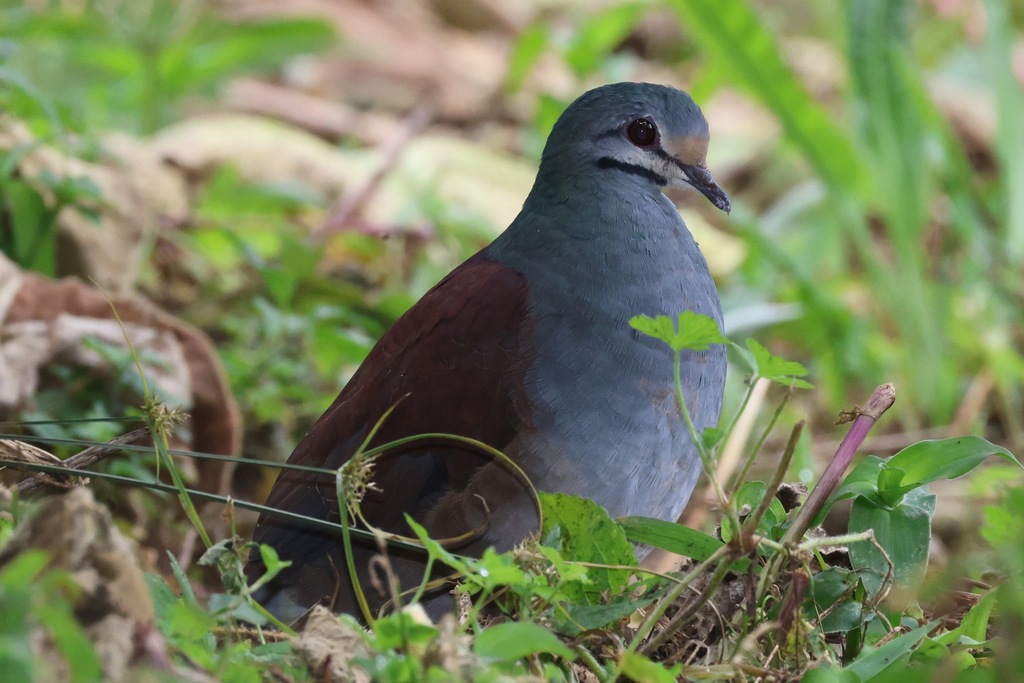
Buff-fronted Quail-Dove
Photo © Cole Wolf
Photo © Cole Wolf — CC BY 4.0 — Source: iNaturalist photo #572129677Identification
The buff-fronted quail-dove is a small pigeon, measuring 24 to 28 cm in length, with males weighing between 310 and 330 g and females between 225 and 283 g. Its most distinctive feature is the facial pattern: a buffy forehead (which gives the species its name) framed by light gray cheeks bordered above and below by narrow black stripes extending just past the eye. The head, neck, and breast are medium gray, while the nape and upper back show a greenish tinge and the belly grades to brownish tones. The back, wings, and tail are striking maroon. A slim but noticeable red eye-ring surrounds the brown eye, the legs are bright coral-red, and the bill is dull brown with a reddish base. Juveniles are distinctly different, with dusky gray crowns and napes showing a green gloss, dull chestnut upperparts with indistinct dusky bars, and gray and cinnamon-barred underparts with a buff belly.
Range & Habitat
This species is a year-round resident of montane forests in Central America, ranging from northern Costa Rica's Cordillera de Guanacaste southeastward into western Panama as far as Veraguas Province. It is endemic to the Talamancan montane forest ecoregion, inhabiting elevations between 1,000 and 3,000 m in Costa Rica and 1,200 to 3,000 m in Panama. Its relatively restricted range makes it a sought-after species for birders exploring highland forests in this region.
Behaviour & Diet
The buff-fronted quail-dove is a ground forager, typically searching alone or in pairs through leaf litter on the forest floor. Though its diet is not completely documented, it is known to feed on fruit, seeds, and probably insects. The species produces a distinctive "low, hollow hoOOOO" song that becomes louder towards the end with a slightly rising inflection, making it recognizable to patient listeners in its montane habitat. Little is known about its breeding biology, though one described nest was a nearly flat platform of coarse twigs, moss, and liverworts constructed almost 4 m above the ground on a horizontal branch of a tall shrub, containing a single nestling.
Best Time & Places to See It
As a year-round resident, the buff-fronted quail-dove can be encountered throughout the year in suitable habitat. Though it has a relatively small range, the species is fairly common within its distribution and maintains a stable population, making it achievable for dedicated birders. Look for it in the highland forests of the Cordillera de Guanacaste in northern Costa Rica and extending into western Panama, particularly at elevations above 1,000 m where the montane forest habitat is pristine.
Photography Tips
The buff-fronted quail-dove's ground-foraging behaviour and preference for dense forest leaf litter make it challenging to photograph. Early morning visits to montane forests may increase the chance of encounters. The species' striking facial pattern—the buffy forehead and black eye-stripes—and the red eye-ring are distinctive features worth capturing. Its maroon back and wings provide strong colour contrast. Patience is essential, as this is primarily a terrestrial species that may freeze or move quickly through vegetation. Recording its distinctive vocalization may help locate birds for photography.
Arenal Volcano National Park
Peñas Blancas, Costa Rica
+551 birds+21 mammals
Straddling the border between Alajuela and Guanacaste in northwestern Costa Rica, this national park rises dramatically around one of Central America's most active volcanic systems. The…
VIEW NATIONAL PARKChirripó National Park
Rivas, Costa Rica
+274 birds+6 mammals
Where the volcanic spine of Costa Rica's Central Cordillera reaches its apex, Chirripó National Park encompasses a landscape that shifts dramatically with elevation, from montane cloud…
VIEW NATIONAL PARKBraulio Carrillo National Park
Las Horquetas, Costa Rica
+547 birds+18 mammals
Where the Caribbean slope descends from the central volcanic cordillera toward the humid lowlands of Heredia, Braulio Carrillo National Park preserves one of Costa Rica's most…
VIEW NATIONAL PARKVolcán Poás National Park
Toro Amarillo, Costa Rica
+237 birds+4 mammals
Where volcanic slopes rise sharply from the Central Valley floor, Volcán Poás National Park protects one of Costa Rica's most active and accessible volcanic systems. The…
VIEW NATIONAL PARKBaru Volcano National Park
Cerro Punta, Panama
+402 birds+6 mammals
Where the land rises sharply toward the Caribbean's western spine, Baru Volcano National Park sprawls across roughly 220 square kilometres of southwestern Panama, anchored by the…
VIEW NATIONAL PARKGeneral de División Omar Torrijos Herrera National Park
La Pintada, Panama
+401 birds+2 mammals
Across the highlands of central Panama, where the continental divide funnels moisture-laden trade winds into steep river valleys, the terrain rises and falls in a landscape…
VIEW NATIONAL PARKParque Internacional la Amistad
Teribe, Panama
+325 birds+11 mammals
Where the continental divide rises between the Caribbean and Pacific watersheds, a wilderness of extraordinary biological richness unfolds across the Talamanca Range and into lowland rainforest—a…
VIEW NATIONAL PARKLos Quetzales National Park
Copey, Costa Rica
+232 birds+3 mammals
Cloud forest sweeps across the upper slopes of the Central Valley watershed, where elevation and persistent moisture forge an ecosystem unlike any other in Costa Rica.…
VIEW NATIONAL PARKTapantí Macizo de la Muerte National Park
Orosi, Costa Rica
+503 birds+18 mammals
Where montane cloud forest rises steeply from the Orosi Valley, Tapantí Macizo de la Muerte National Park enfolds a landscape of perpetual moisture and emerald complexity.…
VIEW NATIONAL PARKLa Amistad International Park
Crorina, Costa Rica
+532 birds+20 mammals
Where the Caribbean slopes of Costa Rica's Talamanca Mountains rise steeply inland from Limón, the boundary between two nations dissolves into an unbroken expanse of rainforest.…
VIEW NATIONAL PARKVolcán Tenorio National Park
Guatuso, Costa Rica
+480 birds+12 mammals
Where volcanic slopes rise through Costa Rica's northwestern borderlands, Volcán Tenorio National Park sprawls across terrain shaped by ancient lava flows and mineral-rich springs. The park's…
VIEW NATIONAL PARKNo community photos yet. Log in to add the first one.
No community observations of this species yet.