Buff-necked Ibis
Photo © Diogo Luiz
Photo © Diogo Luiz — CC BY 4.0 — Source: iNaturalist photo #44931177Identification
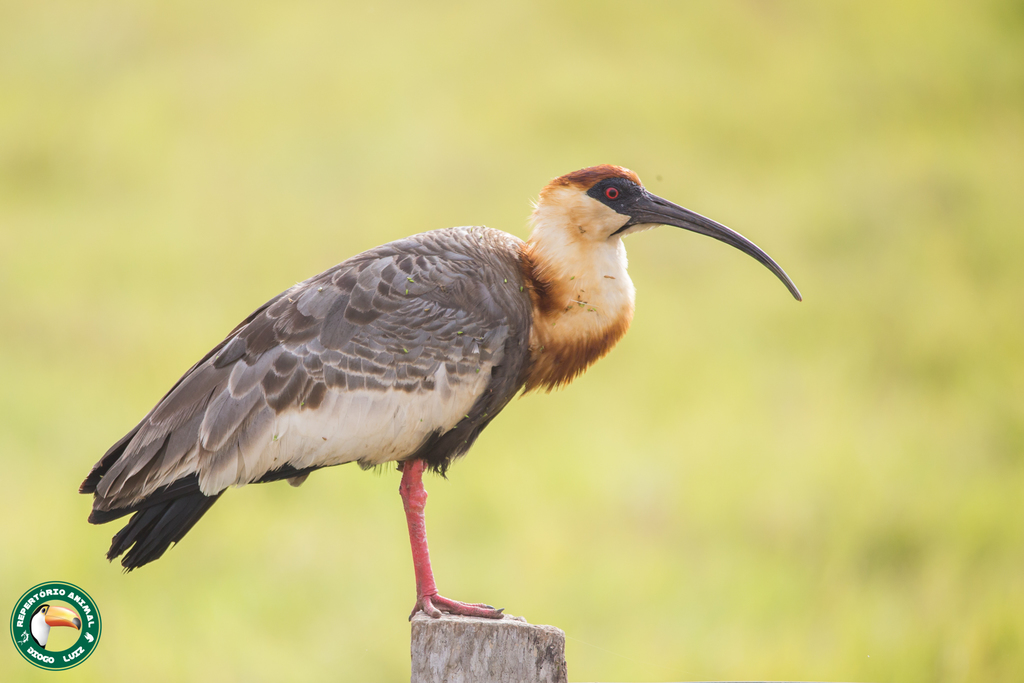
The buff-necked ibis is a fairly large ibis with a total length of approximately 75 centimetres. The species is named for its distinctive buffish neck, which contrasts with its grey upperparts and black belly and flight feathers. In flight, the most striking feature is a large white patch on the wings that forms a broad white band on the upperwing, separating the black remiges from the grey lesser wing-coverts. Unlike some other ibis species, the relatively short legs do not extend beyond the tail in flight. The bill and bare skin around the eyes are blackish, while the legs are a vivid red, providing useful field marks when viewing perched birds.
The buff-necked ibis was formerly considered to include the black-faced ibis as a subspecies, but these are now recognized as distinct species. The black-faced ibis inhabits the colder parts of South America and differs in having a buff lower chest, a darker face, and lacking the white wing-patches that are so conspicuous in the buff-necked ibis.
Range & Habitat
The buff-necked ibis is found widely across eastern and northern South America in two primary populations. The nominate subspecies ranges across northern and central South America, occurring in Colombia, Venezuela, the Guianas and Brazil, while the subspecies hyperorius is found in south-central South America, including southern Brazil, eastern and northern Bolivia, Paraguay, Uruguay, and northern Argentina. The species has been recorded as an accidental visitor in Panama.
This ibis inhabits a wide range of open habitats, including fields, marshes, savanna and grassland. It is almost entirely restricted to tropical and warmer subtropical lowlands, though it may locally extend into highlands, though never reaching the elevations favoured by the Andean ibis. The species is almost entirely resident throughout its range, although local movements may occur. With a large range and an estimated population of 25,000 to 100,000 individuals, the buff-necked ibis is evaluated as Least Concern on the IUCN Red List.
Behaviour & Diet
The buff-necked ibis forages in soft soils, searching for a varied diet consisting mainly of insects, spiders, frogs, reptiles, snails, other invertebrates and small mammals. Like other ibises, it uses its specialized bill to probe and extract prey from the substrate.
The female typically lays two to four eggs in a platform nest constructed from twigs and branches, positioned in a tree. This nesting strategy is typical of many ibis species.
Best Time & Places to See It
The buff-necked ibis is resident throughout its range, making it potentially visible year-round. Open habitats such as grasslands, savannas, marshes and fields across northern South America, particularly in Colombia, Venezuela, the Guianas and Brazil for the nominate subspecies, offer the best opportunities. For the southern subspecies hyperorius, suitable open habitats in southern Brazil, Bolivia, Paraguay, Uruguay and northern Argentina should yield sightings.
Photography Tips
The striking white wing-patches are most visible and dramatic in flight, making flight photography particularly rewarding. The contrast between the white upperwing band and black remiges provides excellent compositional opportunities. The red legs and blackish facial skin are useful field marks to capture in portraits of perched birds. Look for the species in open habitats where it can be observed at a distance while foraging in soft soils. Early morning or late afternoon light will enhance the subtle grey and buff plumage tones.
Tijuca National Park
Brazil
+317 birds+13 mammals
Where the Atlantic forest rises steeply from Rio de Janeiro's urban edge, Tijuca National Park encompasses a landscape of dramatic granite peaks, cascading waterfalls, and closed-canopy…
VIEW NATIONAL PARKEmas National Park
Brazil
+333 birds+23 mammals
Across the high plateaux of central Brazil, where the cerrado grasslands roll toward distant horizons under an immense sky, Emas National Park anchors one of South…
VIEW NATIONAL PARKSerra do Cipó National Park
Brazil
+379 birds+5 mammals
Where granite escarpments rise above the Atlantic Forest transition zone in southeastern Brazil, Serra do Cipó National Park unfolds across a landscape of dramatic ridges, cascading…
VIEW NATIONAL PARKNatural Sierra de Chiribiquete National Park
Solano, Colombia
+359 birds+27 mammals
Massive table-top mountains rise abruptly from the lowland rainforest of southeastern Colombia, their sheer sandstone cliffs and isolated summits creating some of the most dramatic topography…
VIEW NATIONAL PARKNatural Farallones de Cali National Park
Buenaventura, Colombia
+733 birds+27 mammals
Where the Pacific coastal plain meets the western slopes of the Andes, Farallones de Cali National Park sprawls across nearly 3,500 square kilometers of dramatic topography…
VIEW NATIONAL PARKNatural Pisba National Park
Socotá, Colombia
+95 birds
High-altitude grasslands and páramo ecosystems sweep across the Andean terrain of this national park, where thin soils and cool, windswept conditions define a landscape shaped by…
VIEW NATIONAL PARKNatural el Cocuy National Park
Güicán, Colombia
+313 birds+3 mammals
Where the Andes rise to their highest peaks in Colombia's eastern cordillera, El Cocuy National Park sprawls across more than 6,600 square kilometers of some of…
VIEW NATIONAL PARKPuracé National Natural Park
Puracé, Colombia
+327 birds+2 mammals
Where the Andes thrust upward across southwestern Colombia, Puracé National Natural Park spans nearly 2,631 square kilometers of some of South America's most dramatic montane terrain.…
VIEW NATIONAL PARKEl Tamá National Park
Toledo, Colombia
+435 birds
Where the Andes descend toward the Caribbean coastal lowlands of northern Colombia, El Tamá National Park sprawls across nearly 3,800 square kilometres of montane forest, cloud…
VIEW NATIONAL PARKNatural Sierra de la Macarena National Park
Vista Hermosa, Colombia
+566 birds+15 mammals
Across nearly 20,000 square kilometres of Colombia's Meta Department, the terrain rises from lowland savanna into Andean foothills through a mosaic of gallery forests, palm-fringed wetlands,…
VIEW NATIONAL PARKItatiaia National Park
Brazil
+519 birds+12 mammals
Where granite peaks pierce the Atlantic rainforest canopy in southeastern Brazil, Itatiaia National Park rises as one of the country's oldest and most ecologically vital protected…
VIEW NATIONAL PARKPeixe National Park Lagoon
Brazil
+293 birds+4 mammals
Where the coastal plains of Rio Grande do Sul meet the Atlantic, Peixe National Park Lagoon sprawls across nearly 2,200 square kilometres of shallow waters, reed…
VIEW NATIONAL PARKSuperagui National Park
Brazil
+246 birds+2 mammals
Where the Atlantic rainforest meets the subtropical coast of Paraná, Superagui National Park sprawls across more than 1,000 square kilometres of one of Brazil's most biodiverse…
VIEW NATIONAL PARKSerra do Itajaí National Park
Brazil
+227 birds+2 mammals
Where the Atlantic rainforest rises steeply from the coastal plains of Santa Catarina, Serra do Itajaí National Park spreads across 1,136 square kilometres of montane wilderness…
VIEW NATIONAL PARKSerra da Bocaina National Park
Brazil
+441 birds+5 mammals
Where the escarpment of the Serra da Bocaina rises sharply from the Atlantic coastal plain, tropical rainforest cloaks steep mountainsides that climb toward peaks exceeding 2,000…
VIEW NATIONAL PARKIguaçu National Park
Brazil
+387 birds+17 mammals
Where the Paraná Plateau plunges toward the Atlantic watershed, six thousand square kilometers of subtropical rainforest cling to steep gorges and river valleys in this corner…
VIEW NATIONAL PARKIlha Grande National Park
Brazil
+233 birds
Across the subtropical plateaus and Atlantic forest remnants of southern Brazil, a vast protected landscape spanning nearly 4,600 square kilometers safeguards one of the continent's most…
VIEW NATIONAL PARKSão Joaquim National Park
Brazil
+222 birds+9 mammals
Where the southern Brazilian highlands rise above the Atlantic Forest, São Joaquim National Park protects nearly 1,000 square kilometers of montane terrain that shifts between temperate…
VIEW NATIONAL PARKChapada dos Guimarães National Park
Brazil
+450 birds+1 mammals
Where weathered sandstone plateaus rise above the cerrado grasslands of central Brazil, Chapada dos Guimarães National Park protects 624 square kilometres of ecological transition zone that…
VIEW NATIONAL PARKChapada dos Veadeiros National Park
Brazil
+324 birds+6 mammals
Where granite plateaus rise above the cerrado savanna in central Brazil, Chapada dos Veadeiros National Park unfolds across 6,665 square kilometres of some of the world's…
VIEW NATIONAL PARKPantanal Matogrossense National Park
Brazil
+322 birds+17 mammals
Where the flooded forests of central Brazil meet vast seasonally inundated grasslands, Pantanal Matogrossense National Park sprawls across nearly 2,900 square kilometers of one of the…
VIEW NATIONAL PARKLençóis Maranhenses National Park
Brazil
+98 birds+2 mammals
Where white sand dunes rise in dramatic ridges across a coastal lowland, Lençóis Maranhenses National Park reveals one of Brazil's most otherworldly landscapes. Spanning 3,670 square…
VIEW NATIONAL PARKSerra do Gandarela National Park
Brazil
+333 birds+3 mammals
Where granite massifs rise through Atlantic Forest in southeastern Brazil's highlands, Serra do Gandarela National Park protects nearly 1,000 square kilometres of montane terrain that few…
VIEW NATIONAL PARKBrasília National Park
Plano Piloto, Brazil
+338 birds+15 mammals
Cerrado grassland and scattered woodland sweep across the central Brazilian plateau where this national park sprawls across more than a thousand square kilometres of the Federal…
VIEW NATIONAL PARKAraucárias National Park
Brazil
+231 birds+3 mammals
Where the southern Brazilian highlands rise into cool temperate forest, Araucárias National Park protects one of the Atlantic Forest's most distinctive ecosystems across 506 square kilometres…
VIEW NATIONAL PARKSerra Geral National Park
Brazil
+211 birds+2 mammals
Where basalt cliffs and sandstone escarpments rise above the subtropical forests of southern Brazil, Serra Geral National Park preserves one of the Atlantic region's most dramatic…
VIEW NATIONAL PARKAnavilhanas National Park
Brazil
+468 birds+8 mammals
Across the Rio Negro in central Amazonas, an archipelago of over a thousand islands rises from the world's largest rainforest river system, creating a labyrinth of…
VIEW NATIONAL PARKCampos Gerais National Park
Brazil
+143 birds
Where rolling plateaus rise above the Atlantic forest escarpment in Paraná's interior, Campos Gerais National Park unfolds across 539 square kilometers of highland grassland and forest…
VIEW NATIONAL PARKEl Palmar National Park
Distrito Sexto, Argentina
+244 birds+14 mammals
Across the Paraná River floodplain in northeastern Argentina, palms rise from wetland and grassland in a landscape shaped by water and time. El Palmar National Park…
VIEW NATIONAL PARKRío Pilcomayo National Park
Argentina
+271 birds+13 mammals
Where the Río Pilcomayo cuts through northeastern Argentina's subtropical lowlands, a sprawling mosaic of wetlands, grasslands, and seasonally flooded forests creates one of South America's most…
VIEW NATIONAL PARKIguazú National Park
Puerto Iguazú, Argentina
+346 birds+15 mammals
Where the Paraná Plateau plunges toward the Atlantic watershed, nearly 800 square kilometers of subtropical rainforest drape across Misiones Province in a landscape carved by millennia…
VIEW NATIONAL PARKLos Cardones National Park
Argentina
+193 birds+6 mammals
Where the Andes descend into northwestern Argentina, Los Cardones National Park sprawls across nearly 1,200 square kilometres of one of South America's most distinctive high-altitude desert…
VIEW NATIONAL PARKEl Rey National Park
Municipio de Las Lajitas, Argentina
+317 birds+4 mammals
Where the eastern slopes of the Andes descend into northwestern Argentina's subtropical transition zone, El Rey National Park unfolds across 841 square kilometers of dramatically varied…
VIEW NATIONAL PARKCalilegua National Park
Municipio de Calilegua, Argentina
+288 birds+8 mammals
Where the eastern Andean slopes plunge into northwestern Argentina's humid subtropics, nearly 2,645 square kilometers of steep terrain and luxuriant forest compose one of South America's…
VIEW NATIONAL PARKParque Provincial Pampa del Indio
Laguna Limpia, Argentina
+231 birds+4 mammals
Across the flat horizons of Chaco Province, where the Paraná River system spills into vast wetlands and grasslands, Parque Provincial Pampa del Indio protects one of…
VIEW NATURE RESERVEChaco National Park
Municipio de Presidencia de la Plaza, Argentina
+258 birds+7 mammals
Across the humid subtropical lowlands of northeastern Argentina, where the Paraná River basin feeds vast seasonal wetlands and gallery forests, Chaco National Park protects one of…
VIEW NATIONAL PARKNo community photos yet. Log in to add the first one.
No community observations of this species yet.