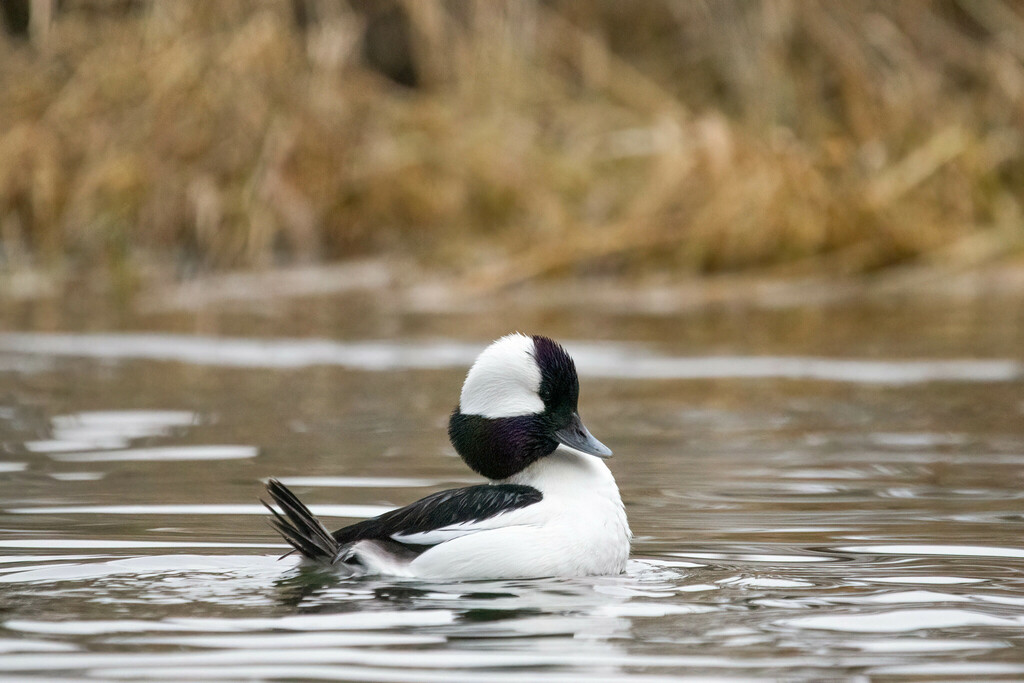
Bufflehead
Photo © Kalvin Chan
Photo © Kalvin Chan — CC BY 4.0 — Source: iNaturalist photo #254507370Identification
The bufflehead is North America's smallest duck, rivaling the green-winged teal in diminutive size at 32–40 cm long and weighing 270–550 g. Adult males are unmistakable: striking black and white plumage with iridescent green and purple heads crowned by a large white patch behind the eye. Females are more subtle, displaying grey tones with a smaller white eye patch and light underside. Their compact build and distinctive head shape—the genus name Bucephala derives from the Greek for "bullheaded"—make them instantly recognizable to experienced birders.
Range & Habitat
Buffleheads breed in wooded lakes and ponds throughout Alaska and Canada, almost entirely within the boreal forest and taiga habitat. In winter, they migrate to protected coastal waters and open inland waters along both coasts of North America and the southern United States, with populations also gathering on the Great Lakes. The species is an extremely rare vagrant to western Europe and occasionally appears in Caribbean islands including Cuba, the Bahamas, and Jamaica. Remarkably, buffleheads are among the world's most punctual migrants, arriving on their wintering grounds within a narrow margin of time year after year.
Behaviour & Diet
These highly active diving ducks have evolved their small size specifically to nest in woodpecker cavities, particularly old northern flicker nests, usually within 25 meters of water. Buffleheads are monogamous and maintain an interesting group dynamic: while some birds dive continuously in search of food, sustained by their high metabolism, one individual serves as a vigilant sentry watching for predators. They rarely form large flocks, preferring small groups. Underwater, they forage at depths of 1.2–4.5 m, eating primarily aquatic insects in freshwater and crustaceans and mollusks in saltwater, with aquatic plants and fish eggs adding nutritional variety.
Best Time & Places to See It
Winter is the optimal season for observing buffleheads, particularly on protected coastal waters, open inland waters, and the Great Lakes across North America. Look for them on the Atlantic and Pacific coasts and throughout the southern United States during the colder months. Their breeding season occurs in summer across Canada and Alaska, though access to remote breeding grounds is limited. Because of their striking appearance and active behavior near human waterfront properties, buffleheads rank among the most popular birds for birdwatchers seeking approachable subjects.
Photography Tips
Winter gatherings on accessible coastal and inland waters present excellent photography opportunities. The male's bold black-and-white contrast and iridescent head make for striking images, especially in bright daylight when colors are most vivid. Anticipate continuous diving behavior—their high metabolism drives almost constant foraging activity, so patience and rapid shutter speeds are essential. Their small size means they can appear distant in wide-angle shots, so a telephoto lens is recommended. Photograph them from a distance to avoid disturbing the group's sentry, whose predator-watching behavior is crucial to the flock's safety.
Tombstone Territorial Park
Acadia National Park
Alaska Maritime National Wildlife Refuge
Algonquin Provincial Park
Alligator River National Wildlife Refuge
Badlands National Park
Banff National Park
Bear River Migratory Bird Refuge
Becharof National Wildlife Refuge
Nothing matches these filters.
No community photos yet. Log in to add the first one.
No community observations of this species yet.