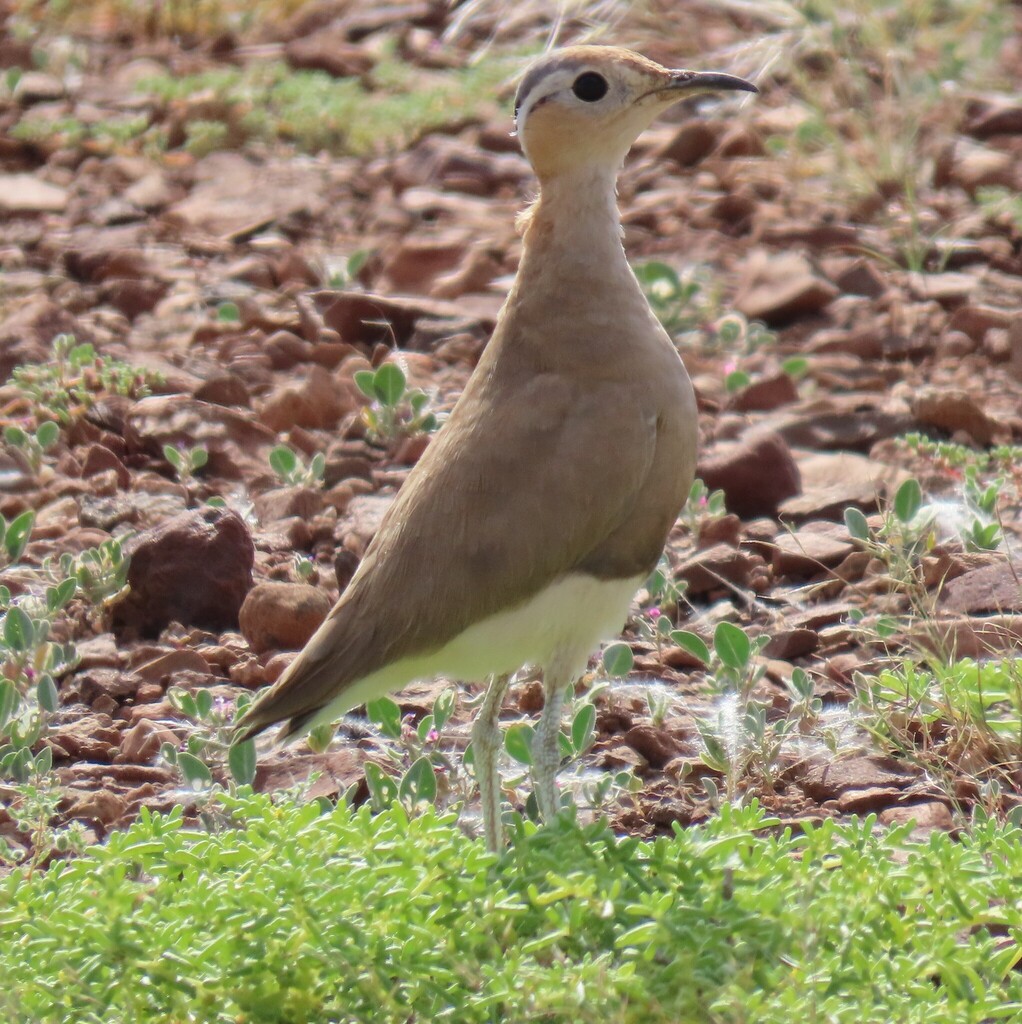
Burchell’s Courser
Photo © Nogga_Eugene
Photo © Nogga_Eugene — CC0 1.0 — Source: iNaturalist #289039968Identification
Burchell's courser is a small wader, reaching just 22 cm in length and weighing around 75 g as an adult. This graceful bird presents an upright posture and distinctive plumage that, while subtle, aids identification in its arid habitat. The most characteristic feature is its blue-grey hind crown, which separates it from the similar Temminck's courser. Look for a horizontal black band demarcating a white underbelly, combined with an overall pale rufous coloration. The face displays striking white supercilia above black eye lines, both terminating at the back of the neck to form a distinctive double V pattern. In flight, the bird's creamy-white legs extend past its tail—an unusual and helpful identifying feature. The long, dark, downward-arching bill is typical of coursers, as are the dark eyes. The secondaries are mostly white with black underwing coverts. Juveniles are notably different, lacking the rufous colouring, facial stripes, and grey hind crown of adults; they appear mottled with black and beige barring, making them even more cryptic.
Range & Habitat
Burchell's courser is endemic to southern Africa, with its range spanning most of South Africa and Namibia, parts of southwestern Angola, and the Kalahari Basin in Botswana. The bird favours warm, dry regions and shows a preference for semi-desert terrain with gravel substrates rather than pure sand. It also frequents open grasslands with short vegetation and burnt or overgrazed areas. The species is locally nomadic, with movements driven by rainfall fluctuations that affect food availability. While classified as least concern, its population is declining due to habitat loss on arable lands and agricultural intensification, including excessive irrigation and pesticide use.
Behaviour & Diet
Despite being classified as waders, Burchell's coursers are birds of dry open country and are predominantly terrestrial, preferring to run rather than fly. They are mostly solitary or occur in small flocks and are monogamous. The species is largely quiet on the ground but becomes vocal in flight, producing a loud throaty "chuk" as it launches, repeated "chuk chuk" grunts while airborne, and contact calls of "kwirrt-kwirrt" or "kok-kok-kwich". When threatened, they emit alarm calls while running away from their nest to divert predators.
Burchell's courser is an insectivore that forages by running on the ground and using its long bill to dig for prey. Harvester termites are strongly preferred, sometimes comprising over 50% of its diet when available. Beetles from the Coleoptera group, particularly curculionidae beetles, form the main alternative food source. The bird almost never consumes seeds, and rainfall patterns directly influence food quality and availability, driving the species' nomadic movements.
Best Time & Places to See It
Burchell's courser is most active during daylight hours and breeds year-round, with peak breeding occurring just before the wet season between July and December. The bird's camouflaged appearance and preference for blending with the landscape make it challenging to spot. Visit semi-desert regions, burnt grasslands, and short-grass savannas in South Africa, Namibia, or the Kalahari Basin in Botswana during the breeding season for the best chance of encounters. The bird's nomadic nature means that timing relative to recent rainfall events may improve sighting opportunities.
Photography Tips
Patience and persistence are essential for photographing this elusive species. The bird's cryptic camouflage and terrestrial habits mean it is often heard before seen—listen for its distinctive flight calls to locate individuals. Early morning or late afternoon light will best reveal the subtle blue-grey crown and pale rufous plumage. Since Burchell's courser prefers running to flying, position yourself along known habitat areas where the bird may pass. When disturbed, it will eventually take flight, providing opportunities to capture its characteristic extended legs trailing past the tail and the striking white secondaries visible in flight. Approach slowly and avoid sudden movements, as the bird is easily spooked and will run considerable distances before taking to the air.
Mokala National Park
Siyancuma Local Municipality, South Africa
+246 birds+35 mammals
Across the semi-arid savanna of the Northern Cape, where red earth meets sparse acacia woodland and open grassland punctuated by rocky outcrops, lies a landscape shaped…
VIEW NATIONAL PARKTankwa-Karoo National Park
Hantam Local Municipality, South Africa
+201 birds+20 mammals
Across the semi-arid heartland of the Northern Cape, where winter rains carve ephemeral watercourses through endless ochre plains, Tankwa-Karoo National Park sprawls across more than 3,100…
VIEW NATIONAL PARKMountain Zebra National Park
Inxuba Yethemba Local Municipality, South Africa
+265 birds+35 mammals
Across the windswept plateaus and deeply incised valleys of the Eastern Cape's interior, Mountain Zebra National Park unfolds as a landscape of geological drama and ecological…
VIEW NATIONAL PARKAugrabies Falls National Park
Kai !Garib Local Municipality, South Africa
+176 birds+20 mammals
Where the Orange River cuts a dramatic scar through the Northern Cape's arid interior, Augrabies Falls National Park sprawls across nearly 1,200 square kilometers of raw,…
VIEW NATIONAL PARKSperrgebiet National Park
Barcelona, Namibia
+181 birds+18 mammals
Where the Namib's ancient gravel plains meet the Atlantic coast, one of Africa's most remote and geologically austere landscapes unfolds across more than 56,000 square kilometres.…
VIEW NATIONAL PARKDorob National Park
Henties Bay, Namibia
+230 birds+13 mammals
Where the Skeleton Coast meets the Namib Desert's inland reaches, Dorob National Park sprawls across 34,021 square kilometres of one of southern Africa's most austere and…
VIEW NATIONAL PARKSkeleton Coast Park
Barcelona, Namibia
+143 birds+7 mammals
Where the Atlantic's cold Benguela Current collides with one of Africa's most hostile coastlines, the Skeleton Coast Park sprawls across more than 104,000 square kilometres of…
VIEW OBSERVATION POINTNamib-Naukluft National Park
Namibia
+217 birds+33 mammals
Across nearly 94,000 square kilometers of southwestern Namibia, a landscape of extremes unfolds where towering sand dunes meet rugged mountain ranges, and ancient riverbeds carve through…
VIEW NATIONAL PARKEtosha National Park
Namibia
+356 birds+58 mammals
Across northern Namibia's stark semi-arid plateau, a vast shallow depression transforms seasonally into one of Africa's most dramatic wildlife theaters. Etosha National Park, encompassing more than…
VIEW NATIONAL PARKNamibRand Nature Reserve
Hammerstein, Namibia
+107 birds+12 mammals
Where rust-coloured dunes surrender to sculpted granite outcrops and vast plains stretch toward an endless horizon, one of southern Africa's most pristine wilderness areas unfolds. The…
VIEW NATURE RESERVENo community photos yet. Log in to add the first one.
No community observations of this species yet.