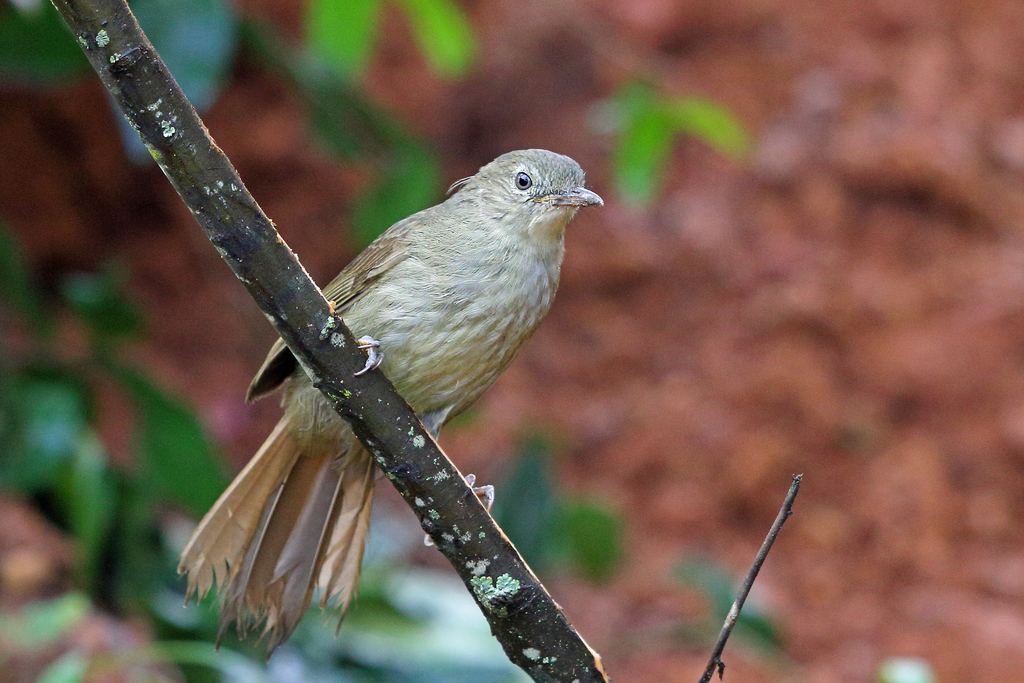
Cabanis’s Greenbul
Photo © Nigel Voaden
Photo © Nigel Voaden — CC BY 4.0 — Source: iNaturalist photo #1498558Identification
Cabanis's greenbul is a small songbird belonging to the bulbul family. Like other members of the genus Phyllastrephus, it shares the characteristic behaviour of moving restlessly through foliage—a trait reflected in its scientific name, which combines the Greek words for 'leaf' and 'to toss' or 'to turn'. The species is best distinguished by careful observation of its plumage, size, and behaviour within its specific range, as it closely resembles other greenbul species across east-central and south-central Africa.
Range & Habitat
Cabanis's greenbul is distributed across east-central and south-central Africa, with three recognised subspecies occupying different regions. The nominate subspecies P. c. cabanisi ranges from central Angola through southeast Democratic Republic of Congo, west Tanzania, and north Zambia. P. c. sucosus is found from south Sudan and west Kenya eastward to the Democratic Republic of Congo and northwest Tanzania, while P. c. placidus occurs from east Kenya through Tanzania to northeast Zambia, Malawi, and northwest Mozambique. The species inhabits subtropical and tropical forests, including dry forests, moist lowland forests, montane forests, and moist shrubland.
Behaviour & Diet
As a member of the bulbul family, Cabanis's greenbul is an active forager, moving restlessly through dense vegetation in search of food. Like other greenbuls, it is primarily frugivorous, feeding on small fruits and berries found throughout its forest habitats, though it also supplements its diet with insects. The species is typically encountered in small groups or pairs moving through the canopy and mid-storey levels of forests, where its active, acrobatic feeding behaviour makes it distinctive despite its small size.
Best Time & Places to See It
Observers seeking Cabanis's greenbul should focus on the forest zones within its range, particularly in areas of moist montane and lowland forest where fruiting trees are abundant. The species is most active during daylight hours and can be located by listening for its calls while scanning the foliage. Visiting protected forest reserves and national parks within the subspecies ranges—particularly in Tanzania, Zambia, and the eastern Democratic Republic of Congo—offers the best opportunities for encounters.
Photography Tips
Photographing Cabanis's greenbul presents challenges due to its small size and restless behaviour in dense vegetation. Success requires patience and a fast shutter speed to capture sharp images of the bird in motion. Early morning hours typically offer the best light and increased activity levels. A telephoto lens (at least 400–600mm) is essential, and positioning yourself near fruiting trees or along established forest trails increases the likelihood of productive encounters. The bird's preference for mid-storey heights means photographers should be prepared to shoot upward into variable light conditions.
Arusha National Park
Tanzania
+555 birds+16 mammals
Where the slopes of Mount Mawenzi rise above the Arusha region, a compact yet ecologically rich national park unfolds across montane forest, moorland, and alpine zones.…
VIEW NATIONAL PARKBwindi Impenetrable National Park
Kanyashogi, Uganda
+603 birds+26 mammals
Steep ridges cloaked in montane forest rise from Uganda's southwestern borderlands, where the landscape grows so dense and tangled that early explorers named it impenetrable. At…
VIEW NATIONAL PARKKidepo Valley National Park
Uganda
+478 birds+24 mammals
Where the Narus and Kidepo rivers carve through northeastern Uganda's semi-arid lowlands, a landscape of sparse acacia woodland, grassland, and riverine thickets creates one of East…
VIEW NATIONAL PARKMgahinga Gorilla National Park
Cyanika, Uganda
+429 birds+6 mammals
Where the Virunga Mountains rise steeply from the Uganda–Rwanda–Democratic Republic of Congo frontier, montane forest cloaks the volcanic slopes in a dense, moisture-laden embrace. Mgahinga Gorilla…
VIEW NATIONAL PARKLake Mburo National Park
Uganda
+505 birds+24 mammals
Rolling acacia woodland and scattered lakes define this intimate savanna preserve in southwestern Uganda, where the rift valley's geological drama shapes every water source and grassland.…
VIEW NATIONAL PARKMount Elgon National Park
Matumbei ward, Kenya
+164 birds+7 mammals
Where the volcanic slopes of Mount Elgon rise above the Trans-Nzoia landscape, a montane wilderness unfolds across multiple ecological zones, each harbouring distinct communities adapted to…
VIEW NATIONAL PARKKilimanjaro National Park
Kenya
+207 birds+16 mammals
Africa's highest mountain rises not in isolation but as the centerpiece of a vast national park that sweeps across the borderlands of northern Tanzania, where savanna…
VIEW NATIONAL PARKMount-Kenya National Park
Abothuguchi west ward, Kenya
+334 birds+11 mammals
Where the slopes of Kenya's second-highest mountain rise steeply from the Meru County foothills, a landscape of profound ecological richness unfolds across Mount Kenya National Park.…
VIEW NATIONAL PARKNgorongoro Conservation Area
Tanzania
+626 birds+55 mammals
Volcanic calderas and open grassland dominate this high plateau in northern Tanzania, where the landscape rises above 2,000 metres and ancient geological forces have shaped both…
VIEW WILDLIFE MANAGEMENT AREAToro-Semliki Proposed National Park
Uganda
+474 birds+5 mammals
Where the Albertine Rift's western escarpment rises above the Semliki River valley, a vast mosaic of forest, savanna and wetland converges to create one of East…
VIEW NATIONAL PARKQueen Elizabeth National Park
Uganda
+672 birds+30 mammals
Across the southwestern escarpment of Uganda, where the Western Rift Valley descends through ancient volcanic terrain, Queen Elizabeth National Park sprawls across more than 8,300 square…
VIEW NATIONAL PARKNairobi National Park
Nairobi, Kenya
+515 birds+35 mammals
Just minutes from Kenya's capital, where the Nairobi River winds through acacia woodland and open grassland, lies one of Africa's most paradoxical wildlife sanctuaries. The park's…
VIEW NATIONAL PARKAberdare National Park
Mweiga ward, Kenya
+394 birds+30 mammals
Where the central highlands of Kenya rise to their elemental grandeur, the Aberdare range unfolds across Nyeri County as a montane stronghold of cool, misty forest…
VIEW NATIONAL PARKSaiwa Swamp National Park
Sinyerere ward, Kenya
+255 birds+4 mammals
Where papyrus and sedge marshes stretch across a highland plateau in western Kenya, Saiwa Swamp National Park shelters one of East Africa's most productive freshwater wetland…
VIEW NATIONAL PARKChyulu Hills National Park
Kibwezi East, Kenya
+232 birds+30 mammals
Volcanic cones rise abruptly from the Kenyan savanna floor, their flanks clothed in dense acacia woodland and grassland that transforms the Chyulu Hills into an ecological…
VIEW NATIONAL PARKOl Donyo Sabuk National Park
Matungulu North ward, Kenya
+200 birds
Granite peaks rise abruptly from the highland plateau of Matungulu North, their weathered slopes clothed in scattered woodland and montane grassland that shifts between verdant and…
VIEW NATIONAL PARKNo community photos yet. Log in to add the first one.
No community observations of this species yet.