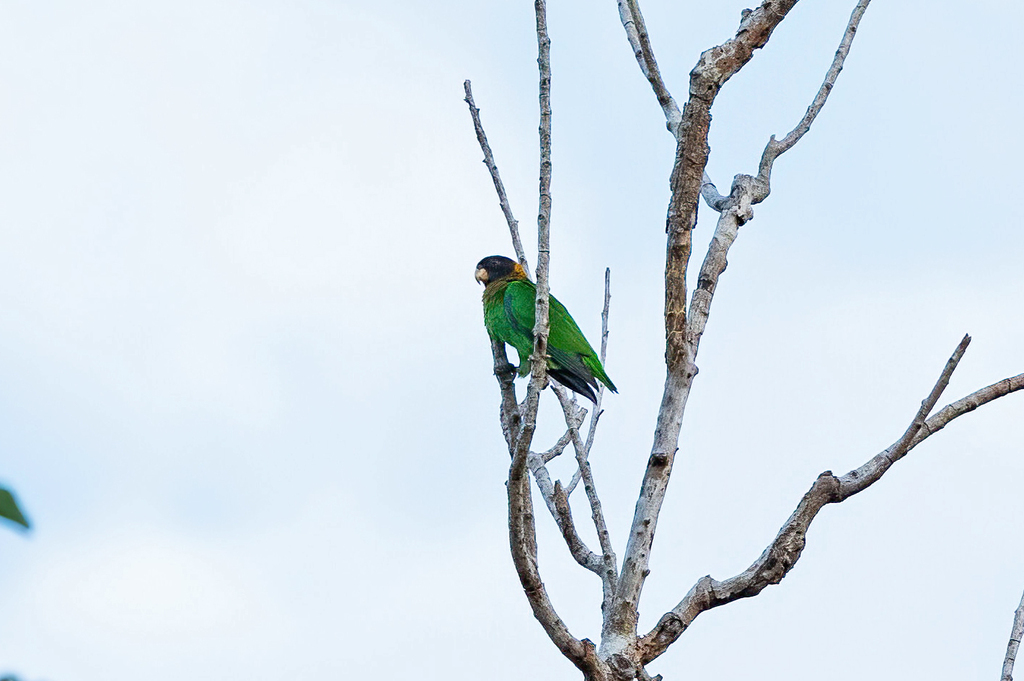
Caica Parrot
Photo © Thibaud Aronson
Photo © Thibaud Aronson — CC BY-SA 4.0 — Source: iNaturalist photo #427521911The caica parrot (Pyrilia caica) is a species of bird in subfamily Arinae of the family Psittacidae, the African and New World parrots. It is found in Brazil, French Guiana, Guyana, Suriname, and Venezuela. == Taxonomy and systematics == The caica parrot and the other six members of genus Pyrilia were until the early 21st century included in genus Pionopsitta with the pileated parrot (P. pileata). The caica parrot is monotypic. == Description == The caica parrot is 23 to 25 cm (9.1 to 9.8 in) long and weighs 121 to 143 g (4.3 to 5.0 oz). Adults have a brownish black head with bare gray skin around the eye. They have a fulvous or golden collar on their hindneck; dark feather edges give it a scaly appearance. Their throat and upper breast are olive-brown and the rest of their body is green. Their primary coverts are dull blue, their primaries are blackish, and their tail feathers have dull blue tips. Immature birds have mostly green heads with a duller collar. == Distribution and habitat == The caica parrot is found from eastern Venezuela through the Guianas into Brazil's Amapá state and south in Brazil to the Amazon River. It…
Viruá National Park
Brazil
+389 birds+6 mammals
Across the northern frontier of Roraima, where the forest canopy rises from ancient Amazonian lowlands, Viruá National Park protects nearly 3,700 square kilometres of terra firme…
VIEW NATIONAL PARKMonte Roraima National Park
Brazil
+226 birds+1 mammals
Where the tepuis rise from the Amazon basin like islands in a sea of forest, Monte Roraima National Park sprawls across 3,714 square kilometres of one…
VIEW NATIONAL PARKAnavilhanas National Park
Brazil
+468 birds+8 mammals
Across the Rio Negro in central Amazonas, an archipelago of over a thousand islands rises from the world's largest rainforest river system, creating a labyrinth of…
VIEW NATIONAL PARKNo community photos yet. Log in to add the first one.
No community observations of this species yet.