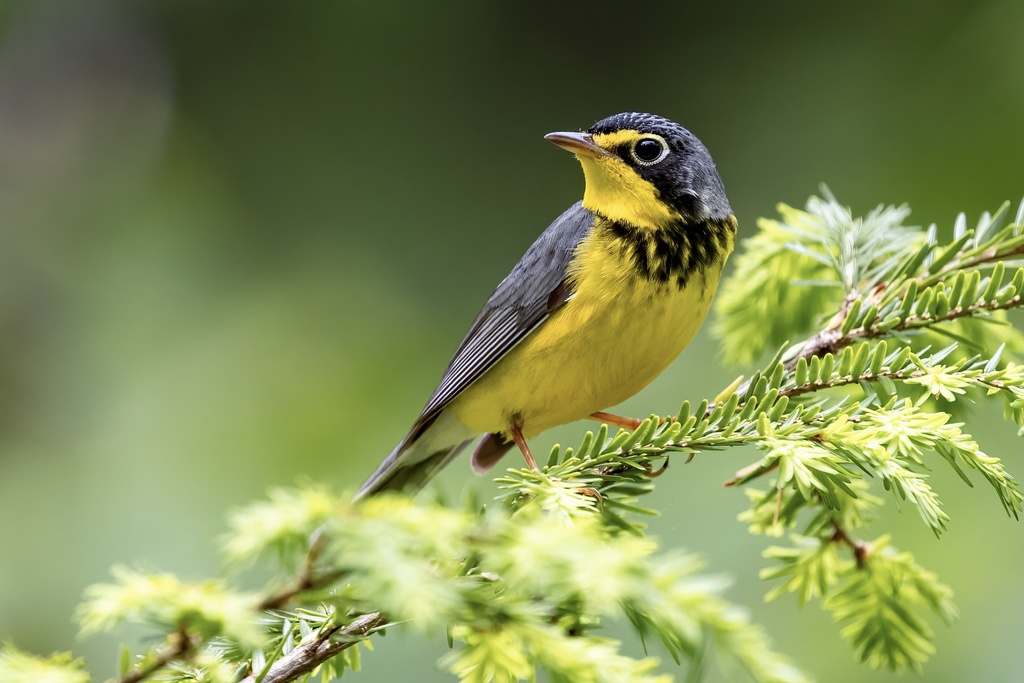
Canada Warbler
Photo © Matt Felperin
Photo © Matt Felperin — CC BY 4.0 — Source: iNaturalist photo #135286276Identification
The Canada Warbler earns its nickname "necklaced warbler" from the distinctive band of dark streaks across its chest. This small songbird measures 12–15 cm long with a wingspan of 17–22 cm, weighing just 9–13 g. Adults display minimal sexual dimorphism, though males sport a darker, more conspicuous necklace and longer tail. The species is unmistakable in its breeding plumage: bright yellow chest, throat, and belly contrasting with a dark grey back. A striking white eyering (or "spectacles") frames the face, and a yellow line runs in front of each eye toward the beak. The wings lack bars and the tail lacks spots, but the undertail is white. Immature birds show similar but duller coloration with less pronounced facial features.
Range & Habitat
The Canada Warbler summers across Canada from southeastern Yukon to Nova Scotia, with 82% of the breeding population in Canada and 18% in the northeastern United States, ranging from northern Minnesota to northern Pennsylvania and Long Island, with populations extending south through the Appalachians to Georgia. In winter, the species retreats to northern South America, from Guyana to northwestern Bolivia around the Andean crest. Year-round, it favors moist thickets. During breeding season, it nests in riparian thickets, brushy ravines, and forest bogs across various elevations and forest types—aspen forests in the northwest, forested wetlands and swamps in the center, and montane rhododendron thickets in the south. Wintering birds prefer mid- and upper-elevation habitats.
Behaviour & Diet
The Canada Warbler's loud, highly variable song resembles "chip chewy sweet dichetty," with low "chup" calls. Male Canada Warblers employ two distinct performance-encoded song types: Mode I (daytime, used when unpaired) features stereotyped songs sung slowly and regularly, while Mode II (dawn, after pairing and near rival males) involves rapid, variable songs with irregular rhythm and chirping. Remarkably, most phrases are common to both modes—a unique feature among New World warblers. Female song, once considered rare in the family, has been documented in this species as well as congeners like Wilson's Warbler and the closely related Hooded Warbler. The birds are at least seasonally monogamous, possibly permanently so, and forage low in deciduous forests. One of the last warblers to arrive at breeding grounds in May, the Canada Warbler is among the first to depart, spending only about two months on territory.
Best Time & Places to See It
To encounter Canada Warblers during breeding season, visit boreal forests and forested wetlands across Canada, the Great Lakes region, New England, and the Appalachian Mountains from May through early July. The species is particularly associated with areas of natural disturbance, such as forest patches recovering from wind throw or timber removal. Migrating birds pass through the southern United States along a route generally south and west to the Texas coast and southern Mexico in late August and early September. Winter birders should seek this species in northern South America from late September through April, where it inhabits mid- and upper-elevation forest thickets.
Photography Tips
The Canada Warbler's striking white eyerings and chest necklace pattern are distinctive field marks worth capturing in detail. Front-lit portraits highlighting the facial pattern and throat coloration work best. During breeding season, males sing regularly from low to mid-story perches, offering opportunities for behavioral photography. The bird's preference for low-height foraging in dense vegetation can make photography challenging; patience and positioning yourself at eye level with the bird's typical foraging height will improve your success. Early morning light during the breeding season captures males at their most vocal and active. The bright yellow underparts contrast sharply with the grey back, so slight underexposure can help retain detail in the yellow plumage.
Acadia National Park
Algonquin Provincial Park
Antisana National Park
Arenal Volcano National Park
Barra del Colorado National Wildlife Refuge
Baru Volcano National Park
Bic National Park
Blackwater National Wildlife Refuge
Bombay Hook National Wildlife Refuge
Nothing matches these filters.
No community photos yet. Log in to add the first one.
No community observations of this species yet.