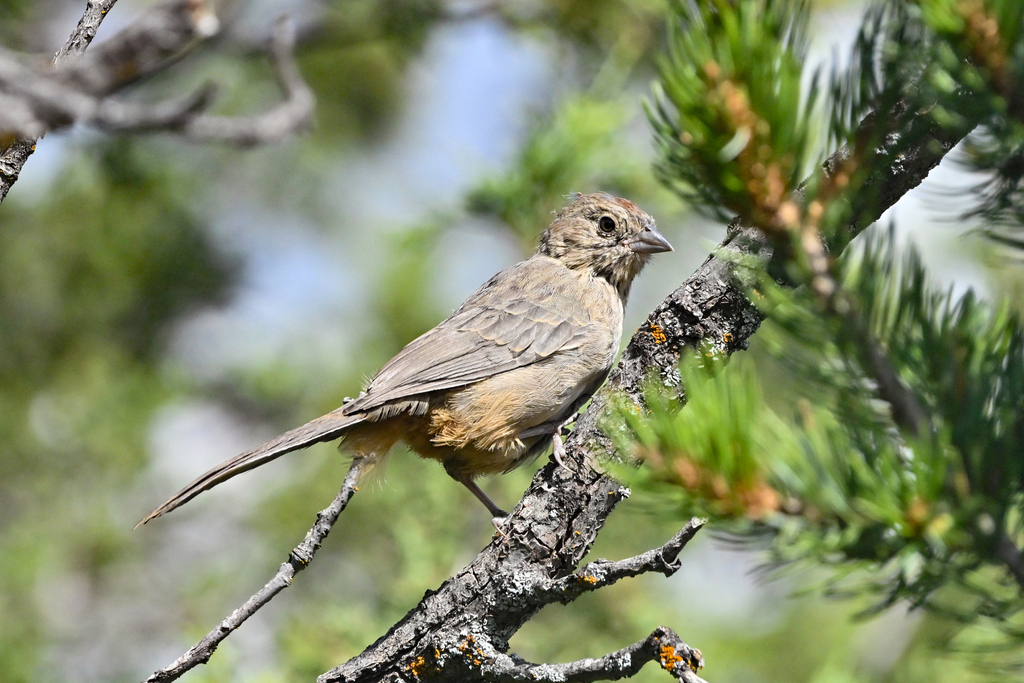
Canyon Towhee
Photo © Tom Kennedy
Photo © Tom Kennedy — CC BY 4.0 — Source: iNaturalist photo #568029659Identification
The canyon towhee is a medium-sized sparrow measuring 19 to 25 cm in length, with a noticeably long tail comprising 8.2 to 11 cm of that total. It weighs around 45 grams on average. This species is predominantly earthy brown in plumage, with slightly lighter underparts and a somewhat darker head crowned by a distinctive rufous cap—though birds in central Mexico lack this rufous coloring, showing a cap matching the rest of the back. A slightly reddish area beneath the tail provides another subtle identifying feature. Sexual dimorphism is minimal, making males and females difficult to distinguish in the field.
Range & Habitat
The canyon towhee inhabits lower-lying areas from Arizona, southern Colorado, New Mexico, and western Texas southward through Mexico to northwestern Oaxaca. The species was not recognized as distinct from the California towhee until 1989, when molecular genetics confirmed they are separate species. The canyon towhee favors brush and chaparral habitats, mostly avoiding coastal regions.
Behaviour & Diet
This ground-dwelling towhee forages on the ground or in low scrub vegetation rather than climbing into the canopy. It feeds primarily on insects, and near human settlements it has adapted to an opportunistic lifestyle—often observed in parking lots where it gleams insects from automobile grilles. When disturbed, the bird readily seeks shelter beneath vehicles or within dense brush, relying on this cover rather than sustained flight to escape threats.
Best Time & Places to See It
Look for canyon towhees in arid and semi-arid brush and chaparral habitats throughout their range in the southwestern United States and Mexico. They are year-round residents in these areas. Ground-level observation with patient scanning of brushy terrain offers the best chance of encountering this species. Areas with scattered scrub and open ground, particularly near human developments where insects are abundant, increase your chances of a sighting.
Photography Tips
Photograph this species in early morning or late afternoon when birds are most active and light is warm and directional. The canyon towhee's preference for ground-level foraging means you'll often need to shoot from lower angles or shoot downward from slightly elevated positions. The bird's earthy brown coloration blends well with its scrubby habitat, so look for movement rather than relying on spotting it visually. Its slightly reddish undertail coverts and rufous cap are key field marks worth capturing; position yourself to catch these subtle features in your images when possible.
Big Bend National Park
Brewster County, United States
+345 birds+34 mammals
Where the Chisos Mountains rise abruptly from the Sonoran Desert floor, Big Bend National Park spans over 7,300 square kilometers of one of North America's most…
VIEW NATIONAL PARKSaguaro National Park
Rincon Valley, United States
+354 birds+40 mammals
Where the Sonoran Desert meets sky-island mountains, two geographically separated districts of Saguaro National Park sprawl across nearly two thousand square kilometers of Arizona's most iconic…
VIEW NATIONAL PARKCarlsbad Caverns National Park
Eddy County, United States
+309 birds+18 mammals
Beneath the Chihuahuan Desert floor of southern New Mexico lies one of North America's most spectacular subterranean landscapes. Carlsbad Caverns National Park encompasses over 518 square…
VIEW NATIONAL PARKParque Nacional Cerro de la Estrella
Mexico
+126 birds+4 mammals
Where volcanic peaks rise sharply above Mexico City's sprawling metropolis, Parque Nacional Cerro de la Estrella offers a rare glimpse of high-altitude terrain within one of…
VIEW NATIONAL PARKTutuaca
Tosanachi, Mexico
+147 birds+13 mammals
Where copper canyons plunge deeper than the Grand Canyon itself, Mexico's remote Sierra Madre Occidental unfolds in dramatic vertical relief. Tutuaca anchors this wilderness realm, a…
VIEW PROTECTED LANDSCAPEGrand Canyon National Park
United States
+277 birds+35 mammals
A mile-deep chasm of rust-red rock and purple shadow cuts through the high desert plateau of northern Arizona, revealing nearly two billion years of geological history…
VIEW NATIONAL PARKGuadalupe Mountains National Park
Culberson County, United States
+262 birds+14 mammals
Where fossil-laden limestone ridges thrust skyward above the Chihuahuan Desert floor, Guadalupe Mountains National Park reveals a landscape sculpted by ancient seas and relentless aridity. These…
VIEW NATIONAL PARKPetrified Forest National Park
Apache County, United States
+206 birds+23 mammals
Across the high desert plateau of northeastern Arizona, where the climate swings between scorching summer days and frost-laden winters, badlands of raw earth and timber-turned-to-stone dominate…
VIEW NATIONAL PARKWhite Sands National Park
Otero County, United States
+178 birds+6 mammals
Across the Tularosa Basin in south-central New Mexico sprawls an otherworldly landscape of gypsum dunes—the largest gypsum field on Earth and a stark desert playground shaped…
VIEW NATIONAL PARKBosque del Apache National Wildlife Refuge
Socorro County, United States
+345 birds+17 mammals
Where the Rio Grande emerges from its desert canyon in central New Mexico, a narrow ribbon of riparian woodland defies the arid landscape that surrounds it.…
VIEW WILDLIFE SANCTUARYCabeza Prieta National Wildlife Refuge
United States
+155 birds+6 mammals
Across southwestern Arizona's harshest terrain, where the Colorado River marks the border with Mexico, lies a sanctuary shaped entirely by heat and aridity. Cabeza Prieta National…
VIEW WILDLIFE SANCTUARYKofa National Wildlife Refuge
Yuma County, United States
+142 birds+10 mammals
Desert mountains rise in sculptured ridges across northwestern Arizona, where the Colorado River's distant influence fades into some of the most austere terrain in the American…
VIEW WILDLIFE SANCTUARYBitter Lake National Wildlife Refuge
Chaves County, United States
+284 birds+10 mammals
Across the high desert floor of southeastern New Mexico, where elevation and aridity shape every living thing, shallow alkaline lakes and marshes form an unexpected oasis…
VIEW WILDLIFE SANCTUARYNo community photos yet. Log in to add the first one.
No community observations of this species yet.