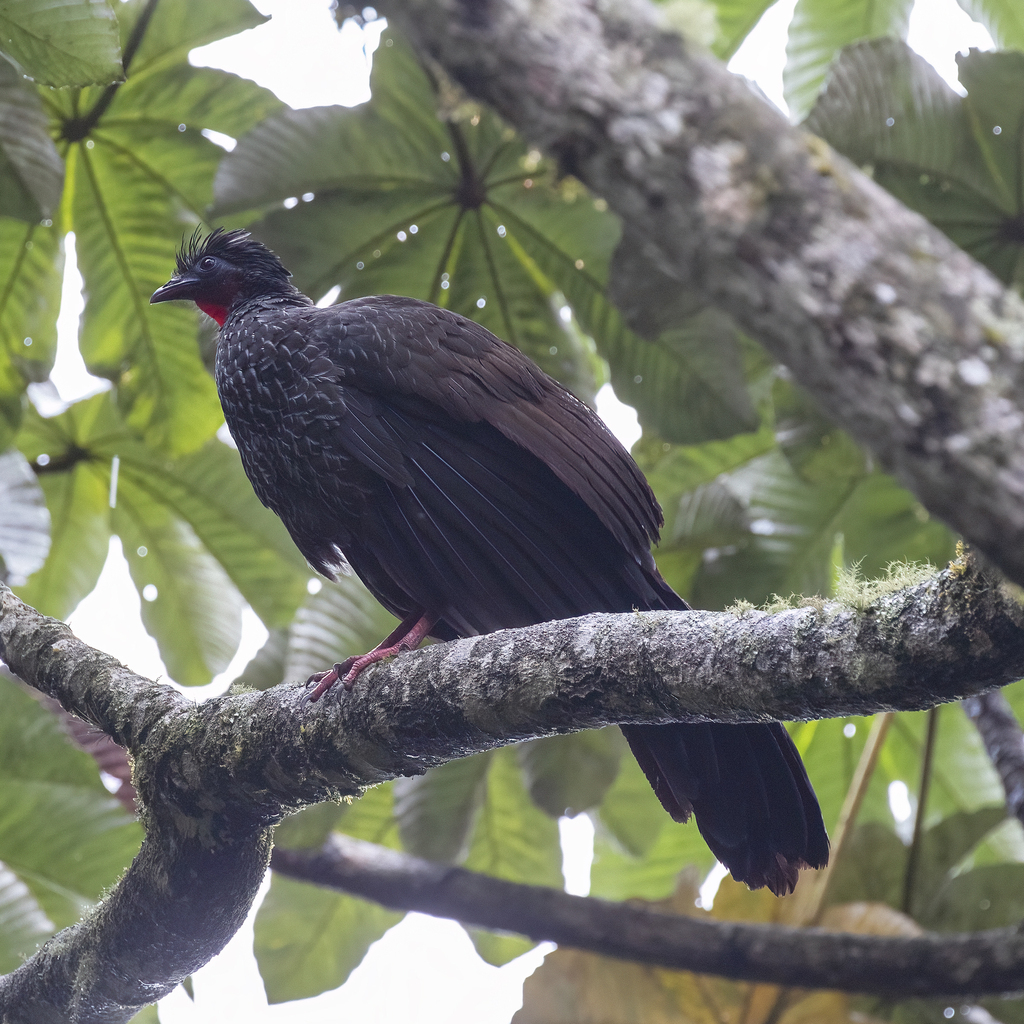
Cauca Guan
Photo © Dan Vickers
Photo © Dan Vickers — CC BY 4.0 — Source: iNaturalist #259470516Identification
The Cauca guan is a large bird measuring 75–85 cm in length, with the characteristic plump body, long tail, and small head typical of the Cracidae family. Its head, neck, and mantle are dark grey, transitioning into reddish-chestnut on the rump, scapulars, wing coverts, and upper tail surfaces. The primary flight feathers are greyish-brown, while the undersides of the tail feathers are grey. A distinctive feature is the scaled appearance created by white outlines on the grey feathers of the mantle, throat, breast, and belly.
Most notably, the Cauca guan displays a prominent bright red gular sac (throat pouch) that is larger than that of the superficially similar Andean guan, making this an important distinguishing feature. The bird also has red tarsi, feet, and eyes, with a dark grey bill. In Spanish, it is known as the pava caucana.
Range & Habitat
This species is endemic to Colombia, historically found throughout the Cauca River valley between Quindío Department and Cerro Munchique in Cauca, and on the Pacific slope of the Cordillera Occidental (Western Andes) in Valle del Cauca and Cauca. The bird inhabits humid primary and secondary forest, forest edges, and tree plantations, including introduced species such as Chinese ash and patula pine, at altitudes between 900 and 2,500 metres above sea level. Once thought extinct by the 1980s, small surviving populations have since been rediscovered in the departments of Cauca, Valle del Cauca, Quindío, and Risaralda.
Behaviour & Diet
Like most guans, the Cauca guan leads a largely arboreal existence, foraging in shrubs and trees typically between 2 and 20 metres above the ground. It is primarily a frugivore, consuming at least 89 species of fruit, supplemented by leaves and flowers from at least 11 species each. Most fruits are eaten whole, though the bird will bite off pieces from larger fruits. During fruit-scarce periods from September to December, Cauca guans feed heavily on young leaves of introduced Chinese ash trees. These birds forage solitarily or in family groups of 3–4, though occasionally larger aggregations of up to 30 individuals gather at productive food sources.
The species has a remarkable behaviour of following swarms of army ants in groups of 3–7 birds, feasting on the invertebrates that flee from the advancing colony. Cauca guans often forage alongside other bird species, including various guan, toucanet, and jay species, without displaying territorial aggression toward these companions, though they will defend good food sources from other Cauca guans. The bird produces several vocalizations: a squawking alarm call repeated rapidly, a long drawn-out call likened to "kōō'EEl," and loud wing-rattling heard especially in the morning and during courtship.
Best Time & Places to See It
The Cauca guan is now restricted to four discontinuous sites in southwestern Colombia, totalling approximately 750 square kilometres. Two important locations for potential sightings are the Otún Quimbaya Fauna and Flora Sanctuary and the Yotoco Forest Nature Reserve. Breeding season varies by location: in the Otún Quimbaya Sanctuary, it occurs from January to June when fruit is most abundant, while in the Yotoco area breeding seems concentrated at year's end. Your best chances of observing these birds are during early morning hours when wing-rattling displays are most frequent.
Photography Tips
Photographing the Cauca guan requires patience and attention to forest canopy zones between 2 and 20 metres high. Early morning visits offer the best opportunity to hear and locate these birds through their distinctive vocalizations and wing-rattling displays. Focus on the bird's most striking features: the prominent bright red gular sac, the scaled breast pattern created by white-outlined grey feathers, and the contrasting reddish-chestnut rump. The red eyes and tarsi also provide excellent focal points. Look for these birds near fruiting trees, particularly during fruit-abundant seasons, and watch for mixed-species feeding flocks where Cauca guans sometimes congregate with other forest birds.
Natural Farallones de Cali National Park
Buenaventura, Colombia
+733 birds+27 mammals
Where the Pacific coastal plain meets the western slopes of the Andes, Farallones de Cali National Park sprawls across nearly 3,500 square kilometers of dramatic topography…
VIEW NATIONAL PARKPuracé National Natural Park
Puracé, Colombia
+327 birds+2 mammals
Where the Andes thrust upward across southwestern Colombia, Puracé National Natural Park spans nearly 2,631 square kilometers of some of South America's most dramatic montane terrain.…
VIEW NATIONAL PARKNo community photos yet. Log in to add the first one.
No community observations of this species yet.