Cetti’s Warbler
Photo © Paulo Martins
Photo © Paulo Martins — CC BY-SA 4.0 — Source: iNaturalist photo #262655566Identification
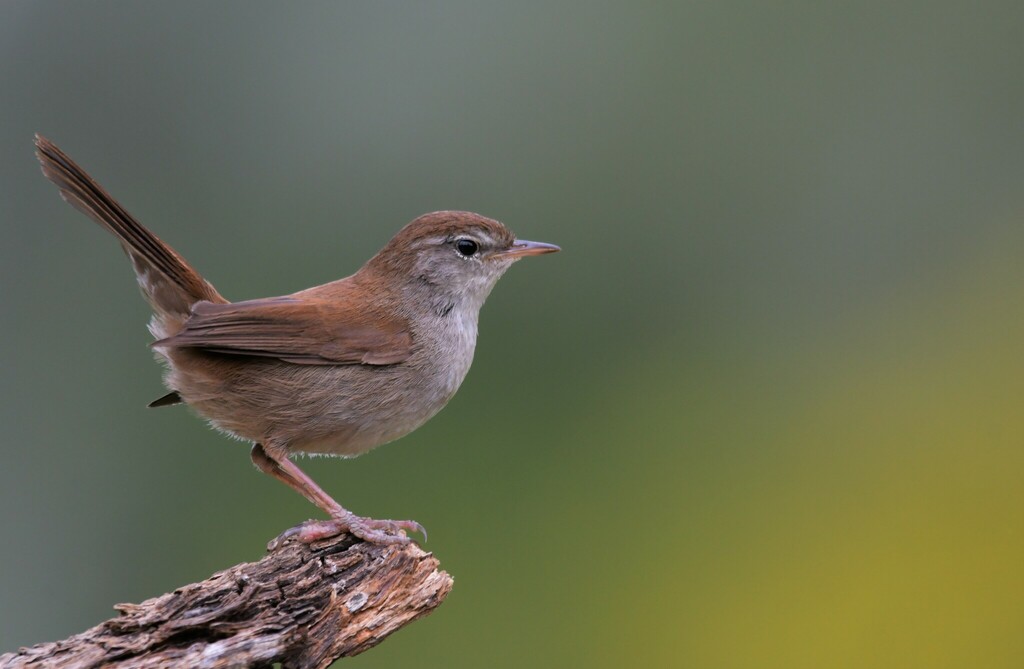
Cetti's warbler is a small brown warbler, measuring approximately 13–14 cm from bill to tail. Males are noticeably heavier than females, weighing around 15 g compared to 12 g, and possess slightly longer wings. The bird's most distinctive features include a rounded head with a narrow pale grey stripe arching over conspicuous black eyes, rich chestnut or dark reddish-brown upperparts, and a pale grey-brown throat and breast. The tail is notably longer and broader than in many other warblers. An unusual characteristic among songbirds is that Cetti's warbler has ten tail feathers rather than the typical twelve. The sexes are alike in plumage, though juveniles can be distinguished by fresher plumage and two dark spots on the tongue.
Range & Habitat
Cetti's warbler breeds across southern and western Europe, northwest Africa, and the east Palearctic region, extending as far as Afghanistan and northwest Pakistan. Three subspecies are recognized, with populations distributed from west Europe to Greece and the Balkans, and eastward through Turkey, Iran, and Central Asia. The species typically inhabits thick shrubby vegetation in damp areas close to, but not directly in, ponds, lakes, marshes, and rivers.
Since 1990, Cetti's warbler populations have increased dramatically across Europe, with the current European population estimated at 600,000–1,600,000 breeding pairs and evaluated as secure overall. The species has expanded its range northward; it was first recorded in the United Kingdom in 1961 and first bred there in 1972–73. By 2016, UK populations had grown to 3,450 territorial males distributed throughout most of England and Wales, with breeding reaching Scotland in 2023. The species was first recorded in Ireland in 2013, with breeding beginning in 2022.
Behaviour & Diet
Cetti's warblers are highly vocal birds that signal their presence with loud, distinctive songs delivered in sharp bursts. Their unique song structure plays a crucial role in territory establishment and mate attraction. During breeding season, males spend most of their time establishing territories and typically attract multiple females. In Europe, egg-laying occurs mainly from mid to late June, with two broods being normal. Females build untidy cup-shaped nests from leaves and stems, lined with feathers and hair, typically placed 30–45 cm above the ground in thick dense vegetation. A clutch of 4–5 chestnut-red eggs is incubated by the female for 16–17 days, and the young fledge after 14–16 days while continuing to receive parental care for another 15 days until independence at around 30 days old.
Cetti's warbler is insectivorous, feeding primarily on small, soft-bodied insects and larvae. The birds prefer tiny insects, which they can digest more rapidly than larger prey.
Best Time & Places to See It
Cetti's warbler is often difficult to observe due to its skulking habits and preference for thick shrubby vegetation. However, during the breeding season from June onward, males are most vocal and active as they establish territories and attract mates, making this the best time to locate them by sound. The species is best found in reed beds, willow scrub, and dense vegetation bordering wetlands across southern and western Europe. As populations continue to expand northward, the species is becoming increasingly established in the United Kingdom, particularly in England and Wales, making these regions increasingly accessible for observation.
Photography Tips
Photographing Cetti's warbler presents a significant challenge due to the bird's secretive nature and preference for dense vegetation. Success is best achieved by locating singing males during breeding season, then waiting patiently for them to emerge briefly from cover. Early morning is often productive as males are more vocal at this time. Position yourself quietly near reed beds or willow scrub near water margins and listen for the distinctive loud song bursts that will alert you to the bird's presence. The pale eyebrow stripe and black eye are key identifying features to capture, though obtaining clear shots requires patience, as the bird rarely remains exposed for extended periods. Avoid sudden movements, as the bird will retreat deeper into vegetation if disturbed.

Private Full-Day Birdwatching Tour from Algarve to Southwest Spain
Private Full-Day Birdwatching Tour from Lisbon to the Tagus Estuary
Nothing matches these filters.
Abruzzo, Lazio and Molise National Park
Alpilles Regional Nature Park
Alta Murgia National Park
Appennino Lucano Val d’Agri Lagonegrese National Park
Aspromonte National Park
Avesnois Regional Nature Park
Bannau Brycheiniog National Park
Bardenas Reales
Bosc de Virós
Nothing matches these filters.
No community photos yet. Log in to add the first one.
No community observations of this species yet.