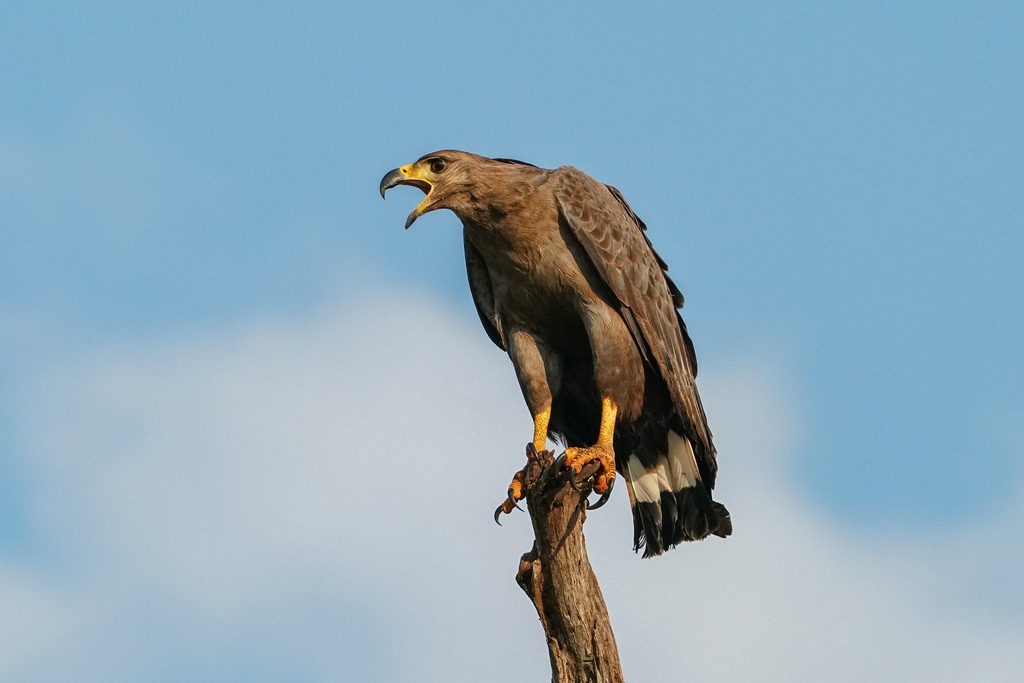
Chaco Eagle
Photo © ....Christopher Borges....
Photo © ....Christopher Borges.... — CC BY-SA 4.0 — Source: iNaturalist photo #590199712Identification
The Chaco Eagle is one of the largest raptors in the Neotropics, a massive bird of prey reaching 73–79 cm in length with a wingspan of 170–183 cm and weighing around 2.95 kg. Adults display mostly dull silvery-grey body plumage with a distinctive crest of darker grey feathers—the feature that inspired both its scientific name and alternative common name, the Crowned Solitary Eagle. Look for its short black tail marked with a broad white medial band and white tip, along with yellow cere and legs. Juveniles are more striking, with dark brown crests, creamy heads and underparts streaked with grey, making them quite different in appearance from adults.
Range & Habitat
This species is endemic to eastern and central South America, occurring in southern and central Brazil, Bolivia, Paraguay, and Argentina south to northern Patagonia. Unfortunately, it has become regionally extinct in portions of its historical range and is believed to be extinct in Uruguay, where it has not been sighted for decades. The Chaco Eagle inhabits semi-open landscapes including grasslands, brushlands, savannahs, marshes, and open woodlands, with a critical requirement for large trees suitable for nesting.
The species is critically endangered, with only 250–999 mature individuals remaining and a total population estimated at 375–1,499 birds. Habitat degradation, collisions with human structures, persecution based on livestock predation concerns, and electrocution from power poles all threaten survival. Argentina is the only country to have implemented a national conservation plan for the species.
Behaviour & Diet
Chaco Eagles are typically seen in solitary pairs or small groups of three. They are tame, crepuscular birds that forage during early morning hours, hunting from elevated perches in a still-hunting strategy. They are highly vocal, producing powerful and shrill whistling calls audible up to 2 km away, making them detectable even when difficult to spot.
The diet consists primarily of small to medium-sized mammals, particularly armadillos including pichis and nine-banded armadillos, along with Andes skunks. They also take rodents, possums, European hares, and lesser grisons. Reptiles including snakes, tortoises, and large tegus supplement their diet. When hunting snakes, eagles characteristically remove the head first, protected by singular scales on their tarsi. Some individuals scavenge roadkill and dead livestock. Monogamous birds breed between August and October, laying a single white egg with grey spots in stick nests high in tall trees. Chicks fledge after 65–70 days, and breeding likely begins at 3–5 years of age.
Best Time & Places to See It
Finding Chaco Eagles requires patience and knowledge of their range. Target semi-open habitats in central and southern Brazil, Bolivia, Paraguay, and Argentina, where the species occurs at very low density. Early morning hours offer the best viewing opportunities, as these crepuscular hunters are most active at dawn. Argentina, with its active conservation programme, may offer the most reliable chances, particularly in the Chaco region where the species is named after and where habitat remains relatively suitable.
Photography Tips
Scout perching locations in open woodlands and brushy terrain where eagles hunt from elevated vantage points. Early morning light is essential for photography. The birds' distinctive silhouette—large body, short tail with white bands, and prominent crest—makes them recognizable even at distance. Listen for their powerful whistling call to locate individuals. Given the species' rarity and endangered status, photographers should prioritize observation and documentation that supports conservation efforts. Exercise patience and use appropriate telephoto lenses to capture images without disturbing these vulnerable birds.
Emas National Park
Brazil
+333 birds+23 mammals
Across the high plateaux of central Brazil, where the cerrado grasslands roll toward distant horizons under an immense sky, Emas National Park anchors one of South…
VIEW NATIONAL PARKItatiaia National Park
Brazil
+519 birds+12 mammals
Where granite peaks pierce the Atlantic rainforest canopy in southeastern Brazil, Itatiaia National Park rises as one of the country's oldest and most ecologically vital protected…
VIEW NATIONAL PARKSerra da Bocaina National Park
Brazil
+441 birds+5 mammals
Where the escarpment of the Serra da Bocaina rises sharply from the Atlantic coastal plain, tropical rainforest cloaks steep mountainsides that climb toward peaks exceeding 2,000…
VIEW NATIONAL PARKSerra dos Órgãos National Park
Brazil
+446 birds+13 mammals
Granite peaks thrust skyward through the Atlantic Forest canopy in the mountains immediately north of Rio de Janeiro, their bare rock faces rising above a landscape…
VIEW NATIONAL PARKChapada dos Guimarães National Park
Brazil
+450 birds+1 mammals
Where weathered sandstone plateaus rise above the cerrado grasslands of central Brazil, Chapada dos Guimarães National Park protects 624 square kilometres of ecological transition zone that…
VIEW NATIONAL PARKChapada dos Veadeiros National Park
Brazil
+324 birds+6 mammals
Where granite plateaus rise above the cerrado savanna in central Brazil, Chapada dos Veadeiros National Park unfolds across 6,665 square kilometres of some of the world's…
VIEW NATIONAL PARKChapada Diamantina National Park
Brazil
+346 birds+5 mammals
Where granite peaks and sandstone cliffs rise abruptly from the Brazilian interior, Chapada Diamantina National Park sprawls across 4,215 square kilometers of some of Brazil's most…
VIEW NATIONAL PARKBrasília National Park
Plano Piloto, Brazil
+338 birds+15 mammals
Cerrado grassland and scattered woodland sweep across the central Brazilian plateau where this national park sprawls across more than a thousand square kilometres of the Federal…
VIEW NATIONAL PARKSierra de las Quijadas National Park
Argentina
+168 birds+5 mammals
Sandstone cliffs and deeply incised canyons define this 1,137-square-kilometre expanse in San Luis Province, where the dry Chacoan landscape of central Argentina reveals an unexpected ecological…
VIEW NATIONAL PARKNo community photos yet. Log in to add the first one.
No community observations of this species yet.