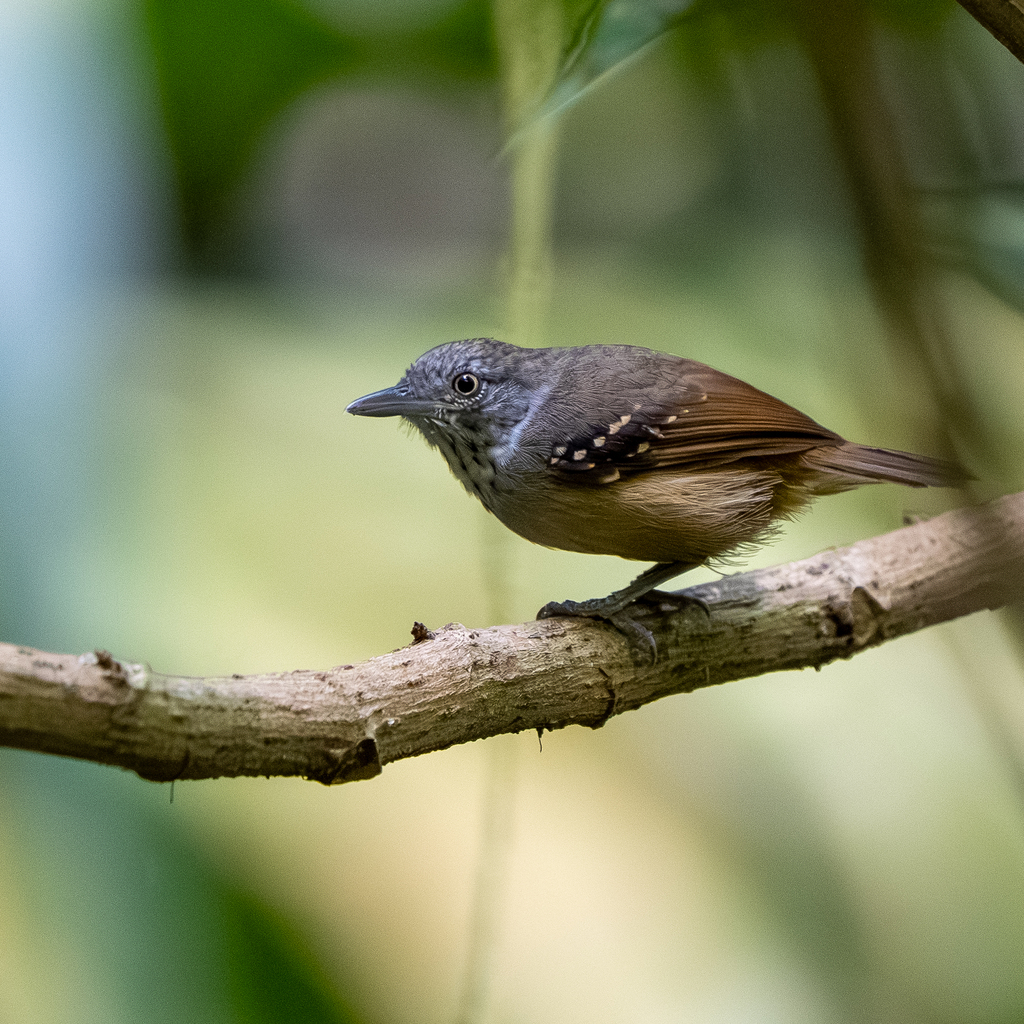
Checker-throated Stipplethroat
Photo © Anthony Batista
Photo © Anthony Batista — CC BY 4.0 — Source: iNaturalist photo #607416256Identification
The checker-throated stipplethroat is a tiny passerine, measuring just 10 to 11 cm in length and weighing between 8.5 and 11.5 grams. Males are distinctive with a mostly gray face and striking black throat marked with large white spots—the "checker" pattern that gives the species its name. Females are more subdued, sporting a brownish buff face and throat instead. Both sexes share a gray-brown crown and upperparts, with a characteristic reddish tail. The wing coverts are blackish brown to olive-brown with yellow-ochre tips, while flight feathers are reddish. The breast is gray, and the underparts are brownish buff, darkening toward the vent. An identifying feature is the golden iris, which darkens with age; juveniles begin with a gray iris that yellows as they mature.
Range & Habitat
This small antbird ranges from far southeastern Honduras southward through Central America and into South America, occurring from the Caribbean slope through Nicaragua and Costa Rica, and on both slopes in Panama, Colombia, and Ecuador, extending nearly to Peru. The species shows considerable elevation variation across its range, typically found up to about 750 meters in Central America, reaching 1,200 meters in Colombia and 900 meters in Ecuador, though it can occasionally reach 2,000 meters in Colombia and 900 meters in Costa Rica.
The checker-throated stipplethroat is a bird of evergreen forest in lowlands and foothills, including adjacent mature secondary forest. It shows a strong preference for areas with dense vine tangles that collect debris, where it spends much of its foraging time. This microhabitat preference makes it a specialist of cluttered, tangled vegetation rather than open forest.
Behaviour & Diet
This species is a year-round resident throughout its range, never undertaking long migrations. It feeds primarily on arthropods, with a particular preference for cockroaches, crickets, katydids, and spiders. The checker-throated stipplethroat typically forages in pairs or small family groups, often joining mixed-species feeding flocks and occasionally attending army ant swarms. It works the forest understory to mid-story, predominantly in vine tangles where it picks through foliage, dead leaves, and trapped debris, though it also hitches along thin branches, gleans from moss clumps and epiphytes, and captures prey from live leaves.
Males defend territories with elaborate visual displays, positioning themselves about 30 centimeters apart and lowering their heads, puffing up their plumage, swaying back and forth while vocalizing continuously. The species produces a distinctive song described as "a series of abrupt, countable, almost staccato notes" that varies in pace, pitch, and intensity, often accelerating and intensifying initially before decelerating toward the end. Calls include a fast rattle and a characteristic "peeyk" note.
Best Time & Places to See It
The checker-throated stipplethroat is considered fairly common across its range and occurs in several protected areas, making it a reliable find for patient birdwatchers in appropriate habitat. The species is a permanent resident, so it can be found year-round throughout its range from Honduras to Ecuador. Breeding seasons vary geographically: in Panama birds nest primarily during the rainy season, in Costa Rica between March and August, and in Colombia including December. Visiting during breeding seasons may increase your chances of hearing vocal males and observing territorial displays.
Photography Tips
Finding and photographing this diminutive species requires patience and attention to its preferred microhabitats. Focus your search on areas with dense vine tangles in lowland and foothill evergreen forests, particularly spots where dead leaves and debris accumulate. Early morning hours are ideal for locating males through their distinctive vocalizations. Because the bird forages mostly below 10 meters—though occasionally reaching 25 meters—position yourself to observe vine tangles and low vegetation. The male's striking black-and-white checked throat and puffed plumage during territorial displays offer compelling photographic opportunities if you can locate an active territory. Use a telephoto lens and work carefully to avoid flushing birds from the dense tangles where they prefer to forage.
Arenal Volcano National Park
Peñas Blancas, Costa Rica
+551 birds+21 mammals
Straddling the border between Alajuela and Guanacaste in northwestern Costa Rica, this national park rises dramatically around one of Central America's most active volcanic systems. The…
VIEW NATIONAL PARKTortuguero National Park
Roxana, Costa Rica
+420 birds+23 mammals
Canals and lagoons thread through a labyrinth of lowland rainforest where the Caribbean coast of Costa Rica meets the wetland frontier. This is terrain shaped by…
VIEW NATIONAL PARKBraulio Carrillo National Park
Las Horquetas, Costa Rica
+547 birds+18 mammals
Where the Caribbean slope descends from the central volcanic cordillera toward the humid lowlands of Heredia, Braulio Carrillo National Park preserves one of Costa Rica's most…
VIEW NATIONAL PARKGuanacaste National Park
Santa Elena, Costa Rica
+461 birds+17 mammals
Where the Pacific slopes of northwestern Costa Rica rise toward the Continental Divide, dry tropical forest gives way to cloud-laden peaks and misty ridges—a landscape that…
VIEW NATIONAL PARKNatural Utría National Park
Alto Baudó (Pie de Pató), Colombia
+372 birds+11 mammals
Where the Chocó's coastal mountains plunge toward the Pacific, Utría National Park preserves one of Colombia's most biodiverse and least-visited wilderness expanses. Sprawling across 1,287 square…
VIEW NATIONAL PARKNatural Farallones de Cali National Park
Buenaventura, Colombia
+733 birds+27 mammals
Where the Pacific coastal plain meets the western slopes of the Andes, Farallones de Cali National Park sprawls across nearly 3,500 square kilometers of dramatic topography…
VIEW NATIONAL PARKNatural Uramba Bahía Málaga National Park
Buenaventura, Colombia
+308 birds+15 mammals
Where the Pacific coastal rainforest descends to mangrove estuaries and rocky headlands, Uramba Bahía Málaga National Park unfolds across nearly 1,000 square kilometres of Colombia's Valle…
VIEW NATIONAL PARKGeneral de División Omar Torrijos Herrera National Park
La Pintada, Panama
+401 birds+2 mammals
Across the highlands of central Panama, where the continental divide funnels moisture-laden trade winds into steep river valleys, the terrain rises and falls in a landscape…
VIEW NATIONAL PARKSoberanía National Park
Cristóbal, Panama
+495 birds+34 mammals
Rainforest and riverine woodland blanket the rolling terrain of this 714-square-kilometre national park in Colón Province, where the Caribbean watershed feeds a maze of streams and…
VIEW NATIONAL PARKChagres National Park
Caimitillo, Panama
+486 birds+19 mammals
Where the Chagres River carves through the humid tropics of central Panama, a vast montane and lowland forest sprawls across more than 2,300 square kilometers, anchoring…
VIEW NATIONAL PARKDarién National Park
Tucutí, Panama
+534 birds+13 mammals
Where the spine of Central America crumbles into wetland and rainforest, Darién National Park sprawls across more than 20,000 square kilometres of some of the tropics'…
VIEW NATIONAL PARKPortobelo National Park
Portobelo, Panama
+366 birds+9 mammals
Where the Caribbean's turquoise waters meet the Darién's verdant shore, Portobelo National Park sprawls across 570 square kilometers of coastal forest, mangrove wetland, and coral-fringed islands…
VIEW NATIONAL PARKCahuita National Park
Talamanca, Costa Rica
+359 birds+15 mammals
Where the Caribbean shoreline dissolves into mangrove creeks and coral gardens, Cahuita's mosaic of habitats unfolds across the Limón coast. The park's signature feature—a living coral…
VIEW NATIONAL PARKTapantí Macizo de la Muerte National Park
Orosi, Costa Rica
+503 birds+18 mammals
Where montane cloud forest rises steeply from the Orosi Valley, Tapantí Macizo de la Muerte National Park enfolds a landscape of perpetual moisture and emerald complexity.…
VIEW NATIONAL PARKLa Amistad International Park
Crorina, Costa Rica
+532 birds+20 mammals
Where the Caribbean slopes of Costa Rica's Talamanca Mountains rise steeply inland from Limón, the boundary between two nations dissolves into an unbroken expanse of rainforest.…
VIEW NATIONAL PARKBarbilla National Park
Chirripó, Costa Rica
+226 birds
Where the Caribbean slope of Costa Rica's eastern cordillera plunges into perpetual moisture, Barbilla National Park rises as one of Central America's most water-rich ecosystems. Fed…
VIEW NATIONAL PARKVolcán Tenorio National Park
Guatuso, Costa Rica
+480 birds+12 mammals
Where volcanic slopes rise through Costa Rica's northwestern borderlands, Volcán Tenorio National Park sprawls across terrain shaped by ancient lava flows and mineral-rich springs. The park's…
VIEW NATIONAL PARKGandoca-Manzanillo National Wildlife Refuge
Manzanillo, Costa Rica
+394 birds+18 mammals
Where the Caribbean coastal plain surrenders to water-logged forest and mangrove tangles, Gandoca-Manzanillo Wildlife Sanctuary shelters one of Costa Rica's most biodiverse lowland wetland ecosystems. The…
VIEW WILDLIFE SANCTUARYBarra del Colorado National Wildlife Refuge
Tortuguero, Costa Rica
+462 birds+36 mammals
Where the Caribbean's restless waters meet the Limón Province coastline, Barra del Colorado National Wildlife Sanctuary unfolds across a landscape of extraordinary ecological complexity. This equatorial…
VIEW WILDLIFE SANCTUARYNo community photos yet. Log in to add the first one.
No community observations of this species yet.