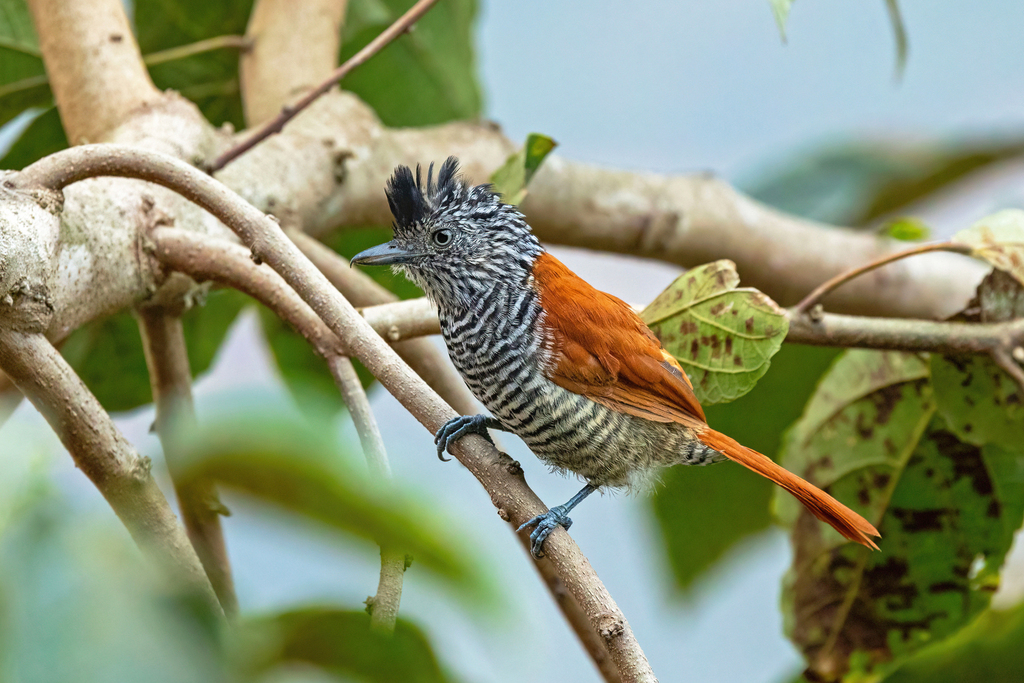
Chestnut-backed Antshrike
Photo © Thibaud Aronson
Photo © Thibaud Aronson — CC BY-SA 4.0 — Source: iNaturalist photo #448204111Identification
The chestnut-backed antshrike is a medium-sized antbird measuring 16 to 17 cm in length. Like all members of its genus, it possesses a stout, hooked bill characteristic of shrikes. Sexual dimorphism is evident: males display a black crown with white spots on the forehead, black face and nape with white spotting, rufous-brown upperparts and wings, and black-and-white striped throat with barred underparts tinged rufous on the flanks. Females are similar but feature a deep rufous-brown crown and broader white barring below. Both sexes sport a pale, variably colored iris and a distinctive crest. Subspecific variation occurs across its range, with some populations appearing paler overall or displaying different intensities of ochre wash and barring patterns.
Range & Habitat
The chestnut-backed antshrike has a disjunct distribution across Bolivia, Brazil, and Peru, with four recognized subspecies occupying different regions. In coastal southeastern Brazil, T. p. vestitus ranges from southern Bahia to Rio de Janeiro state. The widespread T. p. puncticeps inhabits southeastern Peru, northern Bolivia, and Brazilian Amazonia east to the Tapajós River. The nominate T. p. palliatus occurs in southern Amazonian Brazil, while T. p. similis is restricted to central Peru. This species favors semi-open landscapes including forest edges, mature secondary forest, regrowing clearings, and abandoned plantations with bamboo. It also inhabits várzea wetlands and pure stands of Guadua bamboo in lowland Amazonia. Elevations range from sea level to 2,200 m across its range.
Behaviour & Diet
The chestnut-backed antshrike is a year-round resident throughout its range. Its diet comprises insects and spiders, which it gleans through deliberate hops and quick stabs from leaves, stems, branches, and trunks in dense vegetation, typically foraging from near ground level to about 15 meters high. It usually forages singly or in pairs, frequently joining mixed-species feeding flocks. In eastern Brazil, individuals have been observed following army ant swarms, though only in dense cover. The species' song is a moderately long, accelerating series of nasal notes with rising and falling pitch, described as "kah kah-kah-kah-ka'ka'ka'kaka'pah." Its calls include emphatic short nasal notes and upward-inflected squeals.
Best Time & Places to See It
The chestnut-backed antshrike is fairly common throughout much of its range and occurs in several protected areas, making it accessible to patient observers. Breeding occurs from October to January in southeastern Brazil, likely extending to June in Amazonian regions, offering opportunities to observe territorial and nesting behavior during these periods. Early morning hours typically provide the best viewing, as the species is most vocal at dawn. Look for it in edge habitats, secondary forest, and bamboo-dominated areas where it frequents dense vegetation. Mixed-species feeding flocks passing through its territory provide particularly good viewing opportunities.
Photography Tips
Photographing the chestnut-backed antshrike requires patience and attention to its preferred microhabitat of dense vegetation. Position yourself near forest edges and secondary growth where the species is most active. Early morning light works best for capturing the rufous tones of its back and wings against the darker crown and facial markings. Use a shutter speed of at least 1/500th of a second to freeze its quick, deliberate foraging movements among branches. The bird's tendency to forage from ground level to mid-canopy offers varied composition opportunities. Dense vegetation may obscure views, but waiting at gaps in the canopy or following the sound of its distinctive accelerating song will increase your chances of obtaining clear shots. The male's contrasting plumage and pale iris provide excellent focal points for sharp detail work.
Tijuca National Park
Brazil
+317 birds+13 mammals
Where the Atlantic forest rises steeply from Rio de Janeiro's urban edge, Tijuca National Park encompasses a landscape of dramatic granite peaks, cascading waterfalls, and closed-canopy…
VIEW NATIONAL PARKItatiaia National Park
Brazil
+519 birds+12 mammals
Where granite peaks pierce the Atlantic rainforest canopy in southeastern Brazil, Itatiaia National Park rises as one of the country's oldest and most ecologically vital protected…
VIEW NATIONAL PARKSerra da Bocaina National Park
Brazil
+441 birds+5 mammals
Where the escarpment of the Serra da Bocaina rises sharply from the Atlantic coastal plain, tropical rainforest cloaks steep mountainsides that climb toward peaks exceeding 2,000…
VIEW NATIONAL PARKPau Brasil National Park
Brazil
+211 birds
Tropical Atlantic forest cloaks the rolling terrain of northeastern Bahia, where Pau Brasil National Park protects nearly 390 square kilometers of one of Brazil's most biodiverse…
VIEW NATIONAL PARKSerra dos Órgãos National Park
Brazil
+446 birds+13 mammals
Granite peaks thrust skyward through the Atlantic Forest canopy in the mountains immediately north of Rio de Janeiro, their bare rock faces rising above a landscape…
VIEW NATIONAL PARKAmazônia National Park
Brazil
+439 birds+6 mammals
Where the Rio Amazonas and its tributaries weave through the heart of Pará state, a vast tapestry of rainforest stretches across 23,611 square kilometers of unbroken…
VIEW NATIONAL PARKPacaás Novos National Park
Brazil
+279 birds+1 mammals
Across the border between Rondônia and Amazonas, vast tracts of humid tropical forest rise and fall in gentle undulations, carved by clear-flowing rivers that feed into…
VIEW NATIONAL PARKAnavilhanas National Park
Brazil
+468 birds+8 mammals
Across the Rio Negro in central Amazonas, an archipelago of over a thousand islands rises from the world's largest rainforest river system, creating a labyrinth of…
VIEW NATIONAL PARKCampos Amazónicos National Park
Amazonas, Brazil
+434 birds+7 mammals
Sprawling across the southwestern Amazon basin in Amazonas state, this 27,263-square-kilometre national park encompasses some of the region's most pristine lowland rainforest, where terra firme forest…
VIEW NATIONAL PARKYanachaga–chemillén National Park
Palcazu, Peru
+639 birds+6 mammals
Where the eastern slopes of Peru's central cordillera plunge into cloud forest, Yanachaga–Chemillén National Park protects nearly three thousand square kilometres of montane wilderness that few…
VIEW NATIONAL PARKManu National Park
Manu, Peru
+892 birds+26 mammals
Across the eastern slopes of the Peruvian Andes, tropical rainforest descends into the Amazon basin with a complexity that few terrestrial ecosystems match. Manu National Park…
VIEW NATIONAL PARKTingo Maria National Park
Mariano Dámaso Beraún, Peru
+423 birds
Where the eastern slopes of the Peruvian Andes descend toward the Amazon basin, the landscape fractures into a maze of limestone ridges, humid gorges, and cloud-wrapped…
VIEW NATIONAL PARKCordillera Azul National Park
Pampa Hermosa, Peru
+322 birds+1 mammals
Where the eastern Andes descend into the western Amazon basin, Cordillera Azul National Park sprawls across nearly 38,000 square kilometres of some of Peru's most pristine…
VIEW NATIONAL PARKNo community photos yet. Log in to add the first one.
No community observations of this species yet.