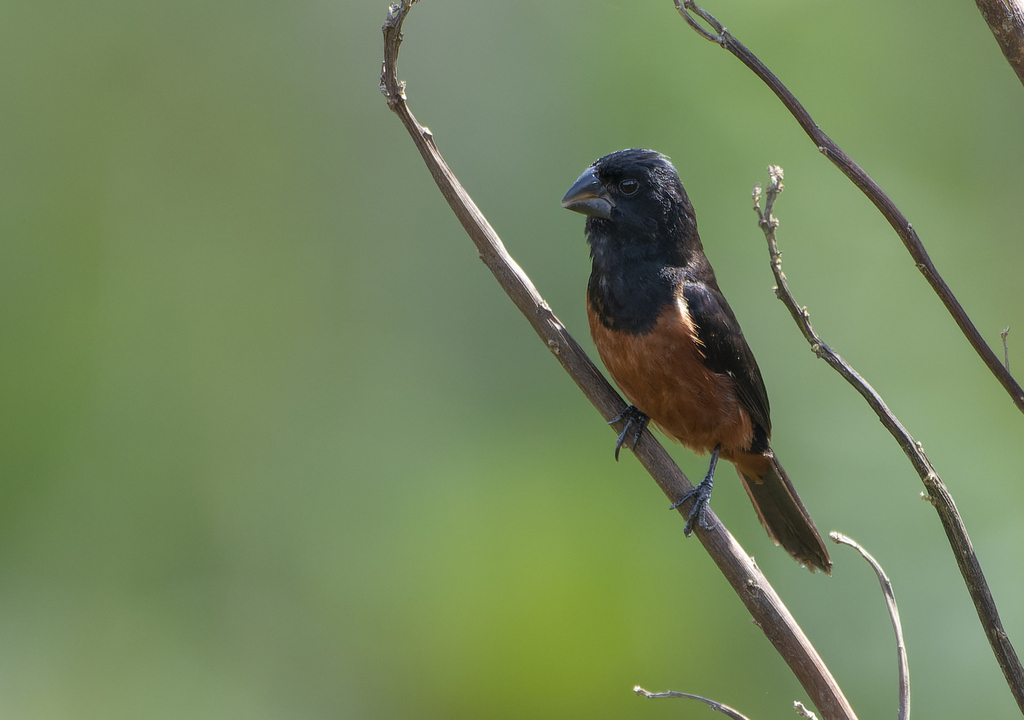
Chestnut-bellied Seed Finch
Photo © David F. Belmonte
Photo © David F. Belmonte — CC BY 4.0 — Source: iNaturalist photo #351775691Identification
The chestnut-bellied seed finch is a small member of the tanager family with distinctive plumage. Males are primarily black with a characteristic chestnut-coloured belly, making them unmistakable in the field. Females and immatures are duller, predominantly olive-brown with a buffy undertone. The species has a notably thick, conical bill adapted for cracking seeds—a feature that distinguishes it from other finches in its range.
Range & Habitat
This species is found widely across tropical and subtropical South America, east of the Andes. Its range extends from the Guianas and northern Amazonia southward through Brazil, Paraguay, and into northeastern Argentina, with populations also present in Trinidad and Tobago. The closely related thick-billed seed finch occupies the western slopes of the Andes and Central America, having replaced the chestnut-bellied seed finch in those regions.
The chestnut-bellied seed finch inhabits shrubby and grassy areas, favouring open or semi-open landscapes with scattered vegetation where seeds are abundant.
Behaviour & Diet
True to its name, this species is a specialist seed-eater, using its thick, powerful bill to crack open seeds of grasses and other plants. It typically forages on or near the ground, often in small flocks, moving methodically through suitable habitat in search of food. Like other seed finches, it is relatively inconspicuous despite the males' striking plumage, and often blends into grassland surroundings.
Best Time & Places to See It
The chestnut-bellied seed finch can be found year-round throughout its range, making it accessible to travellers during any season. Look for this species in open grasslands, savanna-like areas, and scrubby habitats across the Amazon basin, the Guianas, and the savannas of central and eastern Brazil. It is fairly widespread in suitable habitat, though sighting frequency depends on local vegetation conditions and the availability of seeding plants.
Photography Tips
Photograph males in good light to capture the contrast between their black upperparts and distinctive chestnut belly. Since these birds forage on or near the ground, position yourself low to gain better angles. Early morning often provides the best light and bird activity. Use a patient, slow approach when scanning grasslands and shrubby areas, as they may freeze rather than flee when approached. A telephoto lens (at least 300–400mm) will help you capture detail without disturbing the bird.
Emas National Park
Serra do Cipó National Park
Yasuní National Park
Río Negro-Sopladora National Park
Sumaco Napo-Galeras National Park
Antisana National Park
Natural la Paya National Park
Natural el Cocuy National Park
Natural Sumapaz National Park
Natural Sierra de la Macarena National Park
Amacayacu National Park
Itatiaia National Park
Superagui National Park
Serra da Bocaina National Park
Viruá National Park
Iguaçu National Park
Ilha Grande National Park
Pau Brasil National Park
Monte Roraima National Park
Chapada dos Guimarães National Park
Chapada dos Veadeiros National Park
Pantanal Matogrossense National Park
Brasília National Park
Amazônia National Park
Mapinguari National Park
Jaú National Park
Pacaás Novos National Park
Anavilhanas National Park
Campos Amazónicos National Park
Serra do Divisor National Park
Yanachaga–chemillén National Park
Manu National Park
Sierra del Divisor National Park
Bahuaja Sonene National Park
Tingo Maria National Park
Iguazú National Park
No community photos yet. Log in to add the first one.
No community observations of this species yet.