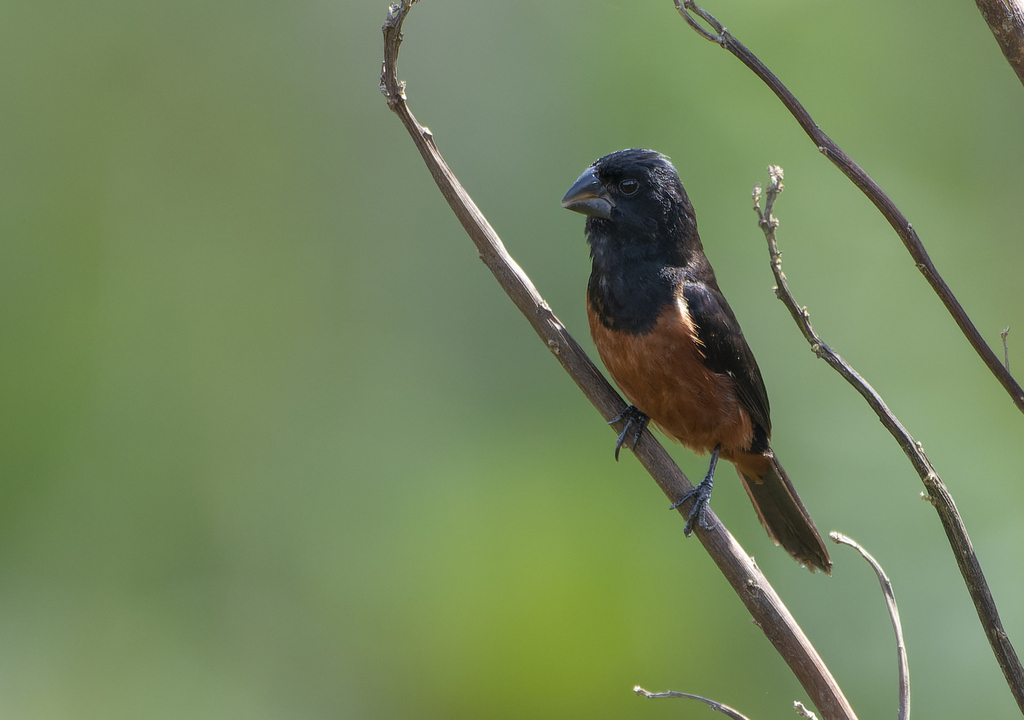
Semillero curió
Photo © David F. Belmonte
Photo © David F. Belmonte — CC BY 4.0 — Source: iNaturalist photo #351775691Identificación
El semillero curió es una pequeña especie de la familia Thraupidae con un plumaje inconfundible. Los machos presentan un colorido característico: cuerpo predominantly negro con el vientre rufescente o castaño, lo que los hace inconfundibles en el campo. Las hembras e inmaduros son mucho más apagados, predominantemente oliva-pardusco con tonos anteados. Poseen un pico robusto y cónico muy desarrollado, adaptado para romper semillas, característica que los distingue claramente de otros fringílidos simpátricos.
Rango & Hábitat
Esta especie se distribuye ampliamente en América del Sur tropical y subtropical, al este de los Andes. Su rango se extiende desde las Guayanas y norte amazónico hacia el sur a través de Brasil, Paraguay y hasta el noreste de Argentina, con poblaciones también presentes en Trinidad y Tobago. El semillero cangrejero (especie hermana), reemplaza al semillero curió en las laderas occidentales andinas y Centroamérica.
El semillero curió habita áreas arbustivas y herbáceas, mostrando preferencia por paisajes abiertos o semibiertos con vegetación dispersa donde abundan las semillas.
Comportamiento & Dieta
Fiel a su nombre, es un especialista en alimentación granívora, utilizando su robusto y poderoso pico para romper semillas de gramíneas y otras plantas. Generalmente forrajea en el suelo o cerca de él, a menudo en pequeñas bandadas, moviéndose metódicamente por el hábitat en búsqueda de alimento. A pesar del colorido llamativo de los machos, es una especie relativamente críptica que se integra bien en pastizales y sabanas.
Mejor Época y Lugar para Observarlo
El semillero curió está presente todo el año en toda su distribución, siendo accesible a naturalistas en cualquier estación. Búscalo en pastizales abiertos, sabanas y áreas arbustivas a través de la cuenca amazónica, las Guayanas y las sabanas del centro y este de Brasil. Es una especie bastante ampliamente distribuida en hábitats apropiados, aunque su frecuencia de observación depende de las condiciones locales de vegetación y la disponibilidad de plantas en semilla.
Consejos Fotográficos
Fotografía a los machos bajo buena iluminación para capturar el contraste entre sus partes superiores negras y el vientre castaño distintivo. Dado que estas aves forrajean en el suelo o cerca de él, posiciónate a baja altura para obtener mejores ángulos. El amanecer proporciona típicamente la mejor luz y máxima actividad de aves. Usa un enfoque paciente y lento al explorar pastizales y áreas arbustivas, ya que tienden a congelarse más que a huir cuando se les aproxima. Un teleobjetivo de al menos 300–400mm te permitirá capturar detalles sin disturbar al ave.
Emas National Park
Serra do Cipó National Park
Yasuní National Park
Río Negro-Sopladora National Park
Sumaco Napo-Galeras National Park
Antisana National Park
Natural la Paya National Park
Natural el Cocuy National Park
Natural Sumapaz National Park
Natural Sierra de la Macarena National Park
Amacayacu National Park
Itatiaia National Park
Superagui National Park
Serra da Bocaina National Park
Viruá National Park
Iguaçu National Park
Ilha Grande National Park
Pau Brasil National Park
Monte Roraima National Park
Chapada dos Guimarães National Park
Chapada dos Veadeiros National Park
Pantanal Matogrossense National Park
Brasília National Park
Amazônia National Park
Mapinguari National Park
Jaú National Park
Pacaás Novos National Park
Anavilhanas National Park
Campos Amazónicos National Park
Serra do Divisor National Park
Yanachaga–chemillén National Park
Manu National Park
Sierra del Divisor National Park
Bahuaja Sonene National Park
Tingo Maria National Park
Iguazú National Park
Aún no hay fotos de la comunidad. Inicia sesión para añadir la primera.
Aún no hay observaciones de la comunidad de esta especie.