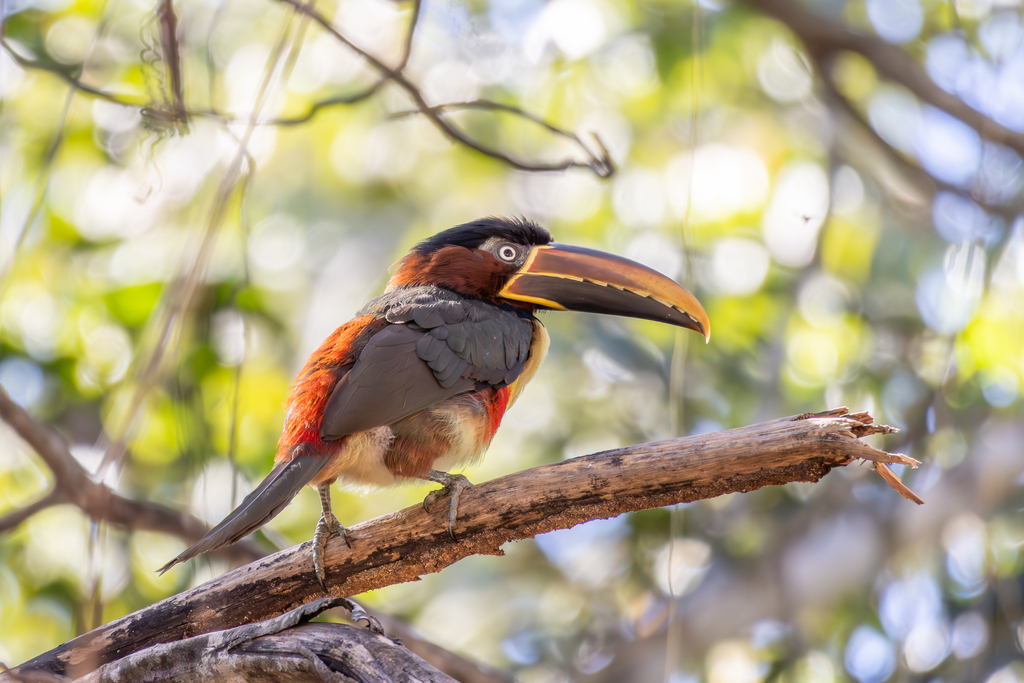
Chestnut-eared Aracari
Photo © Francisco V. Bezerra Neto
Photo © Francisco V. Bezerra Neto — CC BY-SA 4.0 — Source: iNaturalist photo #530979660Identification
The chestnut-eared aracari is a medium-sized toucan, measuring 43 to 47 cm in length and weighing 220 to 310 grams. Both sexes share distinctive bill patterns, though females have slightly shorter bills. The plumage is striking and colourful: males display a black crown and upper nape contrasting with a chestnut lower nape, dark green back, and bright red rump. Their face features blue skin with brown to chestnut sides, while the breast is yellow with red and chestnut-black markings below, and the belly is yellow with typically cinnamon thighs. Females are noticeably browner on the crown, nape, and upper throat, with a thinner black band on the lower throat. The bill itself is particularly diagnostic, featuring a yellow line at the base, mostly black mandible, and a striking pattern of orange-yellow, black, and ivory markings on the maxilla that resemble teeth. Juveniles are duller overall with a muted bill pattern. Two subspecies are recognized: the nominate form and P. c. australis, which is paler overall with rusty cheeks, a wider orange basal line on the bill, and greenish thighs.
Range & Habitat
The chestnut-eared aracari inhabits the western and southern Amazon Basin across seven countries: Argentina, Bolivia, Brazil, Colombia, Ecuador, Paraguay, and Peru. The nominate subspecies ranges from southern and eastern Colombia south through eastern Ecuador to southeastern Peru and into Brazil along the Amazon to the Rio Negro and Amazonas states. The australis subspecies occupies areas south of the Amazon, from north central Brazil southward through northern Bolivia, eastern Paraguay, and northeastern Argentina's Misiones Province, extending into southeastern Brazil. These birds favour landscapes characterised by water, including wet forests by lakes and rivers, várzea, forested river islands, and gallery forests. They also adapt well to edges, clearings, disturbed drier forests, bamboo canebrakes, cerrado, and even coffee plantations. Elevations are typically below 600 metres, though some Andean populations reach about 1,300 metres and southeastern Brazilian birds occur above 1,000 metres.
Behaviour & Diet
The chestnut-eared aracari is primarily frugivorous, foraging at all forest levels to pluck fruit from branches—even while hanging upside down—and probing vines, shrubs, crevices, and cavities for food. It supplements its diet with flowers, nectar, bird eggs, and nestlings. Rather than making conventional migrations, these birds gather in loose flocks and move during the austral winter to fruit-rich areas such as plantations. Breeding seasons vary dramatically across their range, occurring from February to September in northern and western populations but reversed to September to February in the southernmost birds. They typically nest in old woodpecker holes, enlarging them as needed, and breeding is often cooperative, with small groups attending nests rather than isolated pairs. Clutch sizes range from at least two to as many as four eggs. Vocalizations are distinctive and loud, with principal calls described as piercing, high-pitched "sneeep" to longer "psheee-eeep" sounds, alongside various other calls including sharp "tekk" notes and longer sequences of whistled "weet" notes.
Best Time & Places to See It
The chestnut-eared aracari is relatively widespread and adaptable throughout its range, making it more accessible than many forest-restricted toucan relatives. It is considered common in Colombia and Peru, uncommon to fairly common in Ecuador, and relatively common across most of its remaining range. Many populations occur within protected areas, offering reliable viewing opportunities. The bird's preference for water-associated habitats—wetlands, river edges, and várzea forests—makes these locations particularly promising. Seasonal movements toward fruit plantations during the austral winter may concentrate birds in predictable locations. Varied breeding seasons across the range mean that different regions offer different opportunities for observing breeding behaviour and family groups.
Photography Tips
The aracari's bold, contrasting plumage and colourful bill make it an attractive photographic subject. Look for birds foraging at multiple forest levels, from lower growth to mid-canopy; the spectacular upside-down feeding behaviour offers particularly dynamic compositional opportunities. The bright facial skin, chestnut ear coverts, and intricately patterned bill reward close-up and detail shots. Early morning visits to fruiting trees and food sources will maximise encounters. In wetland and várzea habitats, birds may be more visible at forest edges and clearings than deep in dense growth. The bird's loud, distinctive vocalisations can help locate flocks; once found, multiple individuals often permit extended observation and photography from various angles.
Emas National Park
Brazil
+333 birds+23 mammals
Across the high plateaux of central Brazil, where the cerrado grasslands roll toward distant horizons under an immense sky, Emas National Park anchors one of South…
VIEW NATIONAL PARKYasuní National Park
Aguarico, Ecuador
+601 birds+43 mammals
Where the western Amazon basin converges with Ecuador's Orellana Province, lowland rainforest reaches toward the horizon in an unbroken canopy of staggering botanical density. Yasuní National…
VIEW NATIONAL PARKSumaco Napo-Galeras National Park
Loreto, Ecuador
+563 birds+4 mammals
Where Ecuador's Amazon transitions into cloud forest, a massive shield volcano rises from the emerald lowlands of Orellana Province, anchoring one of the continent's most biodiverse…
VIEW NATIONAL PARKAntisana National Park
Quijos, Ecuador
+432 birds+21 mammals
Where the eastern Andean slopes descend into the Amazon basin, Antisana National Park sprawls across roughly 2,500 square kilometers of some of South America's most dramatic…
VIEW NATIONAL PARKLlanganates National Park
Tena, Ecuador
+239 birds+8 mammals
Where the eastern slopes of the Andes plunge toward the Amazon basin, Llanganates National Park sprawls across nearly 3,500 square kilometers of montane wilderness, its terrain…
VIEW NATIONAL PARKNatural Sierra de Chiribiquete National Park
Solano, Colombia
+359 birds+27 mammals
Massive table-top mountains rise abruptly from the lowland rainforest of southeastern Colombia, their sheer sandstone cliffs and isolated summits creating some of the most dramatic topography…
VIEW NATIONAL PARKNatural la Paya National Park
Puerto Leguízamo, Colombia
+262 birds+4 mammals
Where the Amazon's western reaches fold into the Andes foothills, La Paya National Park sprawls across more than 8,500 square kilometers of pristine Amazonian rainforest in…
VIEW NATIONAL PARKNatural Río Puré National Park
La Pedrera, Colombia
+40 birds+1 mammals
Where the Río Puré carves through northwestern Amazonia on the Colombia–Peru border, a landscape of flooded forests, terra firme ridges, and whitewater tributaries protects nearly 14,600…
VIEW NATIONAL PARKNatural el Cocuy National Park
Güicán, Colombia
+313 birds+3 mammals
Where the Andes rise to their highest peaks in Colombia's eastern cordillera, El Cocuy National Park sprawls across more than 6,600 square kilometers of some of…
VIEW NATIONAL PARKNatural Sumapaz National Park
Cubarral, Colombia
+368 birds+1 mammals
Where the Andes descend toward the Amazon basin, the high páramo grasslands of Sumapaz National Park sprawl across more than five thousand square kilometers of Meta…
VIEW NATIONAL PARKNatural Sierra de la Macarena National Park
Vista Hermosa, Colombia
+566 birds+15 mammals
Across nearly 20,000 square kilometres of Colombia's Meta Department, the terrain rises from lowland savanna into Andean foothills through a mosaic of gallery forests, palm-fringed wetlands,…
VIEW NATIONAL PARKAmacayacu National Park
Leticia, Colombia
+567 birds+25 mammals
Where the Rio Amazonas curves through the tri-border region where Colombia, Peru, and Brazil converge, Amacayacu National Park sprawls across more than 5,250 square kilometres of…
VIEW NATIONAL PARKIguaçu National Park
Brazil
+387 birds+17 mammals
Where the Paraná Plateau plunges toward the Atlantic watershed, six thousand square kilometers of subtropical rainforest cling to steep gorges and river valleys in this corner…
VIEW NATIONAL PARKIlha Grande National Park
Brazil
+233 birds
Across the subtropical plateaus and Atlantic forest remnants of southern Brazil, a vast protected landscape spanning nearly 4,600 square kilometers safeguards one of the continent's most…
VIEW NATIONAL PARKChapada dos Guimarães National Park
Brazil
+450 birds+1 mammals
Where weathered sandstone plateaus rise above the cerrado grasslands of central Brazil, Chapada dos Guimarães National Park protects 624 square kilometres of ecological transition zone that…
VIEW NATIONAL PARKChapada dos Veadeiros National Park
Brazil
+324 birds+6 mammals
Where granite plateaus rise above the cerrado savanna in central Brazil, Chapada dos Veadeiros National Park unfolds across 6,665 square kilometres of some of the world's…
VIEW NATIONAL PARKPantanal Matogrossense National Park
Brazil
+322 birds+17 mammals
Where the flooded forests of central Brazil meet vast seasonally inundated grasslands, Pantanal Matogrossense National Park sprawls across nearly 2,900 square kilometers of one of the…
VIEW NATIONAL PARKPacaás Novos National Park
Brazil
+279 birds+1 mammals
Across the border between Rondônia and Amazonas, vast tracts of humid tropical forest rise and fall in gentle undulations, carved by clear-flowing rivers that feed into…
VIEW NATIONAL PARKCampos Amazónicos National Park
Amazonas, Brazil
+434 birds+7 mammals
Sprawling across the southwestern Amazon basin in Amazonas state, this 27,263-square-kilometre national park encompasses some of the region's most pristine lowland rainforest, where terra firme forest…
VIEW NATIONAL PARKSerra do Divisor National Park
Brazil
+448 birds+10 mammals
Where the western Amazon meets the Andes foothills, Serra do Divisor National Park sprawls across one of South America's most biodiverse and least accessible frontiers. Spanning…
VIEW NATIONAL PARKOtishi National Park
Río Tambo, Peru
+108 birds
Where the Andes descend toward the Amazon basin, vast cloud forests cloak the ridges and valleys of Peru's Río Tambo watershed, and this is where Otishi…
VIEW NATIONAL PARKYanachaga–chemillén National Park
Palcazu, Peru
+639 birds+6 mammals
Where the eastern slopes of Peru's central cordillera plunge into cloud forest, Yanachaga–Chemillén National Park protects nearly three thousand square kilometres of montane wilderness that few…
VIEW NATIONAL PARKManu National Park
Manu, Peru
+892 birds+26 mammals
Across the eastern slopes of the Peruvian Andes, tropical rainforest descends into the Amazon basin with a complexity that few terrestrial ecosystems match. Manu National Park…
VIEW NATIONAL PARKSierra del Divisor National Park
Alto Tapiche, Peru
+298 birds+2 mammals
Where the western Amazon meets the Andes foothills, nearly 41,000 square kilometres of pristine rainforest rise across Peru's Alto Tapiche region in a landscape of extraordinary…
VIEW NATIONAL PARKBahuaja Sonene National Park
San Pedro de Putina Punco, Peru
+602 birds+8 mammals
Where the Madre de Dios and Heath rivers converge in southeastern Peru rises one of South America's most biodiverse wilderness regions: a vast protected realm of…
VIEW NATIONAL PARKTingo Maria National Park
Mariano Dámaso Beraún, Peru
+423 birds
Where the eastern slopes of the Peruvian Andes descend toward the Amazon basin, the landscape fractures into a maze of limestone ridges, humid gorges, and cloud-wrapped…
VIEW NATIONAL PARKCordillera Azul National Park
Pampa Hermosa, Peru
+322 birds+1 mammals
Where the eastern Andes descend into the western Amazon basin, Cordillera Azul National Park sprawls across nearly 38,000 square kilometres of some of Peru's most pristine…
VIEW NATIONAL PARKIguazú National Park
Puerto Iguazú, Argentina
+346 birds+15 mammals
Where the Paraná Plateau plunges toward the Atlantic watershed, nearly 800 square kilometers of subtropical rainforest drape across Misiones Province in a landscape carved by millennia…
VIEW NATIONAL PARKNo community photos yet. Log in to add the first one.
No community observations of this species yet.