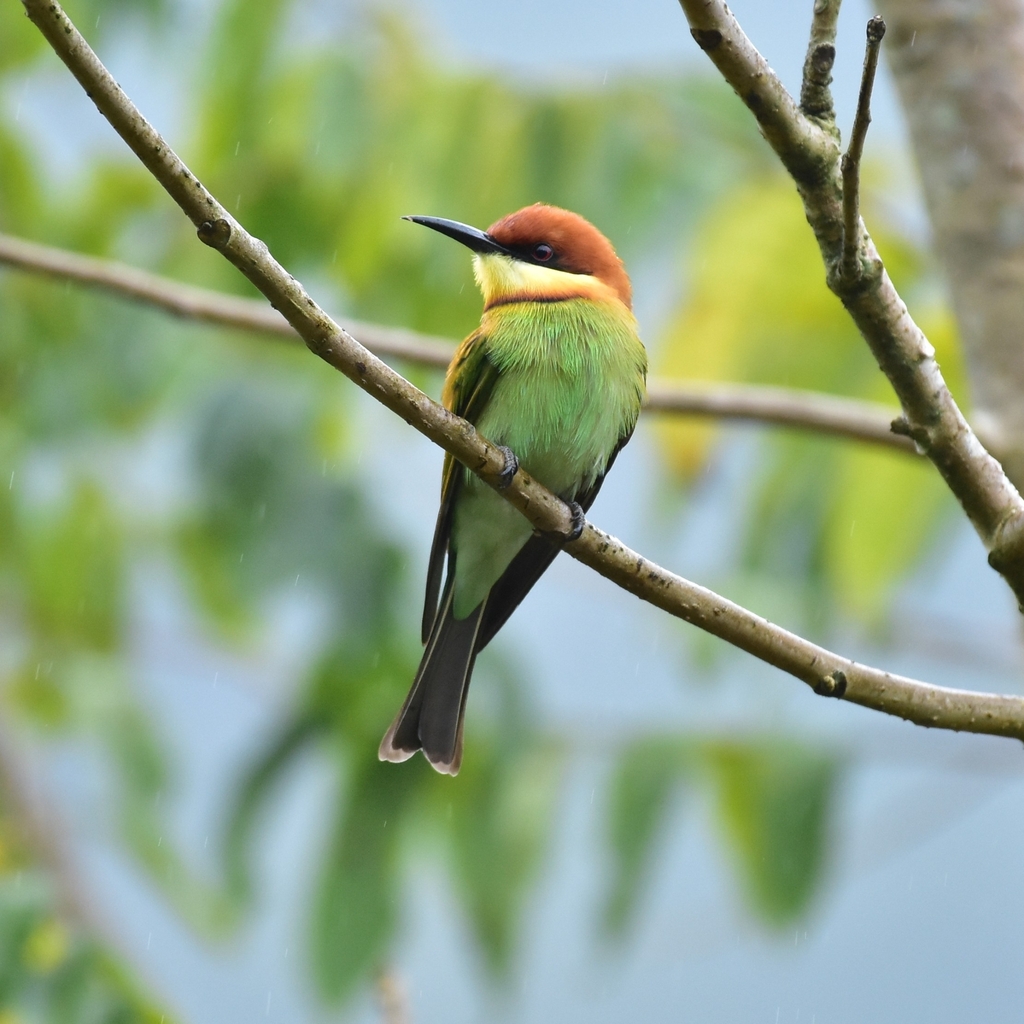
Chestnut-headed Bee-eater
Photo © Renjith Jacob Mathews
Photo © Renjith Jacob Mathews — CC BY 4.0 — Source: iNaturalist #144539496Identification
The Chestnut-headed Bee-eater is a small, richly coloured bird measuring 18–20 cm in length. Its most distinctive feature is its bright chestnut crown, nape, and ear-coverts, which contrast beautifully with its predominantly green plumage. The rump and upper tail coverts are pale shining blue, while the face, chin, and throat are yellow, marked by a thin black eye stripe. A broad chestnut band extends across the lower throat and sides of the neck, followed by a striking black gorget and ill-defined yellow band on the breast. The remainder of the underparts are green, tinged with blue on the vent and undertail coverts. This species has a thin, curved black bill and distinctive red iris. The sexes are alike, though juveniles are noticeably duller, with green (rather than chestnut) on the forehead and forecrown, and a more subdued overall appearance. Unlike most bee-eaters, it lacks the elongated central tail feathers characteristic of many relatives.
Range & Habitat
The Chestnut-headed Bee-eater is found across the Indian subcontinent and Southeast Asia, with its range extending from India, Bangladesh, and Sri Lanka through Indochina and the Malay Peninsula to Indonesia, including Sumatra, Java, Bali, and the Andaman Islands. Three subspecies are recognized, with the nominate race occupying the mainland and Sri Lanka, while quinticolor is restricted to the southern Sunda Islands, and andamanensis inhabits the Andamans.
This species breeds in subtropical open woodland, showing a preference for highland areas where it is most commonly encountered. Its affinity for elevation and open terrain makes it a characteristic bird of foothill and mountain regions throughout its range.
Behaviour & Diet
Chestnut-headed Bee-eaters are gregarious birds, feeding and roosting communally in small groups. They typically nest in colonies, excavating relatively long tunnels in sandy banks where they lay clutches of five to six spherical white eggs. Both parents share incubation and chick-rearing duties, demonstrating strong pair bonds and cooperative breeding behaviour.
As their name suggests, these birds are specialist insectivores, predominantly hunting bees, wasps, and hornets in flight, which they capture with characteristic aerial sorties from open perches. They typically hunt from exposed vantage points, making rapid sallies to snatch prey from the air. Occasionally, they have been observed feeding on fish while flying over water, demonstrating some dietary flexibility.
Best Time & Places to See It
The Chestnut-headed Bee-eater is most readily observed in highland areas of subtropical open woodland throughout its range—particularly in the foothills and mountains of India, Sri Lanka, and Southeast Asia. During the breeding season, colonial nesting sites in sandy banks offer excellent opportunities for observation, as birds are particularly active and visible. The species' gregarious habits mean that sightings often involve multiple individuals, particularly during communal feeding and roosting periods.
Photography Tips
Photographing this colourful bee-eater is rewarding but requires patience and proper technique. Position yourself near active perches where birds make their hunting sorties—these open vantage points make ideal shooting positions with clean backgrounds. The bird's vibrant plumage—chestnut crown, yellow face, green back, and blue rump—shows best in good light, so aim for early morning or late afternoon shooting when the sun accentuates these colours. Use a fast shutter speed to capture birds in flight during their aerial insect-catching dives. When photographing colonies at nesting sites, approach carefully to avoid disturbing breeding birds, and be prepared for sudden flight as these swift, agile birds move quickly between perches.
Lunugamvehera National Park
Sri Lanka
+204 birds+14 mammals
Dry scrubland and shallow wetlands converge in Sri Lanka's southeastern lowlands, where Lunugamvehera National Park anchors one of the island's most ecologically vital landscapes. The park's…
VIEW NATIONAL PARKMinneriya National Park
Sri Lanka
+158 birds+9 mammals
Across the dry zone of Sri Lanka's North Central Province spreads a landscape of shallow tanks, grassland margins, and scattered dry forest—a mosaic of water and…
VIEW NATIONAL PARKWasgamuwa National Park
Sri Lanka
+156 birds+8 mammals
Dry deciduous forest and open grassland sweep across the North Central lowlands where Wasgamuwa National Park protects one of Sri Lanka's largest remaining tracts of this…
VIEW NATIONAL PARKLangtang National Park
Helambu, Nepal
+364 birds+14 mammals
Where the southern slopes of the Himalayan highlands descend toward the subtropical valleys of central Nepal, Langtang National Park sprawls across one of the subcontinent's most…
VIEW NATIONAL PARKOrang National Park
Rangagarapathar, India
+298 birds+1 mammals
Where the Brahmaputra's floodplains meet the foothills of Assam, Orang National Park unfolds across a mosaic of riverine grasslands, forests and wetlands that pulse with the…
VIEW NATIONAL PARKGangotri National Park
Bhatwari, India
+119 birds+1 mammals
Where the Bhagirathi River carves through the western Himalayas in northern Uttarakhand, Gangotri National Park rises across steep alpine terrain that defines the boundary between temperate…
VIEW NATIONAL PARKEravikulam National Park
Devikulam, India
+192 birds+7 mammals
High in the Western Ghats of Kerala, where monsoon mists cling to slopes that rise above 2,000 metres, Eravikulam National Park preserves one of South India's…
VIEW NATIONAL PARKHat Noppharat Thara-Mu Ko Phi Phi National Park
Ao Nang, Thailand
+253 birds+9 mammals
Where limestone karsts rise dramatically from turquoise waters, Hat Noppharat Thara-Mu Ko Phi Phi National Park unfolds across a mosaic of beach, mangrove forest, and island…
VIEW NATIONAL PARKKhao Yai National Park
Prachantakham District, Thailand
+377 birds+46 mammals
Evergreen dipterocarp forest blankets the rolling terrain of this national park in eastern Thailand, where limestone hills rise abruptly from the forest floor and seasonal streams…
VIEW NATIONAL PARKMu Ko Similan National Park
Lam Kaen, Thailand
+82 birds+1 mammals
Granite islands rise from the Andaman Sea in a scattered archipelago where limestone cliffs meet turquoise shallows, their steep faces weathered into caves and overhangs that…
VIEW NATIONAL PARKKhao Laem National Park
Sangkhla Buri District, Thailand
+197 birds
Where the Vajiralongkorn Reservoir sprawls across the forested valleys of Kanchanaburi's northern borderlands, Khao Laem National Park protects a landscape where limestone ridges rise dramatically from…
VIEW NATIONAL PARKKanha Tiger Reserve
Kanha Kisli F.V., India
+321 birds+23 mammals
Where sal forests give way to emerald meadows and crystalline streams carve through ancient valleys, one of India's finest wilderness reserves unfolds across the Maikal Range.…
VIEW NATIONAL PARKTadoba National Park
Palasgaon Singru, India
+270 birds+20 mammals
Where sal forests meet open grasslands and rocky outcrops rise from red laterite soil, central India's landscape unfolds in raw, untamed beauty. Ancient teak woodlands and…
VIEW NATIONAL PARKKaziranga National Park
Kohora, India
+422 birds+26 mammals
Dawn breaks over the floodplains of the Brahmaputra, where tall grasslands stretch endlessly beneath monsoon-heavy skies. This sprawling wilderness of northeastern Assam is a mosaic of…
VIEW NATIONAL PARKPeriyar National Park
Mlappara, India
+232 birds+4 mammals
Dawn breaks over mist-shrouded ridges where the Western Ghats tumble toward Kerala's spice-scented lowlands. Here, ancient tropical forests envelope a glittering artificial lake, creating a mosaic…
VIEW NATIONAL PARKPampadum Shola National Park
Vattavada, India
+258 birds+14 mammals
Where misty shola forests cling to the high plateaus of the Nilgiri Mountains, ancient evergreen remnants create a world apart. This 2,316-hectare reserve protects one of…
VIEW NATIONAL PARKBandipur National Park
Hirehalli, India
+302 birds+19 mammals
Where the Western Ghats descend into the Deccan plateau, ancient deciduous forests blanket a landscape carved by the Nugu River. Bandipur unfolds across 880 square kilometres…
VIEW NATIONAL PARKNagarahole Tiger Reserve
Nalkeri Forest, India
+323 birds+23 mammals
Where granite escarpments rise above dense deciduous forests and the Kabini River carves through pristine wilderness, one of India's most biodiverse landscapes unfolds across the Western…
VIEW NATIONAL PARKTaman Negara National Park
Kampong Samas, Malaysia
+393 birds+48 mammals
Where ancient rainforest meets limestone peaks, one of Southeast Asia's oldest protected wilderness preserves sprawls across 4,343 square kilometers of primordial landscape. Dipterocarp giants tower overhead,…
VIEW NATIONAL PARKPenang National Park
Balik Pulau, Malaysia
+107 birds+2 mammals
Granite peaks rise abruptly from the Andaman Sea where tropical rainforest clings to steep slopes in one of Malaysia's oldest protected landscapes. Mangrove forests fringe the…
VIEW NATIONAL PARKTaman Nasional Baluran
Situbondo, Indonesia
+189 birds+9 mammals
Across the northeastern tip of East Java, where monsoon winds sweep down from the Bali Strait, a landscape of contrasts unfolds within 374 square kilometres of…
VIEW NATIONAL PARKTaman Nasional Meru Betiri
Jember, Indonesia
+93 birds+1 mammals
Across East Java's southeastern coast, where the Indian Ocean meets a landscape of volcanic soils and monsoon-fed forests, sprawls a national park that epitomizes the ecological…
VIEW NATIONAL PARKWest Bali National Park
Gerokgak, Indonesia
+240 birds+8 mammals
Across West Bali's northwestern reaches, where the Indian Ocean meets volcanic slopes and limestone cliffs plunge toward turquoise shallows, sprawls a protected realm of roughly 325…
VIEW NATIONAL PARKMount Merapi National Park
Hargobinangun, Indonesia
+150 birds+3 mammals
Where the volcanic slopes of central Java rise into mist and montane forest, Mount Merapi National Park guards one of Indonesia's most dynamic landscapes. Spanning roughly…
VIEW NATIONAL PARKGaoligong Mountain National Nature Reserve
Nujiang Lisu Autonomous Prefecture, China
+443 birds+13 mammals
VIEW NATURE RESERVENo community photos yet. Log in to add the first one.
No community observations of this species yet.