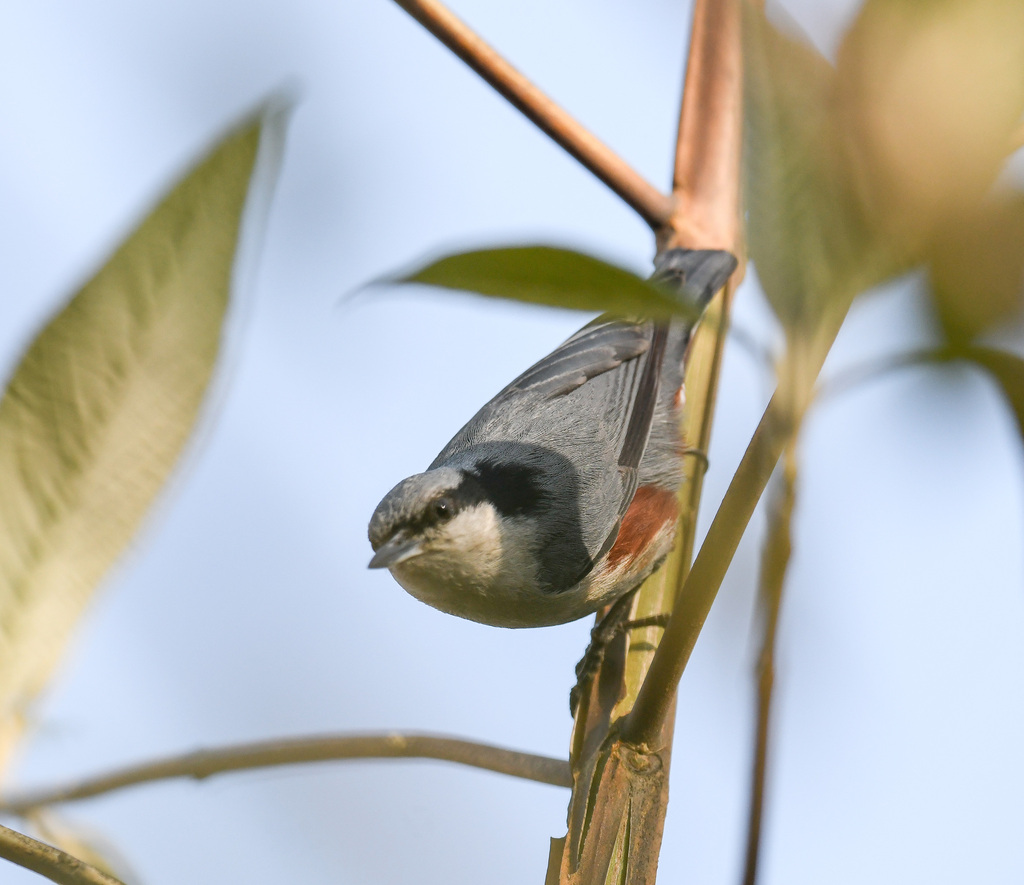
Chestnut-vented Nuthatch
Photo © Rejoice Gassah
Photo © Rejoice Gassah — CC BY 4.0 — Source: iNaturalist #304402645Identification
The Chestnut-vented Nuthatch is a medium-sized nuthatch measuring 12.5–14 cm in length. It is readily identified by its solid blue-grey upperparts contrasting with a marked black loral stripe running from the lore to the base of the wing. The underparts are uniformly pale grey to buff, depending on the subspecies, with the most distinctive feature being brick-red flanks that stand out sharply against the paler belly. The undertail coverts are white with a rufous border. Males show deeper brick-red flanks, while females are more rufous and have duller overall plumage. The species exhibits no other marked sexual dimorphism, though juveniles tend to be more buff-toned than adults.
Range & Habitat
The Chestnut-vented Nuthatch is found across a broad swath of Asia, from northeastern India and parts of Tibet through south-central China, descending into eastern Myanmar and northwestern Thailand. Isolated populations also occur in southern Laos and Vietnam. Three subspecies are recognized, with distribution varying across montane and lowland regions of this range.
This species primarily inhabits evergreen and pine forests, though it readily adapts to mixed and deciduous woodlands. It occurs in subtropical and tropical moist lowland forests as well as subtropical and tropical moist montane forests. Altitudinal distribution is variable across its range but extends from 915 to 4,570 metres, with populations occupying different elevations according to local geography.
Behaviour & Diet
The ecology of the Chestnut-vented Nuthatch remains poorly known, but the species likely feeds on small arthropods and seeds, typical of its family. It produces various calls, some resembling a wren alarm call, and its distinctive song is a monotonous, stereotypical crackle typically described as chichichichi.
The breeding season commences between March and May. Nests are typically constructed in holes in tree trunks, and clutches contain two to five eggs. Like other members of the europaea group, this species builds mud entrances to its nests, a characteristic feature shared with the Kashmir and Eurasian nuthatches.
Best Time & Places to See It
The Chestnut-vented Nuthatch is best sought during the breeding season from March to May, when birds are most active and vocal. The species has a relatively wide range across northeastern India, Tibet, China, Myanmar, Thailand, Laos, and Vietnam, offering multiple opportunities for observation. Suitable habitat in montane evergreen and pine forests within the altitudinal range of 915–4,570 metres should be targeted, though the bird's exact local distribution varies by region.
Photography Tips
Photographers should look for this nuthatch in mixed and evergreen forests, particularly in montane areas. The striking contrast between blue-grey upperparts and brick-red flanks makes this species visually distinctive and rewarding to photograph. Early morning hours during the breeding season are likely to yield the best results, as birds will be more active and vocal. The species' small size—just 12.5–14 cm—requires patience and a good telephoto lens to capture fine plumage details and the characteristic black loral stripe.
Giant Panda National Park
Mianyang, China
+447 birds+47 mammals
Where the eastern slopes of China's Sichuan plateau descend into cloud-wrapped valleys, one of Asia's most biodiverse landscapes unfolds across more than 350,000 square kilometres. This…
VIEW NATIONAL PARKJiuzhai Valley
Jiuzhaigou County, China
+226 birds+7 mammals
Where crystalline alpine streams cascade through limestone gorges and karst terrain rises in dramatic vertical walls, Jiuzhai Valley unfolds across nearly 1,300 square kilometers of southwestern…
VIEW NATURAL MONUMENTWuyishan National Park
Yanshan County, China
+141 birds+2 mammals
Where subtropical monsoon rains sustain a perpetually humid landscape, Wuyishan National Park rises from Fujian's eastern plateau as a realm of forested ridges, cascading streams, and…
VIEW NATIONAL PARKWolong National Nature Reserve
Wenchuan County, China
+333 birds+17 mammals
Where the Qingyi River cuts through the eastern flanks of the Minshan Range, a temperate montane forest cloaks steep valleys in dense canopy that thins dramatically…
VIEW NATURE RESERVEGaoligong Mountain National Nature Reserve
Nujiang Lisu Autonomous Prefecture, China
+443 birds+13 mammals
VIEW NATURE RESERVEBaima Snow Mountain National Nature Reserve
Diqing Tibetan Autonomous Prefecture, China
+204 birds+3 mammals
High-altitude ridges and steep-sided valleys define this reserve in northwestern Yunnan, where elevations surge from around 3,000 metres to peaks above 4,100 metres. The terrain supports…
VIEW NATURE RESERVENo community photos yet. Log in to add the first one.
No community observations of this species yet.