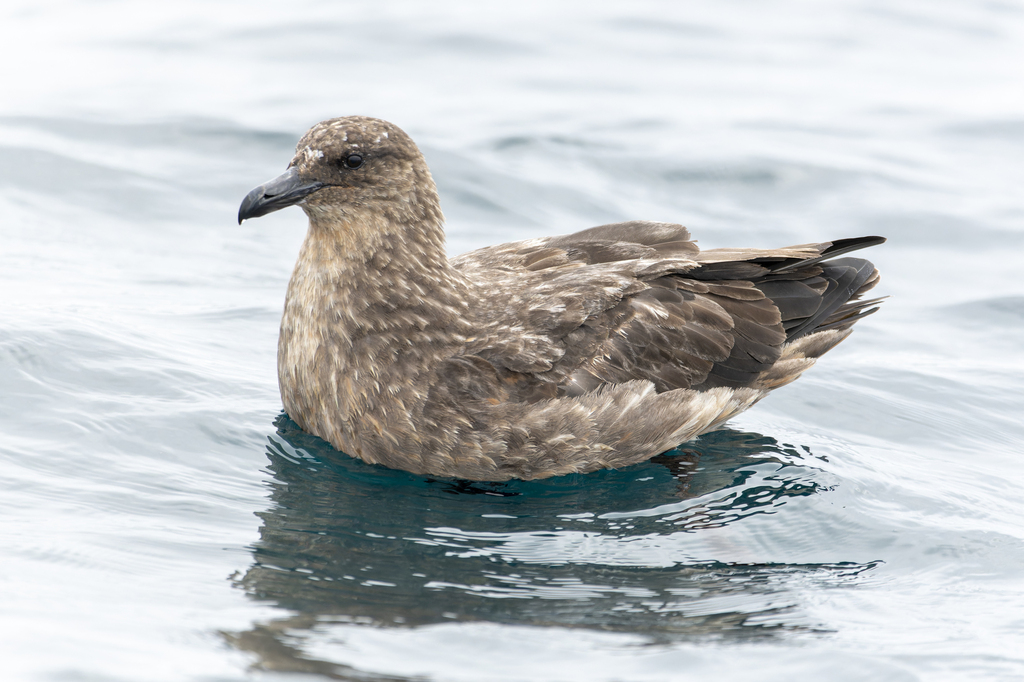
Chilean Skua
Photo © David F. Belmonte
Photo © David F. Belmonte — CC BY 4.0 — Source: iNaturalist photo #317114496Identification
The Chilean skua is a large, distinctive predatory seabird with a wingspan of 130 to 138 centimetres. Its most striking feature is a dark cap that contrasts sharply with a cinnamon-coloured throat and lower face, along with prominent pale gold streaking on the face and neck. The bird's back, flanks, and cheeks are dark, while the underside is uniformly light, often with a dark pectoral collar extending from the back across the upper chest. The underside of the wings is characteristically cinnamon-coloured, though this may appear dull in some individuals. Adults have black legs, brown irises, and a small bluish bill with a dark tip. Juveniles are brighter-coloured than adults, with no light streaking, though they retain the strong cap. The Chilean skua appears notably more slender and compact in flight compared to the similar Falkland skua, with which it can be confused.
Range & Habitat
The Chilean skua is endemic to South America, occupying coastal habitats from central Peru to northern Argentina. It nests along the coasts between southern Chile and Cape Horn in Argentina, though its wintering range extends considerably northward into Brazil, where it exploits tropical coastal waters. Breeding adults show a strong preference for sandy coastline with beached kelp and freshwater streams. The species is also notably associated with southern hake fisheries in the fjords and channels of southern Chile, where fishing activity provides feeding opportunities. Interestingly, hybrids between the Chilean skua and the Falkland skua are known from southern Argentina where their ranges overlap.
Behaviour & Diet
Chilean skuas are highly opportunistic and adaptable feeders, consuming fish, other seabirds, scraps, and carrion. They are known to scavenge penguin meat and dumpster food, and actively steal fish from other seabirds. Their prey includes imperial cormorants, sooty shearwaters, blue petrels, white-chinned petrels, and Magellanic diving petrels, as well as the eggs and chicks of black-browed and grey-headed albatrosses. They also hunt larger prey including geese, cormorants, nutria, and seals, and consume crustaceans and barnacles. At breeding colonies, Chilean skuas are notably aggressive, with nesting parents attacking intruders from above—sometimes discharging excrement onto perceived threats. Intruders of the same species respond by faking leg injuries to signal submission. Their vocalisations are poorly documented, but at breeding colonies they perform a distinctive long-call consisting of ten to twelve short nasal barks described as almost goose-like in its deep, hoarse quality.
Best Time & Places to See It
The best time to observe Chilean skuas is during the Southern Hemisphere breeding season, from November to February or March, when they aggregate into colonies along sandy coasts. Key locations include coastal areas of southern Chile and Argentina, particularly around Cape Horn and the fjords and channels of southern Chile. The species is most reliably encountered in these breeding colonies, where birds concentrate in sandy coastal habitats. During non-breeding months, individuals disperse across a wider range extending north to Brazil and Peru, making them less predictable but still possible to spot along South American coasts.
Photography Tips
Photographing Chilean skuas presents excellent opportunities during the breeding season when birds are concentrated and active in colonies. Look for their distinctive dark cap and cinnamon facial markings, which provide strong compositional elements. In-flight photography is particularly rewarding, as the species' slender, compact silhouette and cinnamon wing undersides are diagnostic field marks. Capture their aggressive breeding behaviour, including the characteristic attack displays from above. Early morning light will best highlight the pale gold streaking on the face and neck and the contrast between the dark cap and lighter throat. Be aware that breeding birds are highly defensive—photograph from a safe distance and exercise caution, as they are known to discharge faeces on intruders.
Chile: Fuegian Snipe & Juan Fernandez
Peixe National Park Lagoon
Brazil
+293 birds+4 mammals
Where the coastal plains of Rio Grande do Sul meet the Atlantic, Peixe National Park Lagoon sprawls across nearly 2,200 square kilometres of shallow waters, reed…
VIEW NATIONAL PARKSuperagui National Park
Brazil
+246 birds+2 mammals
Where the Atlantic rainforest meets the subtropical coast of Paraná, Superagui National Park sprawls across more than 1,000 square kilometres of one of Brazil's most biodiverse…
VIEW NATIONAL PARKChiloé National Park
Dalcahue, Chile
+122 birds+6 mammals
Temperate rainforest cloaks the Chiloé archipelago's northwestern reaches, where granite ridges thrust through dense, moisture-laden canopy and freshwater streams carve ravines toward the Pacific. Across approximately…
VIEW NATIONAL PARKCabo de Hornos National Park
Cape Horn, Chile
+88 birds+9 mammals
Where the Andes plunge into the Southern Ocean and the Drake Passage churns between two continents, Cabo de Hornos National Park sprawls across one of Earth's…
VIEW NATIONAL PARKPan de Azúcar National Park
Chañaral, Chile
+74 birds+4 mammals
Where the Atacama Desert plunges toward the Pacific, Pan de Azúcar National Park sprawls across 727 square kilometres of one of Earth's most extreme transitions—a landscape…
VIEW NATIONAL PARKTorres del Paine National Park
Torres del Paine, Chile
+143 birds+10 mammals
Where granite spires pierce the Patagonian sky, Torres del Paine commands one of South America's most dramatic landscapes. Across 4,106 square kilometres of southern Chile, jagged…
VIEW NATIONAL PARKReserva Nacional Magallanes
Punta Arenas, Chile
+78 birds+2 mammals
Where windswept steppe meets sub-Antarctic forest near the southern tip of continental South America, Reserva Nacional Magallanes unfolds across roughly 352 square kilometres of profound ecological…
VIEW NATIONAL PARKMonte León National Park
Argentina
+100 birds+4 mammals
Where the Patagonian steppe meets the Atlantic, Monte León National Park protects a landscape of windswept coastal cliffs, rocky outcrops, and semi-arid grassland spanning over 1,200…
VIEW NATIONAL PARKArchipiélago Juan Fernández National Park
San Juan Bautista, Chile
+31 birds+2 mammals
Granite peaks rise abruptly from the South Pacific off the Chilean coast, their weathered slopes studded with native woodland and sweeping down to coves where seabirds…
VIEW NATIONAL PARKNo community photos yet. Log in to add the first one.
No community observations of this species yet.