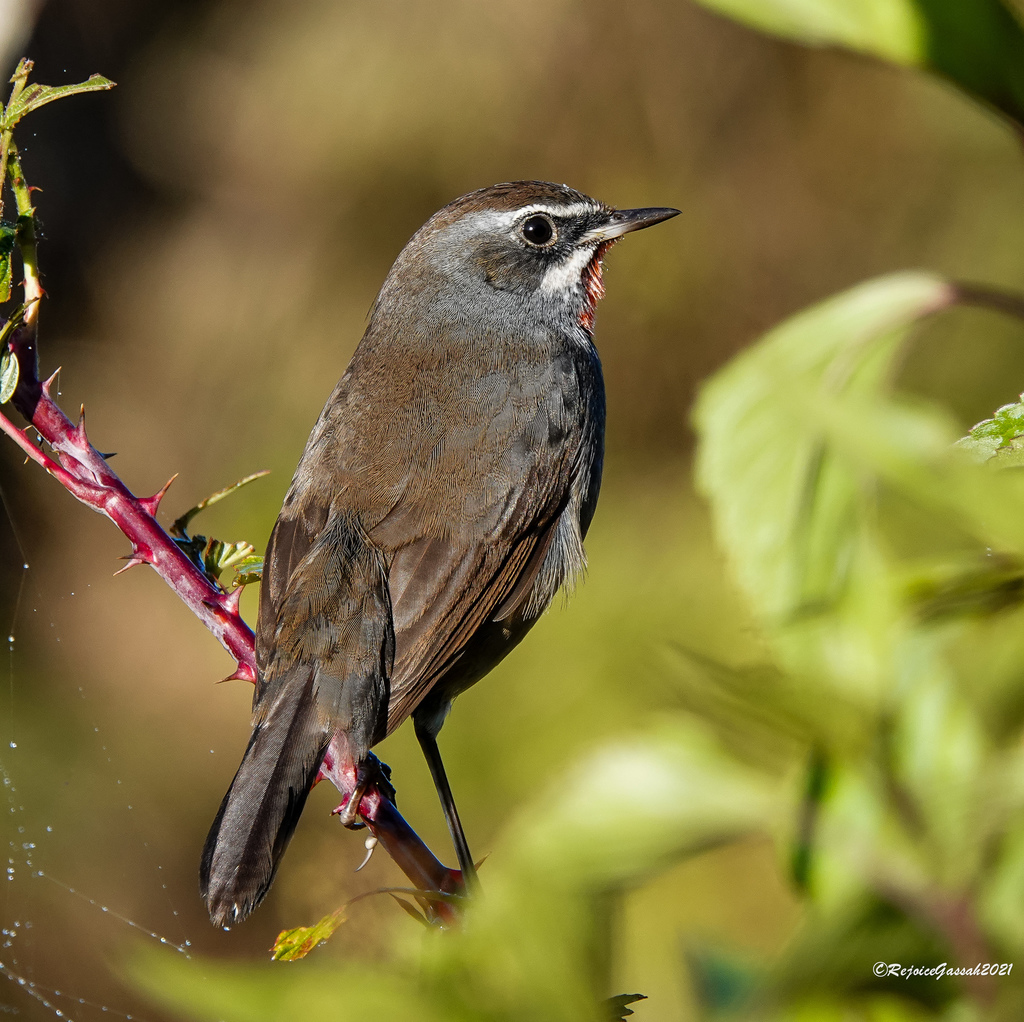
Chinese Rubythroat
Photo © Rejoice Gassah
Photo © Rejoice Gassah — CC BY 4.0 — Source: iNaturalist #104804930Identification
The Chinese rubythroat is a small, striking passerine that displays pronounced sexual dimorphism. Males are immediately recognizable by their slaty-brown upperparts contrasted with a distinctive white forehead and supercilium. The most striking feature is the scarlet centre of the chin and throat, surrounded by black on the sides of the throat and breast; each black feather is narrowly fringed with grey. The blackish tail bears characteristic white bases and tips—a key distinction from the closely related Siberian rubythroat. The belly and vent are white, and the wings are brownish. Females are considerably duller, with brownish-grey upperparts, a diffuse supercilium, and smoky underparts. The female's throat is whitish with a short moustachial stripe, lacking the male's striking ruby gorget.
Range & Habitat
The Chinese rubythroat is found across Central Asia and the Indian subcontinent, ranging from Pakistan and the Himalayan ranges eastward through Nepal, Bhutan, India, Bangladesh, Myanmar, and into Thailand, with populations also occurring in Russia. The species exhibits altitudinal migration, moving to higher elevations and northward during summer breeding season, and retreating to lower elevations southward during winter months. It breeds along the edge of the Tibetan plateau and winters to the south, from Nepal across to Assam.
The bird favours open woodland and scrub habitats. In the Tien Shan region, it is found in juniper elfin thickets at altitudes between 2500 to 2700 metres on gently sloping terrain. During breeding season, nests are constructed in shrubs near dense stands of trees, sometimes on the ground within dense tussocks.
Behaviour & Diet
Despite their vibrant appearance, Chinese rubythroats are shy birds, typically observed singly or in pairs during the breeding season, though they occasionally perch in the open. They are insectivorous, feeding primarily on small insects including beetles and ants. During breeding season, males are vocal performers, singing through daylight hours from exposed perches; their song consists of squeaky notes with considerable variation. Females produce an upward-inflected whistle preceded by short, gruff notes, while both sexes employ a sharp yapping "skyap" alarm call.
Breeding occurs in summer, with females constructing loosely woven, ball-like nests with side entrances, though some are cup-shaped with open tops. Clutches typically contain 4 to 6 greenish-blue eggs marked with rusty dots forming a ring near the broad end. Incubation lasts approximately 14 days and is performed mainly by the female, while both parents feed nestlings after they hatch. Young fledge after about 16 days, sustained primarily on hairy caterpillars foraged near the nest. The species faces predation from martens and stoats, and has been observed abandoning nests parasitized by common cuckoos.
Best Time & Places to See It
Summer is the optimal season for observing Chinese rubythroats at their breeding grounds along the Tibetan plateau edge and in mountain regions of the central and eastern Himalayas. Visitors to Nepal, Bhutan, and the Indian hill stations of Assam during the breeding season have the best chances of encounters. The birds favour juniper elfin thickets and open woodland scrub at higher elevations. Winter observations are possible at lower elevations across their southern range, from Nepal to Assam, though they remain generally shy and less conspicuous during this season.
Photography Tips
Photographing the Chinese rubythroat presents rewarding challenges. Males in breeding plumage offer striking subjects, particularly when singing from exposed perches during daylight hours—position yourself to capture the brilliant scarlet throat against the dark breast and pale belly. Early morning during breeding season yields the most vocal and active males. The distinctive white tail bases and tips are diagnostic features worth documenting. Exercise patience and use long lenses, as these are shy birds; approaching too closely will cause them to retreat into scrub. Overcast days provide better light for capturing the deep red gorget without harsh shadows. Focus on the head and throat region to showcase the species' most distinctive markings.
Giant Panda National Park
Mianyang, China
+447 birds+47 mammals
Where the eastern slopes of China's Sichuan plateau descend into cloud-wrapped valleys, one of Asia's most biodiverse landscapes unfolds across more than 350,000 square kilometres. This…
VIEW NATIONAL PARKJiuzhai Valley
Jiuzhaigou County, China
+226 birds+7 mammals
Where crystalline alpine streams cascade through limestone gorges and karst terrain rises in dramatic vertical walls, Jiuzhai Valley unfolds across nearly 1,300 square kilometers of southwestern…
VIEW NATURAL MONUMENTHuanglong Scenic and Historic Interest Area
Ngawa Tibetan and Qiang Autonomous Prefecture, China
+194 birds+7 mammals
Across the high plateau of northwestern Sichuan, a geological wonder unfolds where limestone terraces and mineral-rich springs have sculpted one of China's most distinctive natural monuments.…
VIEW NATURAL MONUMENTKaziranga National Park
Kohora, India
+422 birds+26 mammals
Dawn breaks over the floodplains of the Brahmaputra, where tall grasslands stretch endlessly beneath monsoon-heavy skies. This sprawling wilderness of northeastern Assam is a mosaic of…
VIEW NATIONAL PARKSanjiangyuan National Park
Nagqu, China
+187 birds+25 mammals
Where the headwaters of three great Asian rivers emerge from a high alpine plateau, the landscape unfolds in tundra and dwarf shrubland—a world of austere beauty…
VIEW NATIONAL PARKWolong National Nature Reserve
Wenchuan County, China
+333 birds+17 mammals
Where the Qingyi River cuts through the eastern flanks of the Minshan Range, a temperate montane forest cloaks steep valleys in dense canopy that thins dramatically…
VIEW NATURE RESERVEQinghai Lake National Nature Reserve
Hainan Tibetan Autonomous Prefecture, China
+243 birds+11 mammals
At 3,200 metres above sea level on the Tibetan plateau, where winter temperatures plunge far below freezing and snow blankets the landscape for half the year,…
VIEW NATURE RESERVEBaima Snow Mountain National Nature Reserve
Diqing Tibetan Autonomous Prefecture, China
+204 birds+3 mammals
High-altitude ridges and steep-sided valleys define this reserve in northwestern Yunnan, where elevations surge from around 3,000 metres to peaks above 4,100 metres. The terrain supports…
VIEW NATURE RESERVENo community photos yet. Log in to add the first one.
No community observations of this species yet.