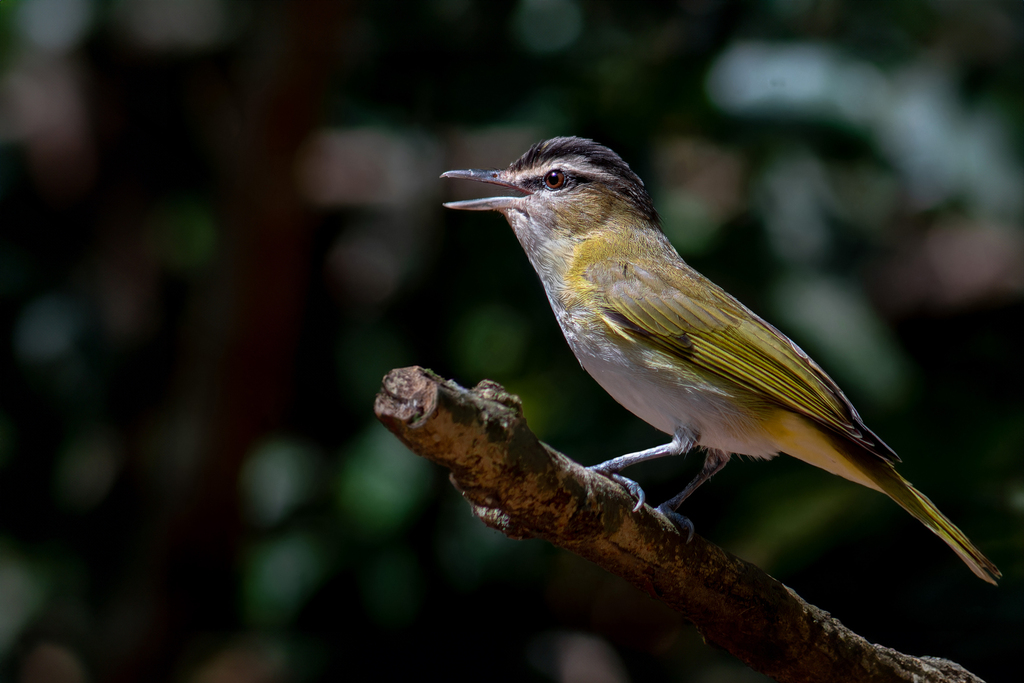
Chivi Vireo
Photo © Enéas V. Gouvêa Junior
Photo © Enéas V. Gouvêa Junior — CC BY-SA 4.0 — Source: iNaturalist photo #569823981Identification
The Chivi Vireo is a small songbird measuring 12–14 cm in length, easily recognized by its distinctive plumage pattern. Adults display a medium gray crown with well-defined borders, a whitish supercilium (eyebrow stripe) extending over the ear coverts, and dull gray lores. The upperparts are dull olive-green, while the underparts are off-white to grayish-white, with a greenish tinge on the flanks and sides of the breast. The undertail coverts are notably pale. Juveniles show brownish or tawny upperparts (depending on subspecies) with less contrasting head patterns than adults. Nine subspecies occur across the range, showing subtle variations in coloration and size; some are brighter yellow-green while others are duller or darker.
Range & Habitat
The Chivi Vireo is found throughout most of northern, eastern, and central South America, with its range notably absent only from southern Chile and southern Argentina. This adaptable species inhabits multiple habitat types across its range and demonstrates a remarkable ability to adjust to slightly disturbed areas. While the species is mainly resident throughout most of its distribution, at least two subspecies inhabiting the southern portions of the range are known to be migratory, adding complexity to its biogeography.
Behaviour & Diet
The Chivi Vireo is primarily insectivorous, with the majority of its diet composed of arthropods. However, dietary flexibility varies by subspecies—some populations supplement their diet with fruit, and certain subspecies are thought to be nectarivorous. Breeding occurs from May to June or October to January, depending on region and subspecies. The species constructs cup nests and typically lays clutches of 2–4 eggs. Females alone incubate the eggs, which take 10–16 days to hatch, while nestlings require 10–13 days to fully develop.
Best Time & Places to See It
Timing your search depends on the specific subspecies and location within the bird's South American range. In migratory populations of the southern range, breeding season offers the best opportunities for observation, while resident populations can be encountered year-round. The species' adaptability to disturbed habitats means it can sometimes be found in modified landscapes rather than pristine forest, making it accessible in various locations across its broad distribution from the Amazon Basin to central Argentina.
Photography Tips
The Chivi Vireo's small size and subtle plumage require patience and attention to detail. Look for the distinctive whitish supercilium and gray crown as key field marks in your viewfinder. The pale undertail coverts and the contrast between the gray-brown wing coverts edged with olive-green provide helpful compositional elements. Since the species frequents various habitat types including slightly disturbed areas, you may encounter it in more accessible locations than strictly forest-dependent species. Early morning is typically productive for vireo photography, as the birds are more active and vocal at this time. Use a fast shutter speed to freeze movement among foliage, and focus on capturing the head pattern, which contains the most diagnostic features for this species.
Amacayacu National Park
Amazônia National Park
Anavilhanas National Park
Araucárias National Park
Bahuaja Sonene National Park
Baritú National Park
Brasília National Park
Calilegua National Park
Campos Amazónicos National Park
Nothing matches these filters.
No community photos yet. Log in to add the first one.
No community observations of this species yet.