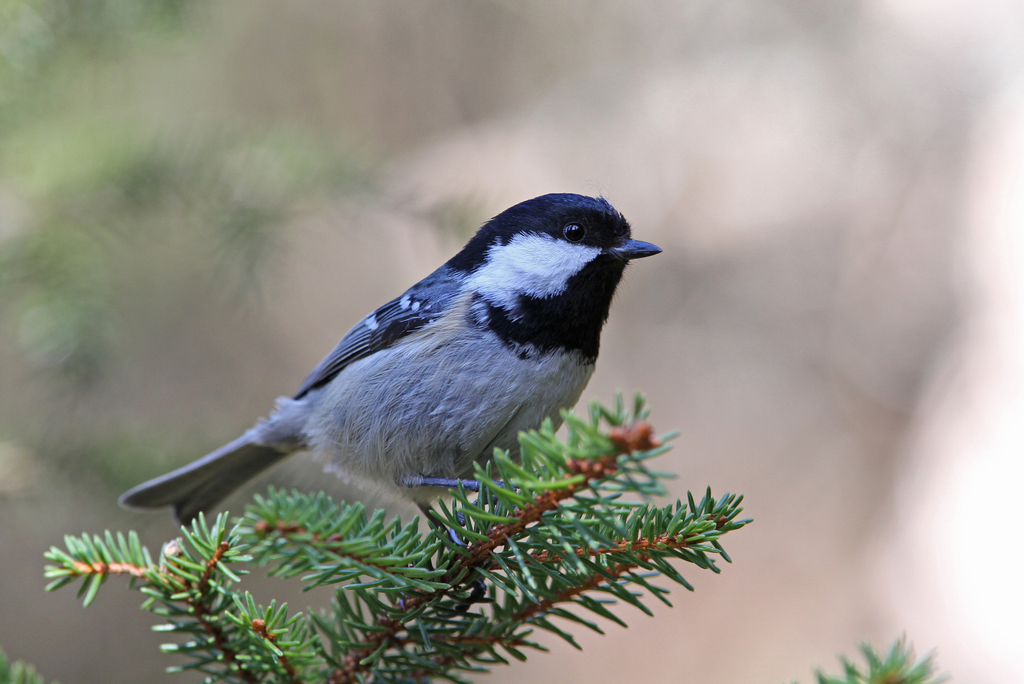
Coal Tit
Photo © Christoph Moning
Photo © Christoph Moning — CC BY 4.0 — Source: iNaturalist photo #92103896Identification
The coal tit is a small passerine measuring 10–11.5 cm in length, making it a compact woodland bird with distinctive markings. Its most striking feature is a brilliant white nape spot set against a glossy blue-black head, throat, and neck. The face is off-white with grey or yellowish tinges depending on subspecies, creating a subtle contrast with the darker crown. Two white wingbars formed by the white tips of the wing coverts are another key identification feature, visible both at rest and in flight.
The underparts are whitish overall, shading to buff or rufous on the flanks. The coal tit has a black bill, lead-coloured legs, and dark brown eyes. Juvenile birds display duller plumage than adults. Across its vast range, 21 subspecies show considerable variation in coloration; some have olive-tinged backs while others appear bluish-grey, and underpart colouration ranges from pure white to deep buff depending on geographic origin.
Range & Habitat
The coal tit is a widespread and common resident breeder throughout the temperate to subtropical Palearctic, with its range extending from western Europe through to northeastern China and Japan. Its distribution includes Great Britain, Ireland, continental Europe, North Africa (including Morocco and northern Algeria), the Mediterranean islands, the Caucasus, Iran, the Himalayas, and much of Asia. The species shows remarkable adaptability, occupying forests across this enormous geographic range and elevation gradient.
These birds are year-round residents in most of their range, preferring coniferous and mixed forests where they can forage and breed. Their presence across such diverse habitats—from Mediterranean uplands to Himalayan montane forests to Far Eastern coniferous woodlands—demonstrates their ecological flexibility and hardiness.
Behaviour & Diet
Coal tits are active, acrobatic foragers typical of the tit family, constantly moving through foliage and branches in search of food. Their behaviour and vocalisations are consistent across their range, which is notable given the significant plumage variation among subspecies. This behavioural uniformity is so pronounced that the formerly distinct black-crested tit of South Asia has recently been reclassified as a subspecies of the coal tit, based partly on similarities in behaviour and calls alongside genetic evidence.
Best Time & Places to See It
Coal tits are year-round residents throughout their range, making them accessible to birdwatchers and wildlife photographers in any season. They are most easily observed in coniferous and mixed forests, where they are common and widespread. Their small size and active foraging behaviour make them rewarding to watch, though patience is required to follow their rapid movements through the canopy.
Photography Tips
The coal tit's bold head markings and distinctive white nape spot provide excellent subjects for photography. Focus on capturing the glossy blue-black head contrasting with the brilliant white nape and the two white wingbars—these features define the species and make for striking images. The bird's constant activity through branches and foliage means photographers should be prepared for quick movements and partially obscured views. Look for moments when the bird pauses on exposed perches, and try to position yourself with light catching the white nape spot and wing detail to best effect.
Abruzzo, Lazio and Molise National Park
Aggtelek National Park
Alpilles Regional Nature Park
Alta Murgia National Park
Altai Tavan Bogd National Park
Appennino Lucano Val d’Agri Lagonegrese National Park
Appennino Tosco-Emiliano National Park
Åsnens National Park
Aspromonte National Park
Nothing matches these filters.
No community photos yet. Log in to add the first one.
No community observations of this species yet.