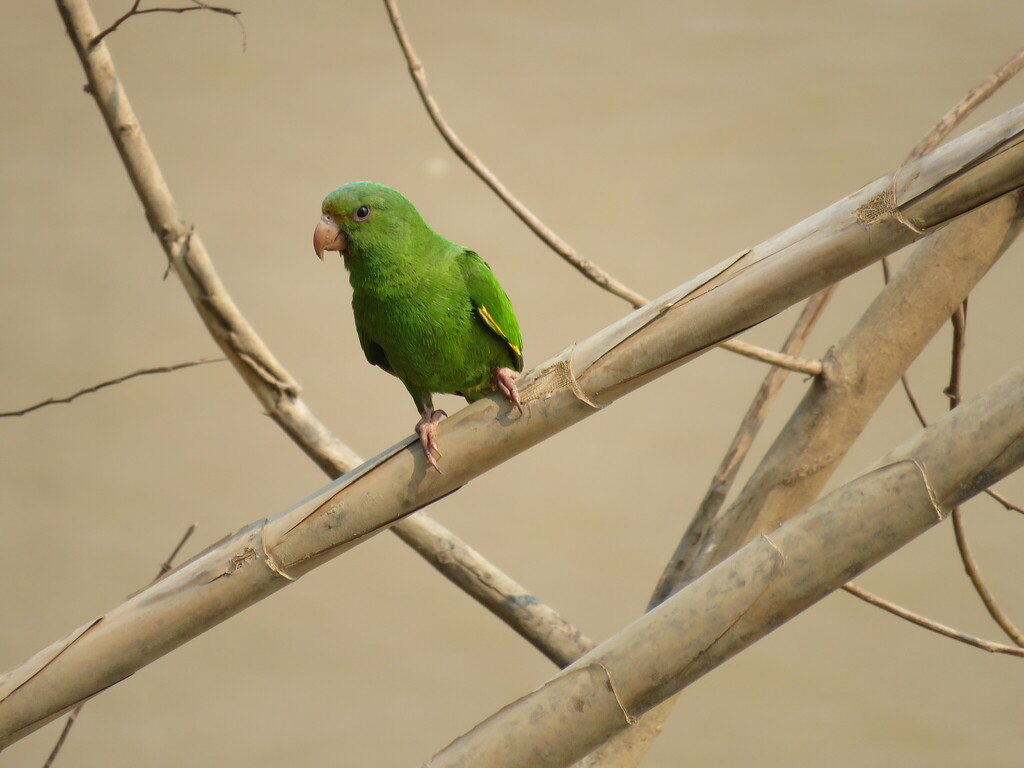
Cobalt-winged Parakeet
Photo © Vincent A. Vos
Photo © Vincent A. Vos — CC BY 4.0 — Source: iNaturalist photo #224497449Identification
The cobalt-winged parakeet is a small parrot, 18–20 cm long and weighing around 67 grams. It is almost entirely green, darker on the upperparts, with distinctive blue flight feathers and blue central tail feathers (the remaining tail feathers are green). The nominate subspecies B. c. cyanoptera features a yellowish forehead, orange chin, and blue tinting on the crown and nape. Immature birds are duller versions of adults. Two other subspecies occur across the range: B. c. gustavi has minimal blue on the head with a yellow carpal edge, while B. c. beniensis is paler overall with similar head markings and yellow carpal edging.
Range & Habitat
This parakeet is found across much of northwestern South America, including Bolivia, Brazil, Colombia, Ecuador, Guyana, Peru, and Venezuela. The three subspecies occupy distinct regions: the nominate form inhabits the upper Amazon Basin from eastern Colombia and southern Venezuela through western Guyana, eastern Ecuador, and Peru into northwestern Bolivia and west-central Brazil; B. c. gustavi is restricted to the upper Huallaga River valley in northern Peru; and B. c. beniensis occupies northeastern and central Bolivia. The species inhabits rainforest edges and interiors, secondary forest, várzea wetlands, savanna, and Llanos, typically at elevations around 1,000 meters, occasionally reaching 1,350 meters.
Behaviour & Diet
Little is known about the cobalt-winged parakeet's foraging technique, though it has been recorded feeding on flowers, fruits, and Cecropia catkins, and also consumes mineral-impregnated soil. The species is believed to be mostly sedentary, though it may make some seasonal elevational movements. Breeding apparently occurs around June and July in western populations, with pairs nesting in tree cavities; captive pairs lay clutches of approximately five eggs that incubate for 24 days.
Vocally, the species is quite active, producing high-pitched "klee" calls, shrill "chree" or "chree-chree" notes both when perched and in flight, along with fast chattering series of "chichichichichi" sounds. When in flocks, birds call simultaneously to create shrill, collective chattering.
Best Time & Places to See It
The cobalt-winged parakeet is common throughout its range with stable populations. The species' preference for rainforest edges, secondary forest, and mixed habitats makes it accessible in many protected areas across the Amazon Basin and adjacent regions. Breeding activity in June and July in western populations may make these months particularly productive for observation. Early mornings are typically best for locating parakeets before they disperse to feed.
Photography Tips
The cobalt-winged parakeet's small size and primarily green plumage demand careful stalking and patience. The blue flight feathers and tail are key identification features but are most visible in flight or when the bird spreads its wings. Position yourself near fruiting trees or flowering plants where birds congregate to feed. Listen for their distinctive high-pitched calls to locate flocks in dense canopy. Early morning light will best reveal the blue and orange markings on the head and chin. A telephoto lens (at least 400mm) is essential given the bird's small size and preference for upper canopy perches.
Ecuador Bird Photography
Nothing matches these filters.
Amacayacu National Park
Bahuaja Sonene National Park
Cordillera Azul National Park
Ichigkat Muja – Cordillera del Cóndor National Park
Llanganates National Park
Manu National Park
Natural Río Puré National Park
Natural Sierra de Chiribiquete National Park
Natural Sierra de la Macarena National Park
Nothing matches these filters.
No community photos yet. Log in to add the first one.
No community observations of this species yet.