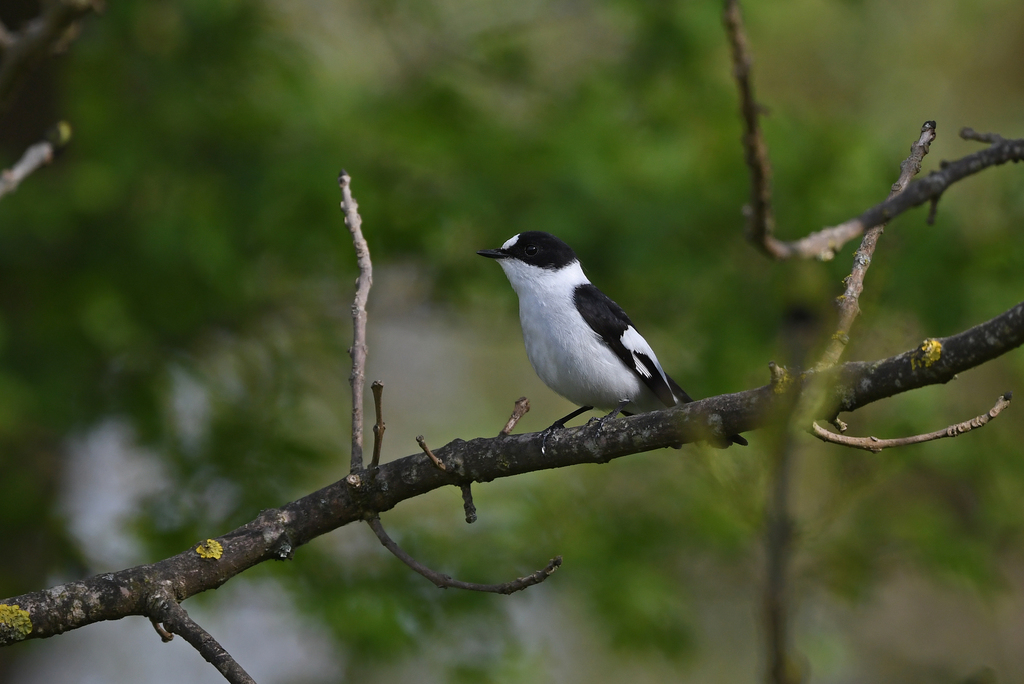
Collared Flycatcher
Photo © Julia Moning
Photo © Julia Moning — CC BY 4.0 — Source: iNaturalist photo #192245613Identification
The collared flycatcher is a small passerine measuring 12–13.5 cm in length. Breeding males are striking: mainly black above and white below, with a distinctive white collar, large white wing patch, black tail (some males show white on the tail sides), and a prominent white forehead patch. They also display a pale rump. The bill is black with the broad, pointed shape typical of aerial insectivores. Non-breeding males, females, and juveniles are much duller, with pale brown replacing the black markings, making them difficult to distinguish from closely related species such as the European pied flycatcher and semicollared flycatcher.
Range & Habitat
This migratory species breeds across southeast Europe, from Eastern France through the Balkan Peninsula to Ukraine, with isolated populations on the Swedish Baltic islands of Gotland and Öland. It winters in Sub-Saharan Africa and is a rare vagrant in western Europe. Collared flycatchers favour deciduous woodlands, parks, and gardens with old trees containing natural cavities. They nest in tree holes or readily adopt man-made nest boxes, typically laying 5–7 eggs per clutch.
Behaviour & Diet
True to their family name, collared flycatchers are skilled aerial insectivores, but they also hunt caterpillars among oak foliage and consume berries. Their song consists of slow, strained whistles quite unlike that of the pied flycatcher. Notably, pied flycatchers in areas where the two species coexist can mimic the collared flycatcher's song, likely as a reproductive isolating mechanism. Limited hybridization occurs with both the European pied flycatcher and semicollared flycatcher where their ranges overlap, yet strong selection acts against hybrids, which suffer reduced fitness and sterility.
Best Time & Places to See It
The Swedish island of Öland in the Baltic Sea offers exceptional opportunities to observe collared flycatchers, particularly during the breeding season. Since expanding northward in the 1960s in response to climate change, this population has been intensively studied since 2002, making it a remarkable location for witnessing both the species and its ecological interactions with the European pied flycatcher. The Balkan Peninsula and other traditional breeding grounds across southeast Europe provide additional opportunities during the breeding season before birds depart for their Sub-Saharan wintering grounds.
Photography Tips
Capturing the stunning plumage of breeding males requires attention to lighting during courtship, when males display peak coloration and spectral qualities. Photograph males early in the breeding season for the most vibrant black-and-white contrast, as plumage reflectance declines as breeding progresses. Their small size and preference for old trees with cavities means patience and careful positioning near nest sites or nest boxes will yield the best results. The pale rump and white forehead patch are particularly diagnostic features worth highlighting in your images.
Abruzzo, Lazio and Molise National Park
Aggtelek National Park
Alta Murgia National Park
Appennino Lucano Val d’Agri Lagonegrese National Park
Åsnens National Park
Białowieża National Park
Biebrza National Park
Bieszczady National Park
Brijuni National Park
Nothing matches these filters.
No community photos yet. Log in to add the first one.
No community observations of this species yet.