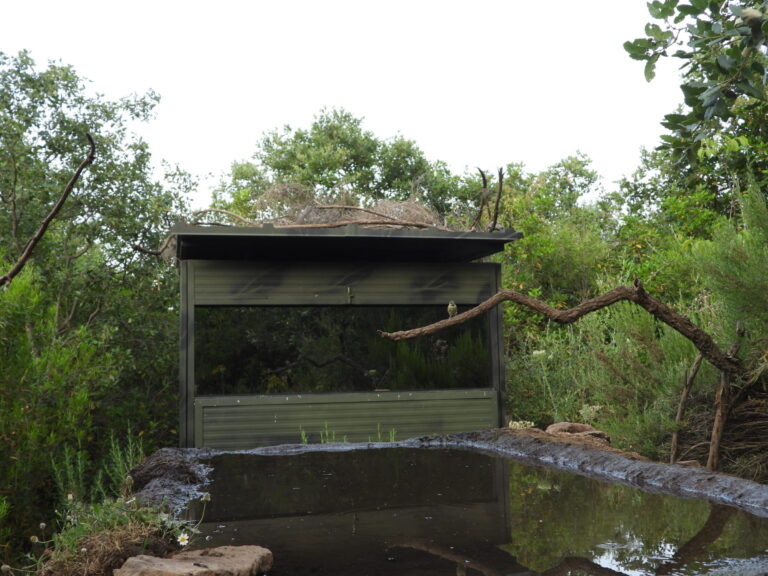
Hide el Venero de los Rabilargos
Great Spotted Woodpecker · Iberian Magpie+33
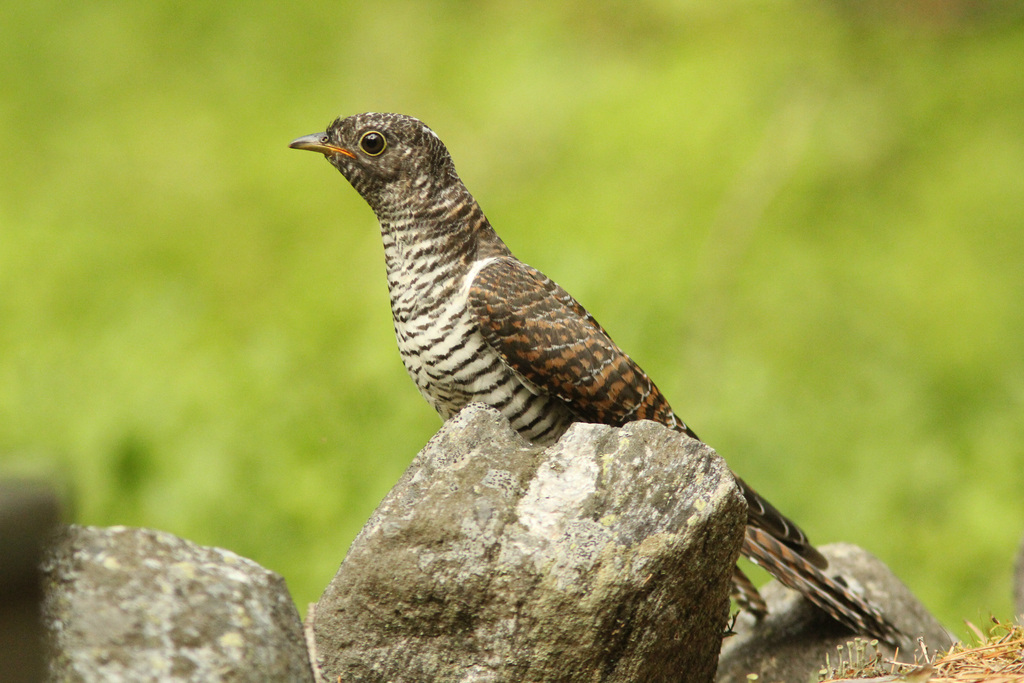
The Common Cuckoo is a medium-sized bird, 32–34 centimetres long with a wingspan of 55–60 centimetres. It has a distinctive slender, greyish body and long tail that resembles a sparrowhawk in flight, with regular wingbeats. During breeding season, cuckoos often perch openly with drooped wings and raised tail. Adult males are uniformly slate-grey, with the grey throat extending sharply down to the breast before barring begins on the underparts. The iris, orbital ring, bill base and feet are yellow. Adult females show more variation: grey morphs have pinkish-buff or buff barring on the neck and underparts, while rufous morphs display reddish-brown upperparts with darker bars. Juveniles are particularly distinctive, featuring a prominent white nape patch and white feather fringes that aid identification. A rufous colour morph occurs occasionally in adult females but more frequently in young birds.
The most striking feature is the cuckoo's resemblance to the Eurasian sparrowhawk, particularly the barred underparts of adults. This mimicry is not coincidental: the resemblance to this predatory species provides the cuckoo protection during its vulnerable egg-laying visits to host nests. Distinguishing Common Cuckoos from the similar Oriental Cuckoo requires careful observation, as Oriental Cuckoos are slightly shorter-winged on average.
The Common Cuckoo is a widespread summer migrant across Europe and Asia, wintering in Africa. The nominate subspecies ranges from Ireland through Scandinavia, northern Russia and Siberia to Japan, and from the Pyrenees through Turkey, Kazakhstan, Mongolia, northern China and Korea. Other subspecies occupy different breeding ranges across western China, the Himalayan foothills, Iberia, the Balearic Islands, North Africa and Central Asia. All populations undertake significant migrations, with European breeders wintering in Africa and Asian birds moving to southern Asia and Africa for the non-breeding season.
The Common Cuckoo is a brood parasite, laying its eggs in the nests of other bird species rather than raising its own young. Primary host species include dunnocks, meadow pipits and reed warblers. Remarkably, the cuckoo's eggs mimic those of its hosts despite being larger, enabling successful deposition in host nests. The adult bird's sparrowhawk-like appearance functions as protective mimicry, giving females crucial time to lay their eggs without being attacked by defensive hosts. Research has shown that host species are more aggressive toward cuckoos with obscured underparts, confirming that the resemblance to sparrowhawks aids brood parasitism.
The Common Cuckoo is best sought during the breeding season when birds are actively calling and visiting host nests across Europe and Asia. Presence varies by subspecies and location, but generally extends through spring and summer months. Look in habitats frequented by host species—from open moorlands and reed beds to woodland edges and agricultural areas. The bird's famous two-note call, from which both its scientific name (canorus, meaning melodious) and common name derive, makes it easier to locate by ear than by sight.
Photographing Common Cuckoos presents a rewarding challenge. Their preference for open perches during breeding season—characteristically with drooped wings and raised tail—offers occasional opportunities for clear shots. The bird's sparrowhawk-like silhouette in flight is distinctive and photogenic, particularly when wingbeats are regular and unhurried. Pay attention to plumage details: the yellow orbital ring and bill base, the sharp demarcation between grey throat and barred underparts in males, and the subtle buffing or rufous tones in females. Patience is essential, as cuckoos are often heard before seen. Early morning during the breeding season offers the best chance of locating birds through their distinctive calls, after which careful stalking may yield photographic opportunities.
Nothing matches these filters.
Nothing matches these filters.
Nothing matches these filters.
No community photos yet. Log in to add the first one.
No community observations of this species yet.
We'd love to hear from you. We'll reply as soon as possible.
Found an error? Have a suggestion? We read every message.
A compact view of how this species lives, moves and responds to its environment.
Select a card to explore the details.
Please confirm the photo rights and credit terms first.
I'm the author of this photo or hold the rights to it, and I keep full ownership. I grant Wild Atlas Guide a free, non-exclusive licence to display it on the site and in Wild Atlas Guide's own channels, including social media, always credited to me by my display name or the Instagram handle I choose to provide. I confirm it does not reveal a sensitive wildlife location or a recognisable person without their permission. I can withdraw future social use for this photo or ask for it to be removed at any time.
Please accept the photo rights and credit terms to continue.
Uploading…
We use cookies to measure traffic and improve Wild Atlas Guide. You decide. Privacy policy