
Hide el Venero de los Rabilargos
Great Spotted Woodpecker · Iberian Magpie+33
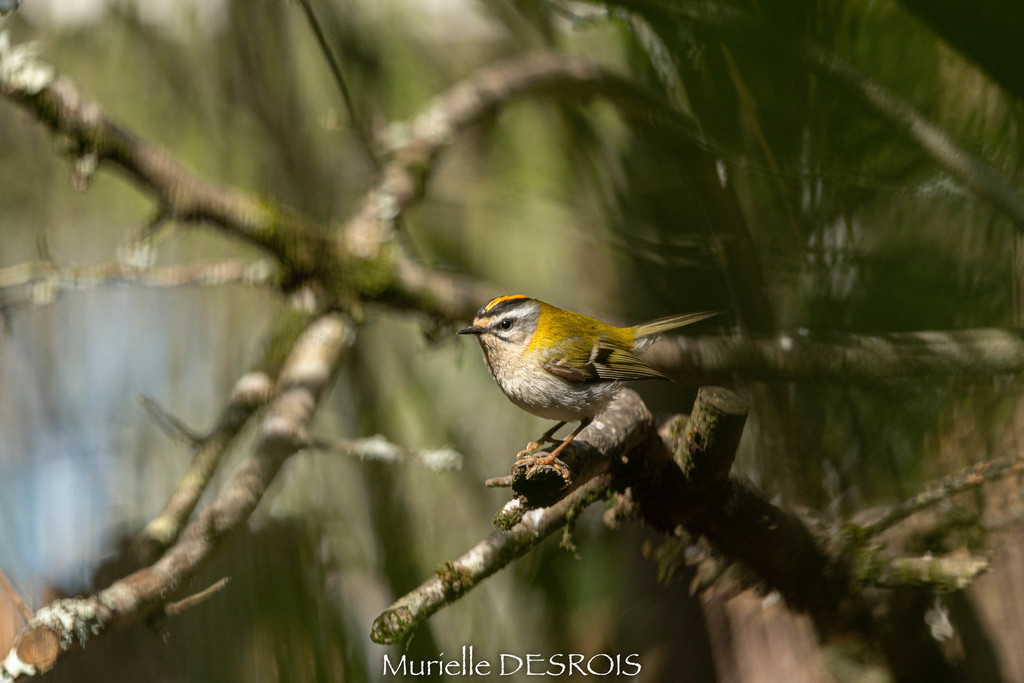
The common firecrest is a tiny, plump bird measuring just 9 cm in length with a wingspan of 13–16 cm and weighing only 4–7 grams. Despite its diminutive size, it is unmistakable in appearance. It has bright olive-green upperparts with distinctive bronze-coloured patches on each shoulder, and whitish underparts washed with brownish-grey on the breast and flanks. The bird displays two white wingbars and possesses a striking head pattern: a black eye stripe, a long white supercilium, and a prominent crest that is bright orange in males and bright yellow in females—features that give the species its evocative name.
The sexes are very similar, though females are slightly duller and smaller on average. Juveniles lack the coloured crown but retain the other head markings, albeit in duller tones; by their first winter, young birds are virtually indistinguishable from adults in the field. The firecrest's bronze shoulders and strong face pattern distinguish it from the superficially similar goldcrest, which shares much of its European range. It typically hops with its body held horizontally and has a weak, whirring flight punctuated by quick evasive turns.
The common firecrest breeds across most of temperate Europe and northwestern Africa, and is partially migratory. Birds from central Europe move south and west during winter, while populations in the Balearic Islands and north Africa are recognized as a separate subspecies. The species has expanded its range considerably over the last century, a positive trend for conservation.
Firecrests inhabit broadleaf and coniferous woodlands as well as gardens, where they build their compact, three-layered nests on tree branches. This habitat flexibility, combined with their expanding distribution, has allowed them to maintain a large and stable European population despite localized declines in some areas.
The common firecrest is a restless and constantly active bird, frequently hovering as it searches for insects among foliage. In winter, it often joins mixed flocks of tits, gaining safety and foraging efficiency through group movement. Both parents feed the chicks, which fledge 22–24 days after hatching; females alone incubate the clutch of seven to twelve eggs during the breeding season.
The firecrest's song consists of a repetition of high, thin notes that are slightly lower-pitched than those of its relative, the goldcrest. The bird faces predation from birds of prey and can carry parasites, yet these factors do not currently pose significant conservation concerns for the species overall.
Firecrests can be observed year-round across their breeding range in temperate Europe, with the most visible displays occurring during the breeding season when males prominently display their brilliant orange crests. In winter, they become more localized but may be encountered within mixed tit flocks in woodlands and well-vegetated gardens, where they remain active despite the season's challenges.
Their presence across broadleaf and coniferous woodlands, as well as gardens throughout their range, means they can be found in varied habitats. Patience and careful observation are rewarded, as their constant movement and small size require attention to spot them among foliage.
Photographing the common firecrest presents a rewarding challenge given its diminutive size and restless behaviour. Position yourself quietly near mixed feeding flocks in winter or in woodland edges during breeding season, as the bird's constant hovering and horizontal hopping provide brief but spectacular photographic opportunities. The striking head pattern—particularly the contrasting white supercilium and eye stripe—and the male's brilliant orange crest are key features worth capturing.
A fast shutter speed is essential to freeze the bird's rapid movements and hovering flight. Early morning light during breeding season will best illuminate the male's orange crown and bronze shoulders, the diagnostic features that distinguish this species from similar kinglets and warblers. Patience is paramount, as these birds rarely remain stationary for extended periods.
Nothing matches these filters.
Nothing matches these filters.
No community photos yet. Log in to add the first one.
No community observations of this species yet.
We'd love to hear from you. We'll reply as soon as possible.
Found an error? Have a suggestion? We read every message.
A compact view of how this species lives, moves and responds to its environment.
Select a card to explore the details.
Please confirm the photo rights and credit terms first.
I'm the author of this photo or hold the rights to it, and I keep full ownership. I grant Wild Atlas Guide a free, non-exclusive licence to display it on the site and in Wild Atlas Guide's own channels, including social media, always credited to me by my display name or the Instagram handle I choose to provide. I confirm it does not reveal a sensitive wildlife location or a recognisable person without their permission. I can withdraw future social use for this photo or ask for it to be removed at any time.
Please accept the photo rights and credit terms to continue.
Uploading…
We use cookies to measure traffic and improve Wild Atlas Guide. You decide. Privacy policy