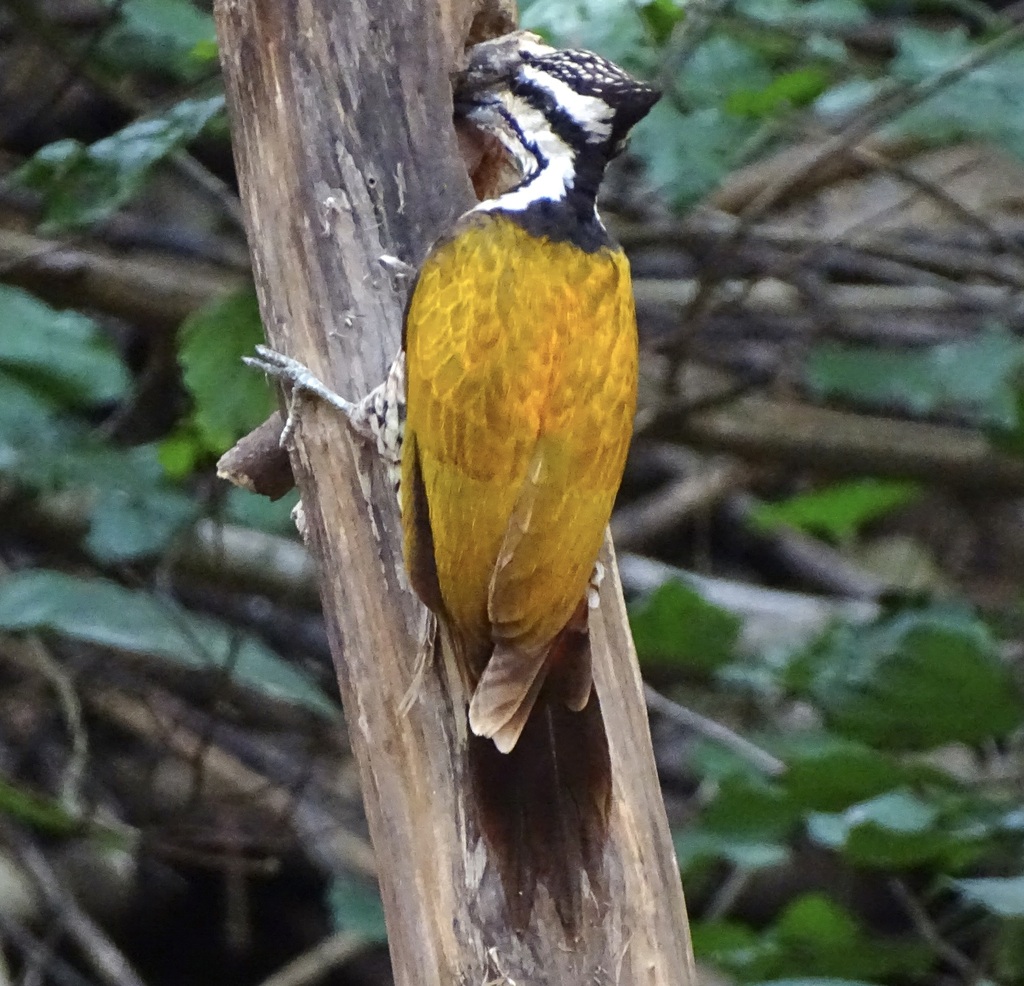
Common Flameback
Photo © Sandra Keller
Photo © Sandra Keller — CC BY 4.0 — Source: iNaturalist #349682139Identification
The common flameback is a small woodpecker measuring 28–30 cm, easily distinguished by its striking plumage. Males sport a bright red crest, while females display a black crest with white streaks. Both sexes share distinctive white facial markings including a supercilium, cheek stripe, and throat area, separated by bold black stripes. The spotted black and white underside is characteristic, along with a red rump and black nape. Its smaller bill sets it apart from the larger greater flameback, while the red rump distinguishes it from the black-rumped flameback. The loud, high-pitched "kow-kowp" rattle call is the best field identifier when separating it from the nearly identical Himalayan flameback.
Range & Habitat
This shy, secretive woodpecker ranges widely across South and Southeast Asia, from India's Western Ghats to the Indochinese peninsula and the Greater Sunda Islands. Six recognized subspecies occupy different regions, from peninsular Thailand and Sumatra to southwest India, Bangladesh, Myanmar, southern China, and various islands of Borneo, Java, and Bali. Common flamebacks favour moist open forests, scrubland, and mangroves in lowland areas, though they can reach altitudes of 1,700 metres in India, where they prefer pine forests. They rarely appear in urban settings, preferring wild habitats where they can forage undisturbed.
Behaviour & Diet
Despite being a woodpecker, the common flameback rarely drums on wood and instead employs quiet, gleaning foraging methods well-suited to its relatively small bill. The bird remains motionless for extended periods before lurching forward with rapid pecks at passing insects. It is a strict insectivore, feeding predominantly on ants, though it also hawks slow-flying insects mid-air and gleans other tree-crawling invertebrates. Occasionally, it hammers young trees to shed bark. The species produces diverse vocalizations including the four-second "wicka call," single or double "kow call," the more complex "kowp call" heard during flight and landing as an alarm, and the rapid "rattle call" of 17–57 notes lasting up to 2.56 seconds.
Best Time & Places to See It
Finding common flamebacks requires patience and knowledge of their preferred habitats. Search moist open forests, mangrove areas, and scrubland throughout their range, particularly in lowland regions. Early morning hours often yield better sightings as the birds forage quietly and unobtrusively. Listen for their characteristic loud, high-pitched "kow-kowp" rattle call, which is often your best clue to their presence. The bird's shy, secretive nature means it may be encountered by chance while exploring suitable habitat rather than being reliably predictable at specific locations.
Photography Tips
Photographing common flamebacks demands patience, as they are quiet and unobtrusive birds that favour shadier forest areas. The distinctive red crest of males and striking facial markings make compelling subjects when you can position yourself without alarming the bird. The bird's tendency to remain motionless for long periods followed by sudden movements means burst mode and fast shutter speeds are essential. Use the loud "kow-kowp" call to locate birds, then move slowly and quietly into position. Early morning light filtering through the forest canopy can beautifully highlight the bird's colourful plumage and create atmospheric images of this elusive woodpecker.
Hat Noppharat Thara-Mu Ko Phi Phi National Park
Ao Nang, Thailand
+253 birds+9 mammals
Where limestone karsts rise dramatically from turquoise waters, Hat Noppharat Thara-Mu Ko Phi Phi National Park unfolds across a mosaic of beach, mangrove forest, and island…
VIEW NATIONAL PARKKhao Yai National Park
Prachantakham District, Thailand
+377 birds+46 mammals
Evergreen dipterocarp forest blankets the rolling terrain of this national park in eastern Thailand, where limestone hills rise abruptly from the forest floor and seasonal streams…
VIEW NATIONAL PARKKhao Laem National Park
Sangkhla Buri District, Thailand
+197 birds
Where the Vajiralongkorn Reservoir sprawls across the forested valleys of Kanchanaburi's northern borderlands, Khao Laem National Park protects a landscape where limestone ridges rise dramatically from…
VIEW NATIONAL PARKPeriyar National Park
Mlappara, India
+232 birds+4 mammals
Dawn breaks over mist-shrouded ridges where the Western Ghats tumble toward Kerala's spice-scented lowlands. Here, ancient tropical forests envelope a glittering artificial lake, creating a mosaic…
VIEW NATIONAL PARKPampadum Shola National Park
Vattavada, India
+258 birds+14 mammals
Where misty shola forests cling to the high plateaus of the Nilgiri Mountains, ancient evergreen remnants create a world apart. This 2,316-hectare reserve protects one of…
VIEW NATIONAL PARKBandipur National Park
Hirehalli, India
+302 birds+19 mammals
Where the Western Ghats descend into the Deccan plateau, ancient deciduous forests blanket a landscape carved by the Nugu River. Bandipur unfolds across 880 square kilometres…
VIEW NATIONAL PARKNagarahole Tiger Reserve
Nalkeri Forest, India
+323 birds+23 mammals
Where granite escarpments rise above dense deciduous forests and the Kabini River carves through pristine wilderness, one of India's most biodiverse landscapes unfolds across the Western…
VIEW NATIONAL PARKBako National Park
Kuching, Malaysia
+210 birds+17 mammals
Weathered sandstone cliffs rise dramatically from the South China Sea, their ochre faces sculpted by millennia of wind and tide into a landscape of extraordinary geological…
VIEW NATIONAL PARKTaman Negara National Park
Kampong Samas, Malaysia
+393 birds+48 mammals
Where ancient rainforest meets limestone peaks, one of Southeast Asia's oldest protected wilderness preserves sprawls across 4,343 square kilometers of primordial landscape. Dipterocarp giants tower overhead,…
VIEW NATIONAL PARKPenang National Park
Balik Pulau, Malaysia
+107 birds+2 mammals
Granite peaks rise abruptly from the Andaman Sea where tropical rainforest clings to steep slopes in one of Malaysia's oldest protected landscapes. Mangrove forests fringe the…
VIEW NATIONAL PARKTaman Nasional Baluran
Situbondo, Indonesia
+189 birds+9 mammals
Across the northeastern tip of East Java, where monsoon winds sweep down from the Bali Strait, a landscape of contrasts unfolds within 374 square kilometres of…
VIEW NATIONAL PARKTaman Nasional Meru Betiri
Jember, Indonesia
+93 birds+1 mammals
Across East Java's southeastern coast, where the Indian Ocean meets a landscape of volcanic soils and monsoon-fed forests, sprawls a national park that epitomizes the ecological…
VIEW NATIONAL PARKWest Bali National Park
Gerokgak, Indonesia
+240 birds+8 mammals
Across West Bali's northwestern reaches, where the Indian Ocean meets volcanic slopes and limestone cliffs plunge toward turquoise shallows, sprawls a protected realm of roughly 325…
VIEW NATIONAL PARKGunung Ciremai National Park
Majalengka, Indonesia
+116 birds+1 mammals
Volcanic slopes rise sharply from West Java's interior, where Gunung Ciremai's 3,078-metre summit dominates a landscape carved by geological upheaval and shaped by equatorial monsoon rainfall.…
VIEW NATIONAL PARKWay Kambas National Park
Lampung Timur, Indonesia
+237 birds+20 mammals
Across the low swamplands of eastern Lampung, where freshwater wetlands merge into tidal mangrove forests along the Sunda Strait, sprawls one of Sumatra's most vital sanctuaries.…
VIEW NATIONAL PARKNo community photos yet. Log in to add the first one.
No community observations of this species yet.