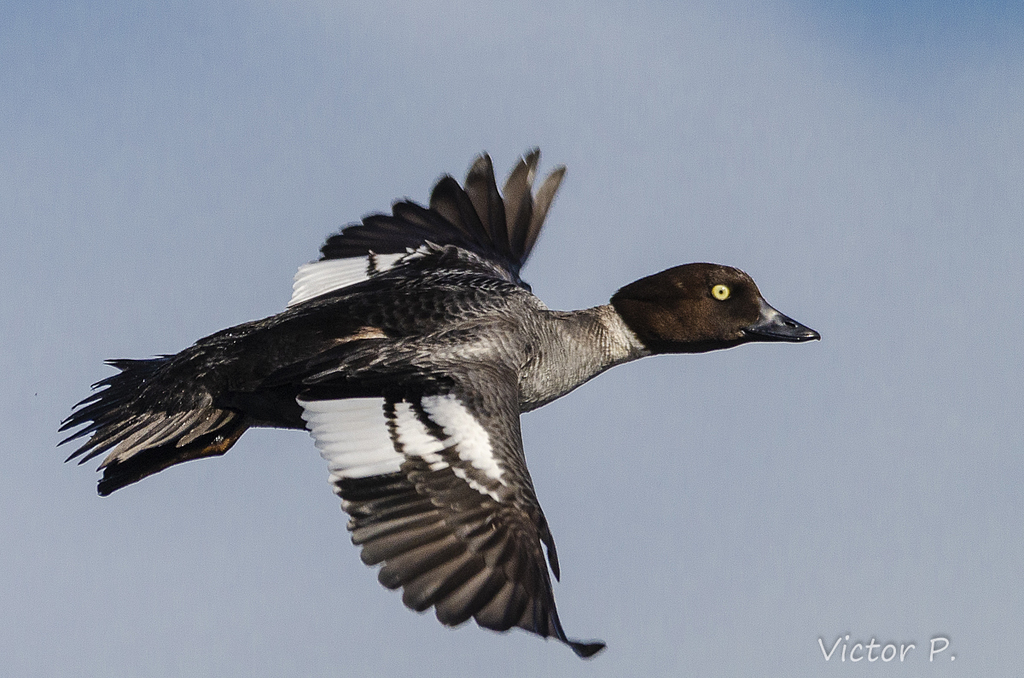
Common Goldeneye
Photo © Виктор
Photo © Виктор — CC BY 4.0 — Source: iNaturalist photo #54718402Identification
The common goldeneye is a medium-sized sea duck immediately recognizable by its striking golden-yellow eyes, which give the species its name. Adult males are particularly distinctive, displaying a dark head with a greenish gloss, a prominent circular white patch below the eye, a dark back, and a contrasting white neck and belly. Adult females are more subdued in appearance, with a brown head and mostly grey body. Both sexes have orange-yellow legs and feet. Males range from 45–51 cm in length with a wingspan of 77–83 cm, while females are slightly smaller at 40–50 cm long. The closest relative, Barrow's goldeneye, is similar enough to warrant careful field identification.
Range & Habitat
Common goldeneyes are found across the subarctic regions of the Northern Hemisphere. The nominate subspecies occurs from Scotland and Scandinavia eastward through boreal Russia to Sakhalin and the Kamchatka Peninsula, while the North American subspecies ranges from western Alaska through Canada to Labrador and New Brunswick. Their breeding habitat is the taiga, where they inhabit lakes and rivers within boreal forests. These ducks are cavity nesters, naturally choosing tree cavities created by broken limbs or excavated by pileated and black woodpeckers, though they readily adopt artificial nest boxes.
As migratory birds, common goldeneyes winter in protected coastal waters or open inland waters at more temperate latitudes, returning year after year to the same nesting sites. Both their breeding and wintering habitats have faced degradation through forest clearance and pollution.
Behaviour & Diet
Common goldeneyes are aggressive and territorial ducks known for their elaborate courtship displays. Breeding females perform all incubation duties, which last 28 to 32 days, while males typically abandon the nest after 1 to 2 weeks. Young remain in the nest for approximately 24–36 hours before fledging and achieve flight capability at 55–65 days of age. Brood parasitism is common within the species, and mixed broods frequently occur as young become independent or are abandoned by mothers.
These diving ducks forage underwater for a varied diet. Year-round, their prey consists of approximately 32% crustaceans, 28% aquatic insects, and 10% molluscs, with proportions shifting seasonally—insects predominate during nesting while crustaceans dominate during migration and winter. Fish eggs and aquatic plants can locally become important food sources.
Best Time & Places to See It
To observe common goldeneyes during breeding season, visit boreal forest lakes and rivers across Canada, the northern United States, Scandinavia, and northern Russia during the warmer months. Winter offers excellent viewing opportunities in protected coastal waters and ice-free inland lakes at temperate latitudes across the Northern Hemisphere. Migration periods in spring and autumn provide particularly good sighting opportunities as birds move between breeding and wintering grounds.
Photography Tips
Photograph males in good light to capture the striking contrast between their dark, glossy green head and white body, along with the distinctive white facial patches and golden eyes. Females present a more subtle challenge with their brown and grey plumage; patience and proper exposure are essential for rendering these tones accurately. Since common goldeneyes are diving ducks, position yourself near water where they forage and expect frequent submersions. Early morning and late afternoon light will best illuminate the iridescent green sheen on males' heads and catch the characteristic golden eyes of both sexes.
Tombstone Territorial Park
Acadia National Park
Alaska Maritime National Wildlife Refuge
Algonquin Provincial Park
Alligator River National Wildlife Refuge
Altai Tavan Bogd National Park
Arches National Park
Arctic National Wildlife Refuge
Åsnens National Park
Nothing matches these filters.
No community photos yet. Log in to add the first one.
No community observations of this species yet.