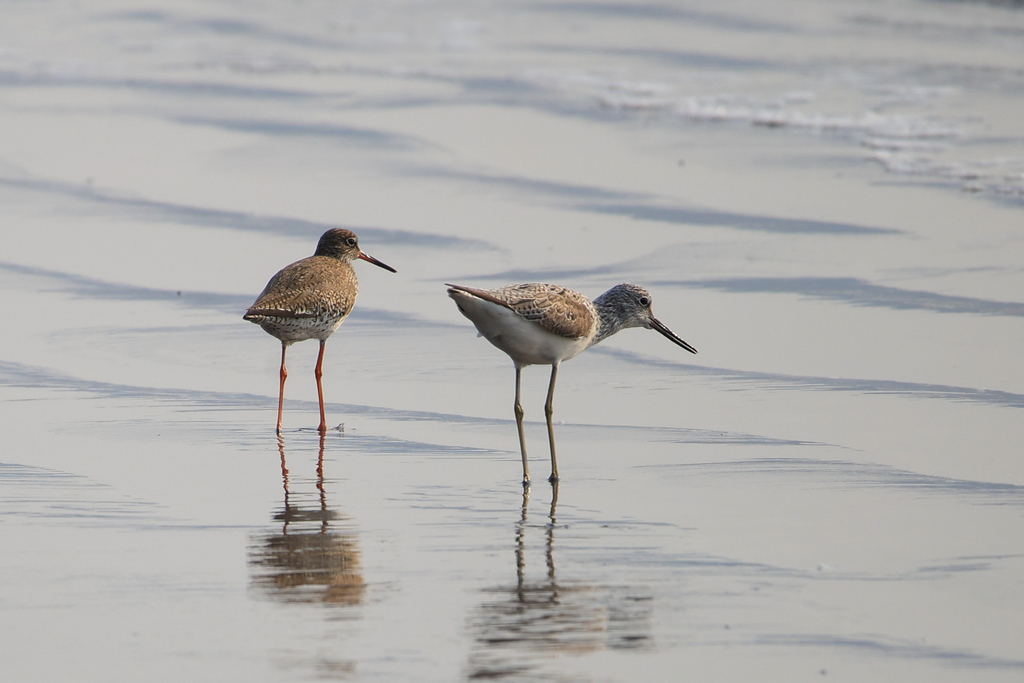
Common Greenshank
Photo © Gannu03
Photo © Gannu03 — CC BY-SA 4.0 — Source: iNaturalist photo #376435248
Birding TourEasy
Birding TourEasy
Nothing matches these filters.
The Common Greenshank is a large shank with distinctive long greenish legs and an elongated bill with a grey base. In breeding plumage, birds appear brown, while winter birds are more uniformly grey-brown. A key field mark is the upturned appearance of the lower bill, which helps distinguish them from the similar marsh sandpiper when seen in water. In flight, look for a striking white wedge on the back. Common Greenshanks are noticeably larger than the related Common Redshank. The usual call is distinctive and diagnostic: a rapid series of three short fluty notes, often syllabilized as "teu-teu-teu".
This is a subarctic wader breeding across northern Europe and the Palearctic, from northern Scotland eastwards. Common Greenshanks breed on dry ground near marshy areas, typically laying about four eggs in a simple ground scrape. They are highly migratory, wintering across Africa, the Indian subcontinent, and Australasia, where they favour fresh water habitats. The species has occasionally been recorded far outside its normal range as a vagrant, with sightings reported in the Americas including Barbados, the United States, Canada, Bermuda, Puerto Rico, and Brazil.
Like most waders, Common Greenshanks feed primarily on small invertebrates, though they will also opportunistically take small fish and amphibians. They are active foragers in shallow water and wetland margins, often visible as they work through their preferred habitats. The species is subject to the Agreement on the Conservation of African-Eurasian Migratory Waterbirds (AEWA), reflecting conservation concerns about their populations across their broad range.
The best time to locate Common Greenshanks depends on your location. In breeding areas of northern Europe and Scotland, they are present during the breeding season. For winter viewing, focus on wintering grounds in Africa, the Indian subcontinent, and Australasia, where they congregate on fresh water habitats including marshes, lakes, and river systems. Migration periods offer opportunities to spot them at stopover sites across their range, often at wetlands and coastal locations.
The Common Greenshank's long legs and elegant posture make it a rewarding subject. Photograph birds in shallow water or on mudflats to showcase their distinctive green legs and upturned bill profile. The white wedge on the back is best captured in flight shots. In breeding plumage, the brown tones and darker shoulder and back markings are more striking than in winter grey-brown birds. Early morning light at wetland habitats often provides excellent conditions, and patience near favoured feeding areas will yield good opportunities for sharp, detailed images of this elegant wader.
Nothing matches these filters.
Nothing matches these filters.
No community photos yet. Log in to add the first one.
No community observations of this species yet.
We'd love to hear from you. We'll reply as soon as possible.
Found an error? Have a suggestion? We read every message.
A compact view of how this species lives, moves and responds to its environment.
Select a card to explore the details.
Please confirm the photo rights and credit terms first.
I'm the author of this photo or hold the rights to it, and I keep full ownership. I grant Wild Atlas Guide a free, non-exclusive licence to display it on the site and in Wild Atlas Guide's own channels, including social media, always credited to me by my display name or the Instagram handle I choose to provide. I confirm it does not reveal a sensitive wildlife location or a recognisable person without their permission. I can withdraw future social use for this photo or ask for it to be removed at any time.
Please accept the photo rights and credit terms to continue.
Uploading…
We use cookies to measure traffic and improve Wild Atlas Guide. You decide. Privacy policy