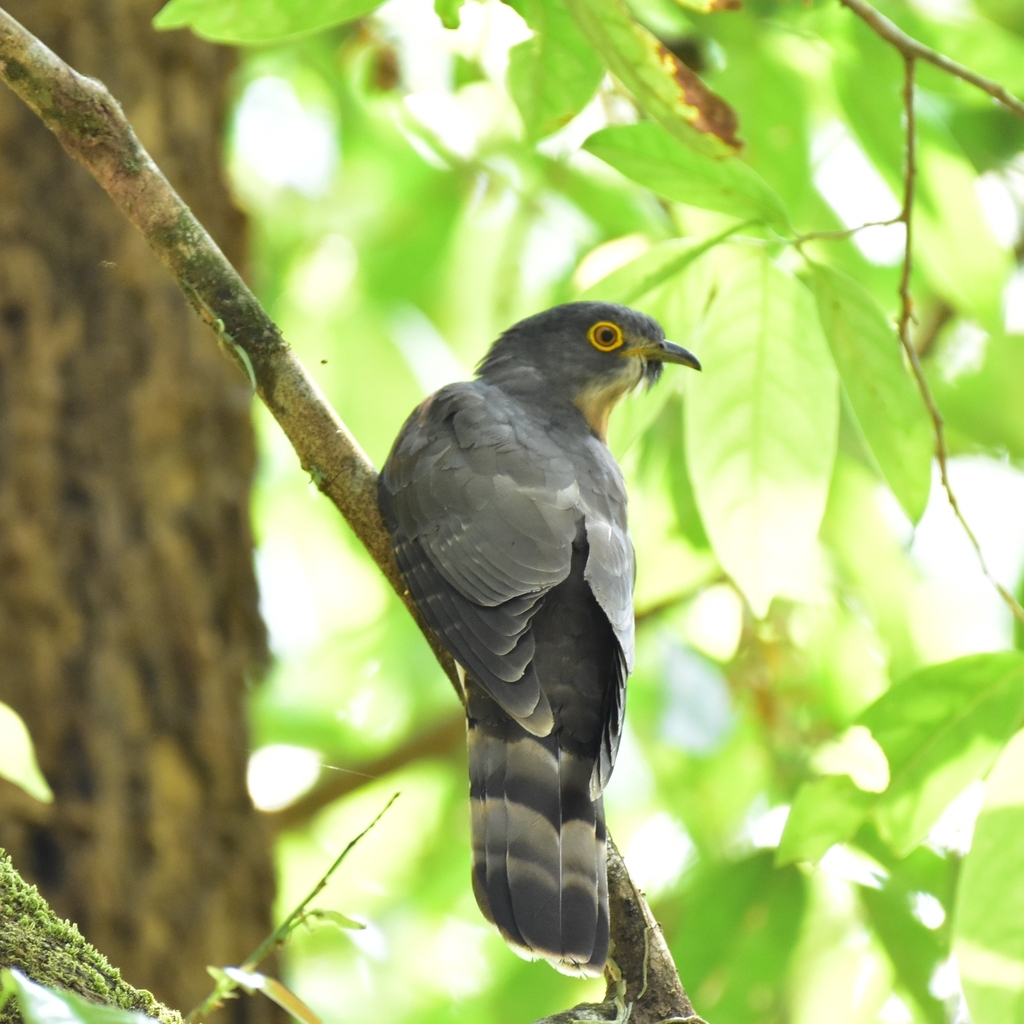
Common Hawk-Cuckoo
Photo © Renjith Jacob Mathews
Photo © Renjith Jacob Mathews — CC BY 4.0 — Source: iNaturalist #154924628Identification
The common hawk-cuckoo is a medium- to large-sized cuckoo, about the size of a pigeon at approximately 34 cm long. Its plumage is ashy grey above and whitish below, cross-barred with brown, with a broadly barred tail. A distinctive yellow eye ring is a key identifying feature. The sexes are alike, though males tend to be larger. Subadults have streaked breasts and large brown chevron marks on the belly, making them particularly similar to immature shikras.
At first glance, this species can easily be mistaken for a hawk—a resemblance that extends to its flight style. It uses a characteristic flap-and-glide pattern resembling that of sparrowhawks, and when landing on a perch, it shakes its tail from side to side. This hawk-like appearance can be distinguished from the similar large hawk-cuckoo, which has dark streaks on the throat and breast, whereas the common hawk-cuckoo has a pale chin. Small birds and squirrels often raise alarm calls at its presence, just as they would for a genuine predator.
Range & Habitat
The common hawk-cuckoo occurs throughout most of the Indian subcontinent, from Pakistan in the west across the Himalayan foothills, east through Nepal, Bhutan, Bangladesh, and North East India, and south into Sri Lanka. Some birds of the Indian population winter in Sri Lanka, while the hill population in central Sri Lanka (subspecies ciceliae) is resident year-round. The species is generally resident but locally migratory in high altitudes and arid areas. It is found in the lower elevations of the Himalayas, mostly below 1000 metres, though in higher areas the larger hawk-cuckoo becomes more common.
This is an arboreal species that rarely descends to the ground. It inhabits gardens, tree groves, and deciduous and semi-evergreen forests. The Indian population displays paler plumage than the Sri Lankan subspecies.
Behaviour & Diet
Like many cuckoos, the common hawk-cuckoo is a brood parasite, laying its eggs in the nests of babblers—primarily those of the genus Turdoides and occasionally laughing-thrushes of the genus Garrulax. The breeding season runs from March to June, coinciding with that of its babbler hosts. A single blue egg is laid in each nest, matching the host's coloration. The hatchling usually evicts the host's eggs and is raised to maturity by foster parents, whom it follows for nearly a month. The young bird makes a distinctive grating kee-kee call to beg for food, and foster parents within a flock may feed it. The predominant host species in India are Turdoides striatus and Turdoides affinis, while in Sri Lanka it is Turdoides striatus.
The common hawk-cuckoo feeds mainly on insects and is a specialized feeder capable of handling hairy caterpillars. It has a remarkable feeding technique: it removes caterpillar guts by pressing them and rubbing them on a branch before swallowing, preventing the ingestion of toxic contents. The hairs are swallowed and later separated in the stomach, then regurgitated as a pellet.
Best Time & Places to See It
During the breeding season in summer, before the monsoons, males are easily detected by their loud, distinctive calls but can be difficult to spot visually. The best time to hear this species is throughout the day and frequently during moonlit nights, when males produce their characteristic repeated calls. The call is a loud screaming three-note phrase, rising in crescendo and ending abruptly, repeated 5 or 6 times before pausing briefly and beginning again. This call has been popularly transcribed as "brain-fever," earning the species its common nickname.
Look for this species in gardens, tree groves, and deciduous and semi-evergreen forests across the Indian subcontinent. Its arboreal habits mean watching the canopy and mid-story vegetation will yield better results than scanning the ground.
Photography Tips
Photographing the common hawk-cuckoo presents challenges due to its habit of remaining hidden in foliage while calling loudly. During breeding season, locate birds by their distinctive calls and position yourself in suitable viewing spots before dawn or in the early morning when calling activity is high. The species' hawk-like appearance and flight pattern—particularly the tail-shaking motion when landing—make these movements worthwhile to capture.
The distinctive yellow eye ring and barred plumage are key field marks to capture in your images. Its tendency to perch regularly on branches while calling offers opportunities for photography, though patience and careful stalking will be required. The bird's resemblance to a shikra, including its flap-and-glide flight style, provides interesting compositional possibilities for action shots.
Lunugamvehera National Park
Sri Lanka
+204 birds+14 mammals
Dry scrubland and shallow wetlands converge in Sri Lanka's southeastern lowlands, where Lunugamvehera National Park anchors one of the island's most ecologically vital landscapes. The park's…
VIEW NATIONAL PARKMinneriya National Park
Sri Lanka
+158 birds+9 mammals
Across the dry zone of Sri Lanka's North Central Province spreads a landscape of shallow tanks, grassland margins, and scattered dry forest—a mosaic of water and…
VIEW NATIONAL PARKLangtang National Park
Helambu, Nepal
+364 birds+14 mammals
Where the southern slopes of the Himalayan highlands descend toward the subtropical valleys of central Nepal, Langtang National Park sprawls across one of the subcontinent's most…
VIEW NATIONAL PARKOrang National Park
Rangagarapathar, India
+298 birds+1 mammals
Where the Brahmaputra's floodplains meet the foothills of Assam, Orang National Park unfolds across a mosaic of riverine grasslands, forests and wetlands that pulse with the…
VIEW NATIONAL PARKValmiki National Park
Ramnagar, India
+66 birds+6 mammals
Along Bihar's western frontier, where the Gandak River winds through subtropical forest and grassland, Valmiki National Park sprawls across terrain shaped by monsoon rains and seasonal…
VIEW NATIONAL PARKRanthambhore National Park
Sawai Madhopur, India
+294 birds+20 mammals
Granite ridges and ravines carved through the Aravalli Range frame this protected landscape in eastern Rajasthan, where deciduous forest mingles with open scrubland and seasonal water…
VIEW NATIONAL PARKEravikulam National Park
Devikulam, India
+192 birds+7 mammals
High in the Western Ghats of Kerala, where monsoon mists cling to slopes that rise above 2,000 metres, Eravikulam National Park preserves one of South India's…
VIEW NATIONAL PARKKanha Tiger Reserve
Kanha Kisli F.V., India
+321 birds+23 mammals
Where sal forests give way to emerald meadows and crystalline streams carve through ancient valleys, one of India's finest wilderness reserves unfolds across the Maikal Range.…
VIEW NATIONAL PARKTadoba National Park
Palasgaon Singru, India
+270 birds+20 mammals
Where sal forests meet open grasslands and rocky outcrops rise from red laterite soil, central India's landscape unfolds in raw, untamed beauty. Ancient teak woodlands and…
VIEW NATIONAL PARKBandhavgarh National Park
Garhpuri, India
+285 birds+17 mammals
Where granite ridges rise dramatically above sal and bamboo forests, one of India's most pristine tiger reserves unfolds across the Vindhyan plateau. Ancient rock formations tower…
VIEW NATIONAL PARKPanna National Park
Badgadi Kalan, India
+271 birds+17 mammals
Where granite gorges slice through central India's Vindhyan plateau, a landscape of stark beauty unfolds across nearly six hundred square kilometers. The Ken River carves through…
VIEW NATIONAL PARKKeoladeo National Park
Shreenagar Rural, India
+326 birds+14 mammals
Where shallow wetlands shimmer beneath vast Rajasthani skies, one of Asia's finest bird sanctuaries pulses with extraordinary life. This former maharaja's hunting reserve, now spanning 29…
VIEW NATIONAL PARKPeriyar National Park
Mlappara, India
+232 birds+4 mammals
Dawn breaks over mist-shrouded ridges where the Western Ghats tumble toward Kerala's spice-scented lowlands. Here, ancient tropical forests envelope a glittering artificial lake, creating a mosaic…
VIEW NATIONAL PARKPampadum Shola National Park
Vattavada, India
+258 birds+14 mammals
Where misty shola forests cling to the high plateaus of the Nilgiri Mountains, ancient evergreen remnants create a world apart. This 2,316-hectare reserve protects one of…
VIEW NATIONAL PARKNo community photos yet. Log in to add the first one.
No community observations of this species yet.