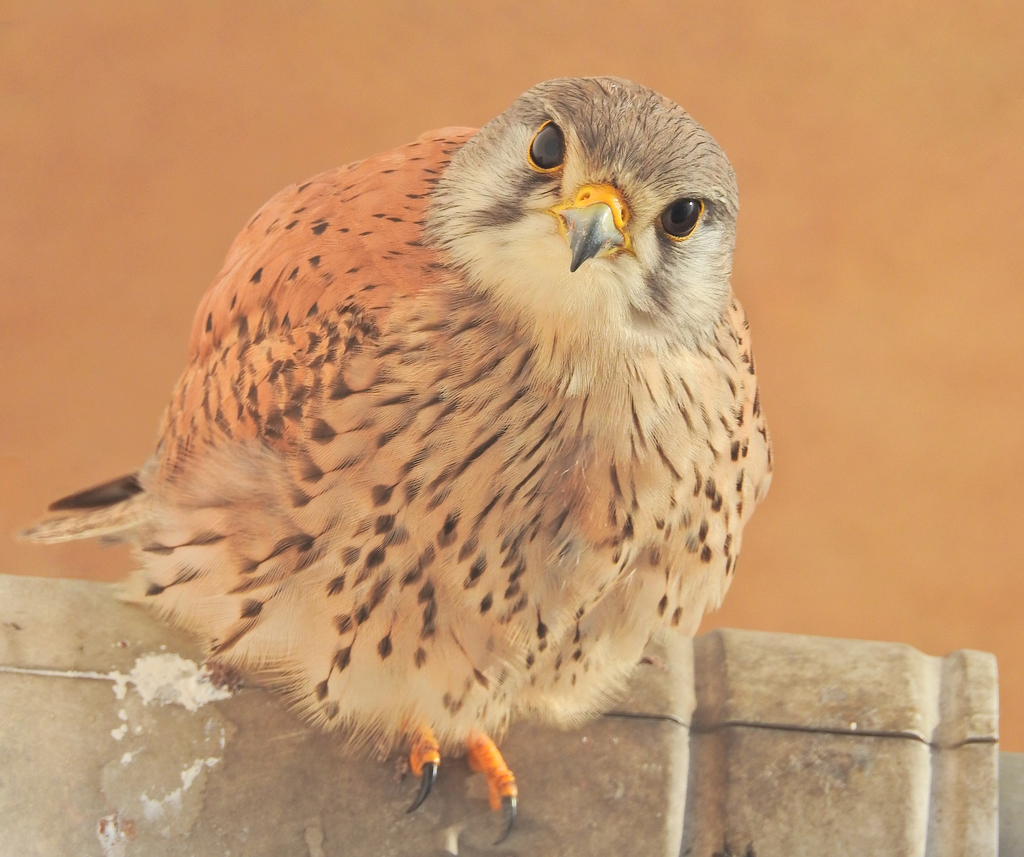
Common Kestrel
Photo © xulescu_g
Photo © xulescu_g — CC BY-SA 4.0 — Source: iNaturalist photo #76546586Identification
The common kestrel is a small falcon measuring 32–39 cm from head to tail, with a wingspan of 65–82 cm. Females are noticeably larger than males, a trait known as sexual dimorphism. The species is characterized by distinctive black malar stripes (facial markings) and relatively uniform plumage compared to other falcon species. Tropical African forms show less grey in male plumage, while other subspecies vary mainly in accordance with Bergmann's and Gloger's rules, adapting to their respective climates and environments.
Range & Habitat
The common kestrel has one of the widest distributions of any kestrel species, occurring across Europe, Asia, and Africa, with occasional records reaching the east coast of North America. Eleven recognized subspecies are found throughout this vast range, from temperate European regions to tropical African savannas, the Arabian Peninsula, and across to East Asia including Korea and Japan. The species has even colonized several oceanic islands, though vagrant individuals are generally rare outside their established ranges.
Behaviour & Diet
The common kestrel is renowned for its characteristic hovering behaviour, beating its wings rapidly to stay stationary in mid-air while hunting for prey. This distinctive hunting technique gave rise to archaic names including "windhover" and references to its habit of hovering against the wind. The species hunts small animals, particularly voles and other rodents, making it an important natural control for pest populations. Northern Asian populations migrate south during winter, diverting westward rather than crossing the Himalayan mountain ranges.
Best Time & Places to See It
The common kestrel's widespread distribution across Europe, Asia, and Africa makes it accessible to wildlife travelers in numerous locations. Year-round residents can be found throughout much of temperate Europe and tropical Africa, while winter months offer opportunities to observe migratory populations in their southern wintering grounds. Open grasslands, agricultural areas, and semi-arid regions are particularly productive habitats where the bird's hovering hunting technique can be easily observed.
Photography Tips
The kestrel's distinctive hovering behaviour provides excellent photography opportunities, as the bird remains relatively stationary during hunting. Early morning and late afternoon light is ideal for capturing the subtle plumage details and the characteristic facial markings. Photographers should position themselves in open habitats where kestrels hunt, such as grasslands and agricultural areas. The species' small to medium size and relatively approachable nature make it an excellent subject for both telephoto and moderate-range lenses.
Private Full-Day Birdwatching Tour from Lisbon to the Tagus Estuary
Nothing matches these filters.
Bwindi Impenetrable National Park
Kanha Tiger Reserve
Lake Mburo National Park
Mabamba Swamp
Murchison Falls National Park
Queen Elizabeth National Park
Aberdare National Park
Abijata-Shalla Lakes National Park
Abruzzo, Lazio and Molise National Park
Nothing matches these filters.
No community photos yet. Log in to add the first one.