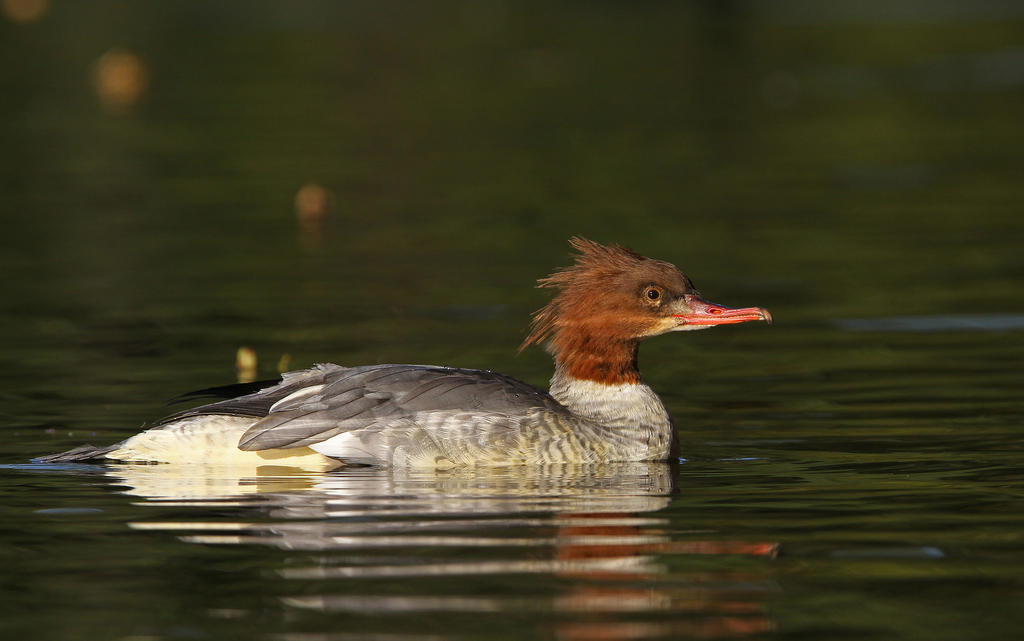
Common Merganser
Photo © Christoph Moning
Photo © Christoph Moning — CC BY 4.0 — Source: iNaturalist photo #94335133Identification
The common merganser is a large duck, measuring 58–72 cm long with a wingspan of 78–97 cm. Adult males in breeding plumage are distinctive: they have a white body with a variable salmon-pink tinge, a black head with an iridescent green sheen, grey rump and tail, and wings that are largely white on the inner half and black on the outer half. Females and non-breeding males are largely grey with a reddish-brown head, white chin, and white secondary feathers. Both sexes have a crest of longer head feathers that usually lies smoothly rounded behind the head rather than standing erect. Juveniles resemble adult females but display a short black-edged white stripe between the eye and bill. The bill and legs are red to brownish-red, brightest in adult males and dullest in juveniles.
Range & Habitat
The common merganser is found across forested areas of Europe, Asia, and North America, inhabiting rivers and lakes where it requires mature forest as breeding habitat. The species is equally at home in both salt and fresh water in most locations. For nesting, it depends on tree cavities, though in treeless areas such as the mountains of Central Asia, it uses holes in cliffs and steep banks.
Behaviour & Diet
This piscivorous duck feeds mainly on fish, earning the nickname "sawbill" from the serrated edges on its bill that help grip slippery prey. Beyond fish, it takes molluscs, crustaceans, worms, insect larvae, and amphibians, with small mammals and birds taken more rarely. The salmon-pink coloration in males is likely derived from carotenoid pigments in crustaceans and fish.
Common mergansers are highly skilled hunters, often fishing in groups that form a semicircle to drive fish into shallow water. In larger streams, they characteristically float downstream and either fly back or fish their way back upstream. They are wary birds with sentries watching for danger, and they often rest on rocks in the middle of rivers with wings half-open. Notably, they form crèches during breeding season, with single females sometimes attending over 70 ducklings at once. Their normal vocalization is a low, harsh croak, though males and juveniles produce a plaintive whistle during breeding season.
Best Time & Places to See It
The common merganser is a partial migrant. In regions where waters freeze, birds move away in winter; elsewhere they remain year-round. In Eastern North America, birds migrate south to ice-free lakes and rivers within the United States, while Pacific coast populations are permanent residents. Scandinavian and Russian birds migrate southward seasonally, whereas western European populations are largely resident. Males in some populations show distinct moult migration, with Western European males migrating north to Norwegian estuaries in summer.
Photography Tips
The striking contrast between breeding males and females makes this species rewarding to photograph. Males in their white and black plumage are particularly photogenic, especially when their iridescent green head catches the light. Watch for birds diving for food or resting on rocks mid-river—their characteristic upright posture and wing-half-open sunbathing behavior provide good photo opportunities. Early morning light along rivers and lakes will enhance the color of their bills and heads. The species' wariness means approaching slowly and remaining patient; their fast, strong flight makes action shots challenging but dramatic when captured.
Tombstone Territorial Park
Acadia National Park
Alaska Maritime National Wildlife Refuge
Algonquin Provincial Park
Alligator River National Wildlife Refuge
Altai Tavan Bogd National Park
Arches National Park
Arctic National Wildlife Refuge
Åsnens National Park
Nothing matches these filters.
No community photos yet. Log in to add the first one.
No community observations of this species yet.