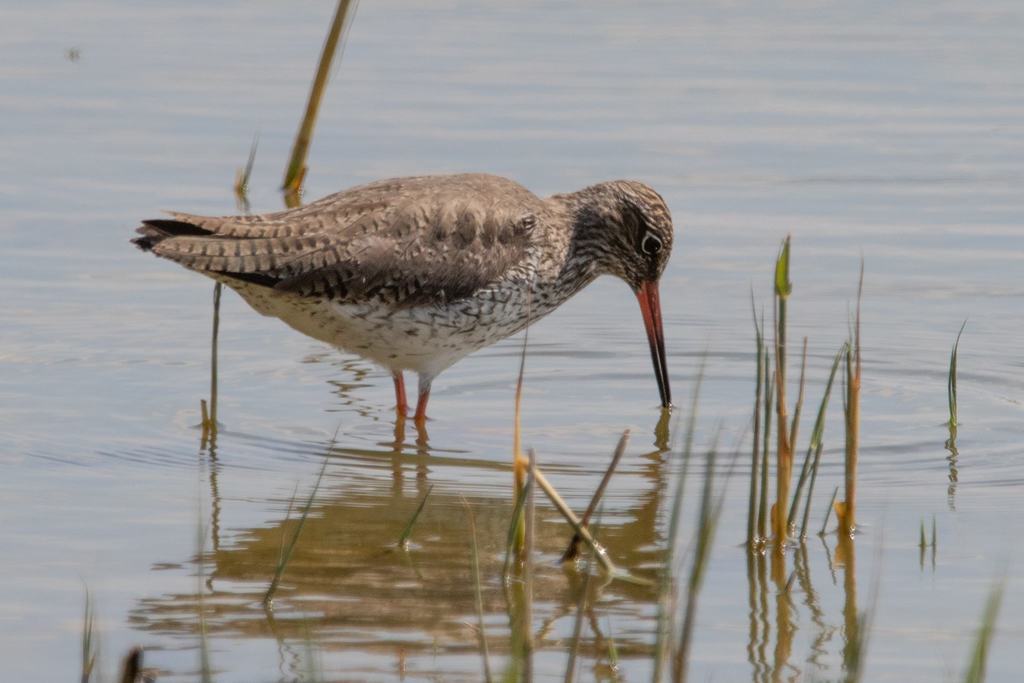
Common Redshank
Photo © Alexis Lours
Photo © Alexis Lours — CC BY 4.0 — Source: iNaturalist photo #192762103Identification
The common redshank is a small to medium-sized wader with distinctive field marks that make it relatively easy to identify. In breeding plumage, birds display marbled brown coloring, slightly lighter on the underparts, with somewhat diffuse small brownish spots on the breast and neck. During winter, they become noticeably lighter-toned and less patterned, appearing rather plain greyish-brown above and whitish below. The most striking features year-round are their bright red legs and black-tipped red bill. In flight, white markings are visible up the back and on the wings, providing excellent confirmation of identity.
The common redshank belongs to a group of closely related smallish shanks that includes the marsh sandpiper and wood sandpiper, species with which it shares similar proportions and subdued coloration. It differs significantly from the spotted redshank, a larger Arctic-breeding relative with longer bill and legs that appears almost entirely black in breeding plumage.
Range & Habitat
The common redshank is a widespread breeding bird across temperate Eurasia, with six recognized subspecies distributed from Iceland and western Europe eastward to Siberia, Mongolia, and China. This highly migratory species winters on coasts around the Mediterranean, along the Atlantic coast of Europe from Ireland and Great Britain southwards, and throughout South Asia, including India, Indonesia, and the Malay Peninsula. While they are uncommon vagrants outside these regular ranges, occasional records document their appearance in unexpected locations, from the Caribbean to Brazil and Colombia, and even rare sightings in North America.
During breeding season, redshanks are flexible in their habitat choices, nesting in any wetland environment including damp meadows and saltmarsh, often at high densities. Their preference for wet grasslands and shallow water habitats makes them characteristic birds of European lowlands and coastal regions.
Behaviour & Diet
Common redshanks are notably wary and noisy birds, quick to alert their surroundings and other species with their loud piping call. This vocal, vigilant nature makes them useful sentinels of wetland habitats, often being among the first to sound an alarm at approaching threats.
Like most waders, redshanks feed on small invertebrates, foraging in shallow water and muddy margins typical of their wetland habitats. They typically lay 3–5 eggs when breeding, often nesting alongside other pairs in the same wetland, sometimes in concentrated colonies.
Best Time & Places to See It
The best opportunities to observe common redshanks depend on your geographic location and season. In Europe, breeding birds are present from spring through summer in wetlands, coastal marshes, and damp meadows. Winter visitors can be found along Atlantic coasts and Mediterranean shores from autumn through early spring. In South Asia, wintering populations arrive in autumn and depart by spring.
Key habitats include shallow coastal lagoons, saltmarshes, estuaries, and inland wetlands with exposed mudflats and vegetation. The species' noisy, alert behavior often makes them conspicuous in suitable habitat, and their loud calls frequently draw attention before the birds themselves are spotted.
Photography Tips
Photograph common redshanks in their preferred habitats of shallow water and muddy margins where they feed actively. The contrast between their bright red legs and bill against water or mud provides excellent compositional opportunities. Spring and summer offer the best chances to capture birds in breeding plumage with distinctive marbled brown coloring and spotted breasts.
Since redshanks are wary birds, approach slowly and use distance to your advantage—their small size requires good magnification or cropping. Capture them in flight to showcase the white markings on back and wings that are diagnostic in identification. Early morning and late afternoon light will enhance the color saturation of their red legs and bills, making for more striking images.
Kanha Tiger Reserve
Minneriya National Park
Queen Elizabeth National Park
Abijata-Shalla Lakes National Park
Alpilles Regional Nature Park
Alta Murgia National Park
Altai Tavan Bogd National Park
Altun Mountain National Nature Reserve
Arabuko Sokoke Forest Reserve
Nothing matches these filters.
No community photos yet. Log in to add the first one.
No community observations of this species yet.