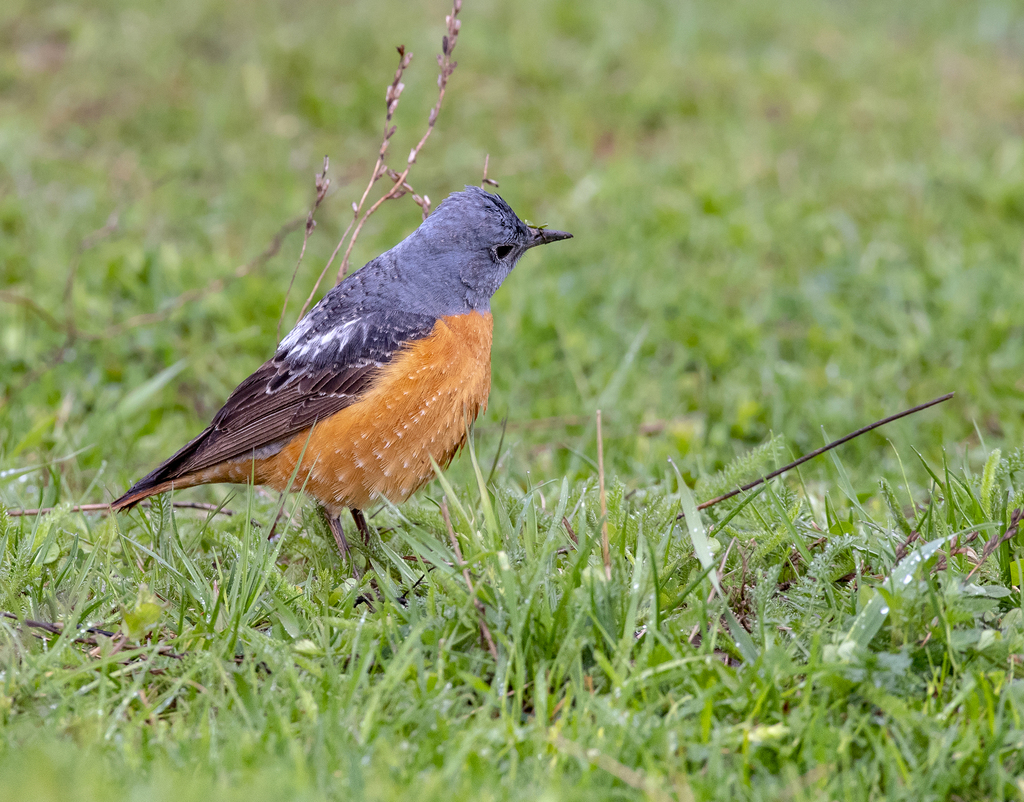
Common Rock Thrush
Photo © Griha Hasanov
Photo © Griha Hasanov — CC BY 4.0 — Source: iNaturalist #80355953Identification
The common rock thrush is a medium-sized, stocky thrush measuring 17–20 cm in length. The summer male is unmistakable and highly distinctive, displaying a striking blue-grey head contrasting sharply with bright orange underparts and outer tail feathers. The wings are dark brown and the back is white, creating a bold and colourful appearance. Females and immatures are far less conspicuous, with dark brown scaly upperparts and paler brown scaly underparts that provide excellent camouflage in rocky terrain. However, both sexes share reddish outer tail feathers, which can aid identification in the field.
Range & habitat
The common rock thrush breeds across southern Europe through Central Asia to northern China, making it a widespread species across a vast geographic range. This species is strongly migratory, with all populations wintering in Africa south of the Sahara. It is an uncommon visitor to northern Europe. The species favours open, dry hilly areas, typically breeding at elevations above 1500 metres. It nests in rock cavities, which provide shelter for its clutch of 4–5 eggs. Whilst the species is not considered globally endangered, its range has contracted somewhat at the periphery in recent decades due to habitat destruction.
Behaviour & diet
The common rock thrush is an omnivorous forager with a diverse diet encompassing a wide range of insects, berries, and small reptiles. The male possesses a clear and tuneful song, which it uses to defend territory and attract mates during the breeding season. This behaviour is particularly noticeable in the rocky mountain habitats where the species breeds, where sound carries well across open terrain.
Best time & places to see it
For those seeking to observe this species, the breeding season in southern European and Central Asian mountain ranges offers the best opportunities. Since all populations migrate to Africa for winter, sightings in northern Europe are uncommon and would be considered notable. Travellers visiting open, dry, rocky uplands above 1500 metres elevation during the breeding season stand the best chance of encountering this striking bird.
Photography tips
The vibrant plumage of breeding males makes them rewarding photographic subjects, particularly the contrasting blue-grey head and orange underparts. However, photographers should note that females and immatures are significantly more cryptic, requiring patience and careful observation in rocky terrain. Early morning light can enhance the brilliant colours of male birds, making dawn an ideal time for photography in suitable mountain habitats.
Aberdare National Park
Abijata-Shalla Lakes National Park
Abruzzo, Lazio and Molise National Park
Alpilles Regional Nature Park
Altai Tavan Bogd National Park
Altun Mountain National Nature Reserve
Amboseli National Park
Appennino Lucano Val d’Agri Lagonegrese National Park
Appennino Tosco-Emiliano National Park
Nothing matches these filters.
No community photos yet. Log in to add the first one.
No community observations of this species yet.