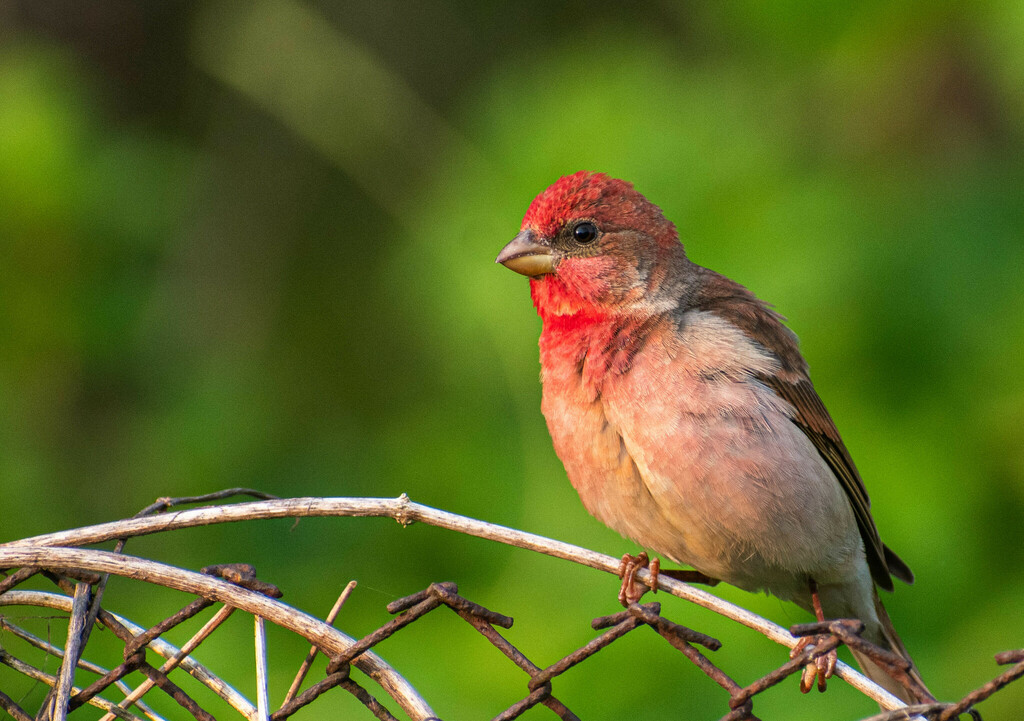
Common Rosefinch
Photo © Михаил Малышев
Photo © Михаил Малышев — CC BY 4.0 — Source: iNaturalist photo #284921386Identification
The common rosefinch is a small finch measuring 13–15 cm in length, instantly recognizable by its stout, conical bill adapted for cracking seeds. The most striking feature is the brilliant rosy-carmine plumage of mature males, which display this vibrant colouring on the head, breast, and rump, contrasting sharply with dark brown wings bearing two indistinct bars and a white belly. Females and young males are far more subdued, appearing dull yellowish-brown above with a brighter rump, greyer head, and buff underparts—a distinction that is crucial for field identification.
Interestingly, the intensity of male plumage varies seasonally. Adults moult between September and November in their winter quarters, after which the red colouring becomes temporarily subdued but brightens again during winter as feather wear progresses. A rare yellow variant exists in some populations, caused by environmental factors such as diet and parasites rather than genetics, adding another dimension to field identification challenges.
Range & Habitat
The common rosefinch is the most widespread and common rosefinch across Asia and Europe. It breeds across a vast range from the Danube valley, Sweden, and Siberia to the Bering Sea, with populations extending south through the Caucasus, northern Iran, Afghanistan, the western Himalayas, Tibet, and China to Japan, spanning latitudes between 25° and 68°. In recent decades, the species has dramatically expanded westward, reaching Portugal and appearing as a rare visitor to the British Isles, with some breeding records in recent years.
Seasonally, the species shifts its distribution, wintering from southern Iran to south-east China, India, Burma, and Indochina, with occasional vagrants recorded in Sri Lanka. During breeding season, common rosefinches favour thickets, woodland, and forest edges near rivers. In winter, they adapt to more human-modified landscapes, frequenting gardens, orchards, wetlands, and locally in dry oak woods, making them accessible to birdwatchers across diverse habitats.
Behaviour & Diet
Common rosefinches are seed-eating specialists, their heavy conical bills perfectly suited to cracking and processing seeds found in their preferred habitats. This dietary focus shapes their seasonal movements and habitat preferences, driving them toward areas rich in fruiting trees and seed-bearing plants.
During breeding season, pairs construct nests placed low in bushes, where females typically lay clutches of five dark blue eggs marked with coarse dark brown spots. This nesting strategy keeps eggs concealed in dense vegetation, offering protection from predators—an adaptation well-suited to their woodland and thicket habitats.
Best Time & Places to See It
The best time to observe common rosefinches depends on geography and season. In their breeding grounds across Siberia, Scandinavia, and Central Asia, late spring through summer offers the most reliable viewing opportunities. In winter quarters spanning southern Iran to south-east Asia, the species becomes more widespread and conspicuous in gardens, orchards, and agricultural areas.
Western European birdwatchers should watch for this expanding species in late spring and autumn, particularly in gardens and orchards where it increasingly appears as a vagrant. Birdwatchers in the British Isles may encounter migrants during spring and autumn passage, while Asian travellers visiting suitable habitats during winter months stand excellent chances of encountering this increasingly familiar finch.
Photography Tips
Photographing common rosefinches requires patience and attention to plumage detail. Male birds in breeding plumage offer the most dramatic photographic opportunities with their brilliant rosy-carmine colouration, though ensure adequate lighting to capture the vibrancy without blown highlights. Use a telephoto lens to maintain distance and avoid disturbing birds at low-set nests during the breeding season.
Remember that seasonal plumage variation and the rarity of yellow colour morphs make any photographs of unusual individuals valuable for documentation. Winter birds in gardens and orchards may be more approachable than wild populations, offering opportunities for detailed shots of the bill structure and plumage patterns that aid field identification for other observers.
The Classic Tour – 3 hours – all year round
Nothing matches these filters.
Kanha Tiger Reserve
Aggtelek National Park
Altai Tavan Bogd National Park
Baikal National Park
Baima Snow Mountain National Nature Reserve
Bandhavgarh National Park
Bandipur National Park
Banke National Park
Bardiya National Park
Nothing matches these filters.
No community photos yet. Log in to add the first one.
No community observations of this species yet.