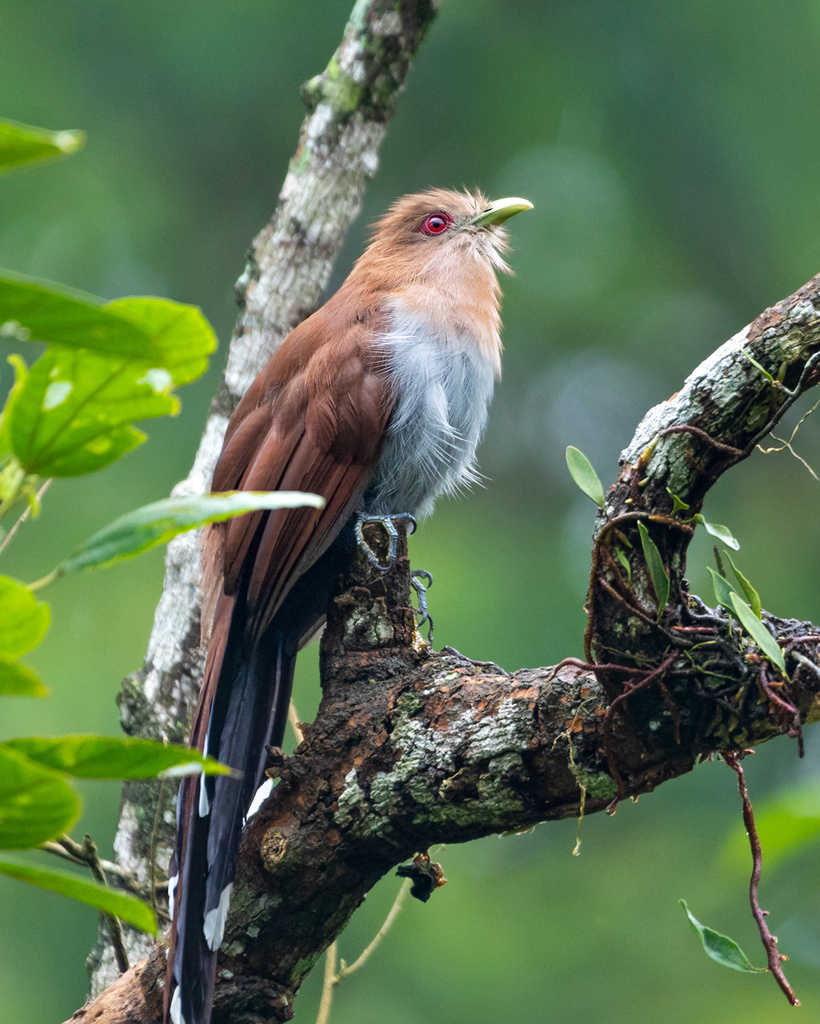
Common Squirrel Cuckoo
Photo © Paulo Mascaretti
Photo © Paulo Mascaretti — CC0 1.0 — Source: iNaturalist photo #348803492Identification
The common squirrel cuckoo is a large, extremely long-tailed cuckoo measuring 40.5–50 cm in length. Adults display mainly chestnut upperparts and head, becoming paler on the throat, with a grey lower breast and blackish belly. The central tail feathers are rufous, while the outer tail feathers are black with white tips. Look for the distinctive yellow bill and red iris. Immature birds are duller, with a grey bill, eyering, and brown iris. Geographic variation exists across subspecies: birds from Mexico, Central America, and northern and western South America have yellow eye-rings, while those in the remainder of South America have red eye-rings. Some South American subspecies also show brown rather than black outer tail feathers.
Range & Habitat
This species is found throughout wooded habitats from northwestern Mexico south to northern Argentina and Uruguay, as well as on Trinidad. The common squirrel cuckoo inhabits woodland canopy and edges, second growth, hedges, and semi-open habitats from sea level to 2,500 m elevation, though it is uncommon above 1,200 m.
Behaviour & Diet
True to its name, the common squirrel cuckoo runs along branches and leaps from branch to branch like a squirrel, normally flying only short distances with a gliding motion and occasional flaps. It feeds on large insects including cicadas, wasps, and caterpillars—even those with stinging hairs or spines—as well as occasional spiders, small amphibians, and small lizards. Non-flying prey is typically snatched from foliage with a quick lunge, while wasps may be caught in flight. The bird often forages peacefully alongside small mammals such as marmosets and attends army ant columns to pick off flushed prey. It frequently joins mixed-species feeding flocks. The species produces explosive "kip!" calls and a distinctive whistled song of repeated "wheep" notes.
Best Time & Places to See It
The common squirrel cuckoo is plentiful throughout most of its extensive range and relatively tolerant of human disturbance where woodland remains. Though bold and conspicuous compared to many cuckoos, it is most often encountered skulking within vegetation. Look for it in woodland canopy and edges across Central and South America, particularly in areas with mixed-species feeding flocks and around army ant columns during the dry season.
Photography Tips
Patience and attention to foliage movement will reward photographers seeking this active species. Position yourself in productive feeding areas, particularly where mixed-species flocks congregate or near army ant columns. The bird's chestnut and rufous plumage contrasts well with green woodland, and its long tail is a distinctive feature to capture. Early morning when feeding activity is high offers the best opportunities to photograph this relatively conspicuous but vegetation-loving cuckoo.
Guided Birding Tour
Nothing matches these filters.
Amacayacu National Park
Amazônia National Park
Anavilhanas National Park
Antisana National Park
Araucárias National Park
Arenal Volcano National Park
Bahuaja Sonene National Park
Barbilla National Park
Barra del Colorado National Wildlife Refuge
Nothing matches these filters.
No community photos yet. Log in to add the first one.
No community observations of this species yet.