Common Whitethroat
Curruca communis
Photo © Alexis Lours
Photo © Alexis Lours — CC BY 4.0 — Source: iNaturalist photo #509671088ABOUT
Subspecies of Common Whitethroat
Western Common WhitethroatEastern Common WhitethroatSouthern Common WhitethroatCurruca communis rubicola
Identification
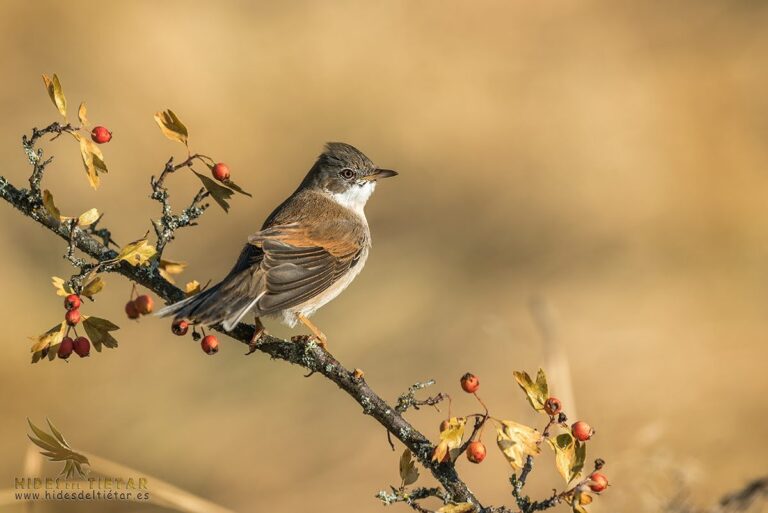
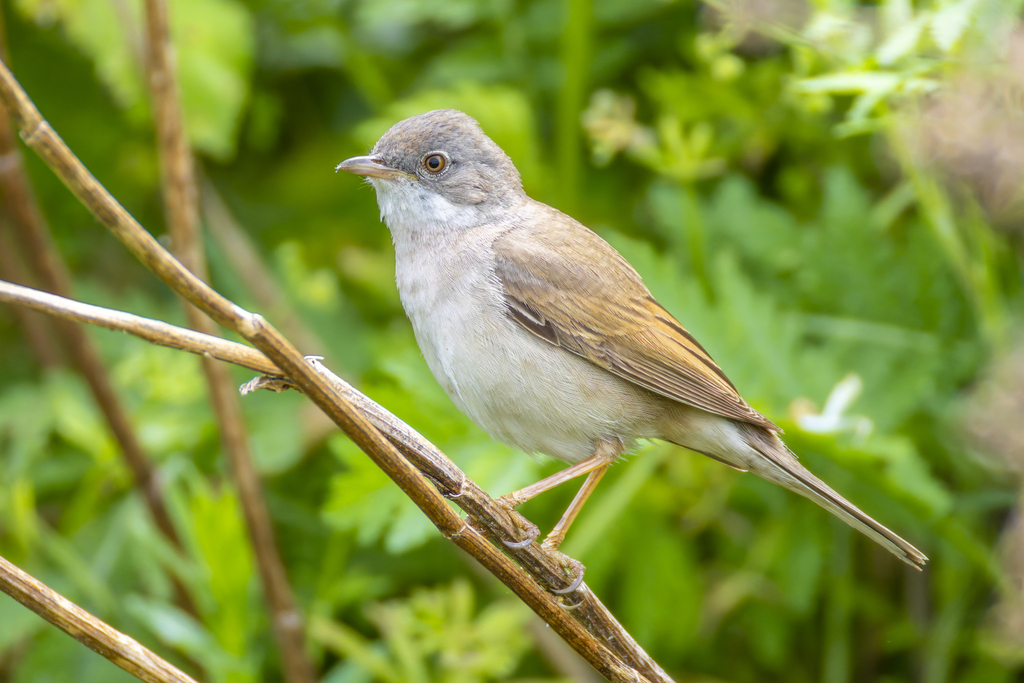
The Common Whitethroat is a small warbler with distinctive sexual dimorphism. Adult males display a striking grey head contrasting with a pure white throat, buff underparts, and brown upperparts with chestnut fringes to the secondary wing feathers. Females lack the grey head and have a duller, less conspicuous throat. Both sexes are compact and active, with a restless demeanour typical of their genus.
The species is highly vocal. Its song is characteristically fast, scratchy, and scolding in tone. The hoarse, slightly nasal call sounds like "wed-wed" or "woid-woid," while the warning cry is a long, rough "tschehr" reminiscent of the Dartford Warbler.
Range & Habitat
The Common Whitethroat breeds throughout Europe and across temperate western Asia, with four recognised subspecies showing different breeding and wintering distributions. The nominate subspecies breeds in Europe to northern Turkey and North Africa, wintering in west and central Africa, while eastern populations range from southeast European Russia through to central Asia, wintering in east and southern Africa.
This is a bird of open country and cultivation where suitable low shrubs and brambles provide nesting sites. The species is strongly migratory, abandoning breeding grounds entirely to winter in tropical Africa, Arabia, and Pakistan. Interestingly, western and eastern populations employ contrasting moulting and pre-migratory fuelling strategies to maximise energy stores before departure.
Behaviour & Diet
The Common Whitethroat is primarily insectivorous but supplements its diet with berries and soft fruit, particularly before migration. The species is restless and active, moving through low vegetation with quick, jerky movements. Nests are constructed in low shrubs or brambles, with clutches typically comprising 3–7 eggs.
Best Time & Places to See It
In Europe, the Common Whitethroat arrives in late spring and departs by early autumn. Prime viewing occurs during the breeding season in open habitats across the continent, from lowland farmland to scrubby hillsides. Birds are most easily detected when males are singing from exposed perches during territorial display.
Photography Tips
Male Common Whitethroats are more visually distinctive than females, making them the preferred photographic subject. Look for males perched prominently on bramble tops or singing from shrub summits—they often adopt characteristic postures while vocalising. The contrast between the grey head and white throat is most striking in good light. Early morning is ideal for capturing birds before they move into deeper cover. Patient stalking through suitable habitat and familiarity with the bird's scratchy song will improve encounter rates significantly.
HIDES
HOTSPOTS
Country
Type
Sort by
5,0 (1)
National Park
Murchison Falls National Park
Uganda
+608 birds+33 mammals
National Park
Aberdare National Park
Mweiga ward·Kenya
+394 birds+30 mammals
Natural Park
Alpilles Regional Nature Park
Saint-Rémy-de-Provence·France
+219 birds+37 mammals
National Park
Amboseli National Park
Etonet/Lenkism ward·Kenya
+501 birds+43 mammals
National Park
Arusha National Park
Tanzania
+555 birds+16 mammals
National Park
Åsnens National Park
Kronoberg County·Sweden
+141 birds+8 mammals
Natural Park
Avesnois Regional Nature Park
Saint-Hilaire-sur-Helpe·France
+206 birds+40 mammals
Nature Reserve
Bandia Wildlife Reserve
Sindia·Senegal
+162 birds+8 mammals
National Park
Bannau Brycheiniog National Park
Powys·United Kingdom
+178 birds+36 mammals
Nothing matches these filters.
COMMUNITY
Share your photo of this species
Sort by
No community photos yet. Log in to add the first one.
0
Observed by
0
Hotspots reported
0
Countries
No community observations of this species yet.