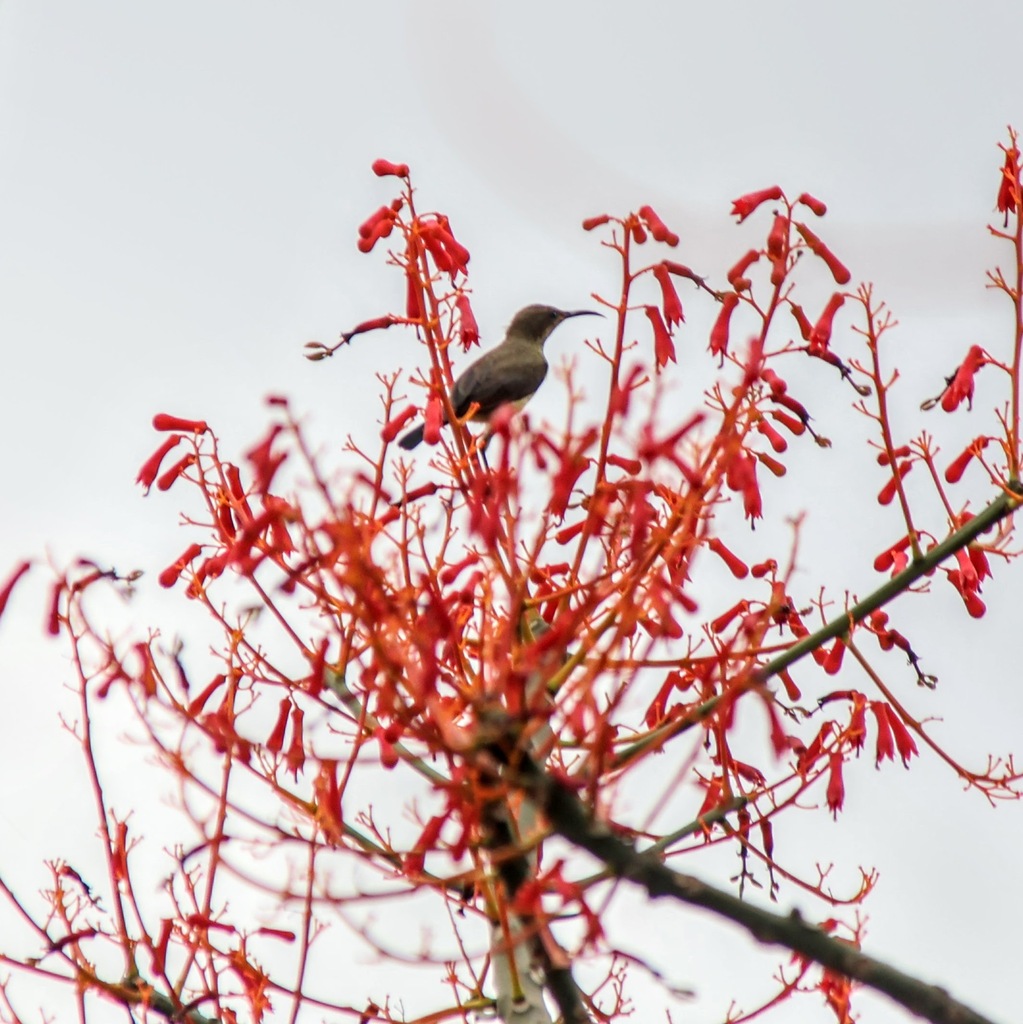
Copper Sunbird
Photo © cappycollins
Photo © cappycollins — CC BY 4.0 — Source: iNaturalist #336058013Identification
The copper sunbird is a small passerine, measuring about 12.5 cm (5 inches) in length. Males and females differ slightly in size, with males weighing 7.5 to 11 grams and females weighing 7.3 to 10.2 grams. Two subspecies are recognized: C. c. cupreus in the western portion of the range, and C. c. chalceus in the eastern half. The species' name derives from its distinctive coloring, which is particularly striking in males.
Range & Habitat
The copper sunbird is widely distributed across tropical Africa, with its range extending from Senegal and Guinea in the west to South Sudan and Kenya in the east, and southwards through Angola, Zambia, Zimbabwe, and Mozambique. The species is non-migratory and resident throughout its range, which spans over 30 African countries.
This adaptable species inhabits diverse environments, with savannas forming its primary habitat. However, it readily occupies degraded forest, woodland, marshes, mangroves, coastal thickets, and agricultural land, making it a common sight across much of tropical Africa.
Behaviour & Diet
Like other sunbirds, the copper sunbird is primarily a nectar-feeder, delicately sipping nectar from flowers using its specialized curved bill. The bird shows clear preferences for particular plants and trees, frequently visiting Calliandra species, Leonotis leonurus, Syzygium species, and Senegalia polyacantha for their floral resources.
Beyond nectar, the copper sunbird supplements its diet with fruits, spiders, and insects. It is an agile hunter capable of catching insects on the wing, demonstrating the hunting prowess characteristic of many small passerines.
Best Time & Places to See It
As a resident, non-migratory species, the copper sunbird can be encountered year-round throughout its range. Its abundance and adaptability to various habitats mean it is commonly encountered across savannas, woodland margins, and even cultivated areas throughout tropical Africa. The bird's wide distribution and large total population make it one of the more reliable sunbird sightings across much of the continent.
Photography Tips
The copper sunbird's small size and preference for flowers and flowering trees make it an engaging subject for bird photographers. Position yourself near flowering plants that attract the species, particularly Calliandra, Leonotis, and Syzygium trees where the birds concentrate their feeding activity. The bird's diminutive frame requires patience and a telephoto lens to capture fine detail, but its regular visits to blooming flowers reward those who wait. Early morning hours typically provide the best light for photography and increased bird activity.
Serengeti National Park
Tanzania
+558 birds+57 mammals
Across Tanzania's northern plateau, where volcanic soils meet acacia woodland and open grassland, unfolds one of Earth's most dynamic ecosystems. The Serengeti National Park sprawls across…
VIEW NATIONAL PARKChobe National Park
Botswana
+446 birds+45 mammals
Where the Chobe River cuts a sinuous path through northern Botswana, the landscape transforms into one of Africa's most dynamic wetland-savanna mosaics. This national park encompasses…
VIEW NATIONAL PARKVirunga National Park
Uganda
+418 birds+13 mammals
Where the Western Rift Valley fractures the landscape of North Kivu, Virunga National Park sprawls across terrain as geologically dramatic as it is ecologically vital. Volcanic…
VIEW NATIONAL PARKBwindi Impenetrable National Park
Kanyashogi, Uganda
+603 birds+26 mammals
Steep ridges cloaked in montane forest rise from Uganda's southwestern borderlands, where the landscape grows so dense and tangled that early explorers named it impenetrable. At…
VIEW NATIONAL PARKKidepo Valley National Park
Uganda
+478 birds+24 mammals
Where the Narus and Kidepo rivers carve through northeastern Uganda's semi-arid lowlands, a landscape of sparse acacia woodland, grassland, and riverine thickets creates one of East…
VIEW NATIONAL PARKMurchison Falls National Park
Uganda
+608 birds+33 mammals
Where the Victoria Nile compresses through a narrow gorge and explodes across a 45-meter precipice, the landscape speaks in thunder. Murchison Falls National Park sprawls across…
VIEW NATIONAL PARKMgahinga Gorilla National Park
Cyanika, Uganda
+429 birds+6 mammals
Where the Virunga Mountains rise steeply from the Uganda–Rwanda–Democratic Republic of Congo frontier, montane forest cloaks the volcanic slopes in a dense, moisture-laden embrace. Mgahinga Gorilla…
VIEW NATIONAL PARKLake Mburo National Park
Uganda
+505 birds+24 mammals
Rolling acacia woodland and scattered lakes define this intimate savanna preserve in southwestern Uganda, where the rift valley's geological drama shapes every water source and grassland.…
VIEW NATIONAL PARKToro-Semliki Proposed National Park
Uganda
+474 birds+5 mammals
Where the Albertine Rift's western escarpment rises above the Semliki River valley, a vast mosaic of forest, savanna and wetland converges to create one of East…
VIEW NATIONAL PARKMabamba Swamp
Memere, Uganda
+464 birds+2 mammals
Across the Central Region of Uganda spreads one of Africa's most biodiverse freshwater wetlands, a sprawling nature reserve of roughly 283 square kilometres where papyrus swamps…
VIEW NATURE RESERVEZiwa Rhino and Wildlife Ranch
Nakasongola, Uganda
+359 birds+11 mammals
Where papyrus wetlands merge into sprawling savanna, Uganda's central landscape opens into one of East Africa's most vital rhino recovery zones. Ziwa Rhino and Wildlife Ranch…
VIEW WILDLIFE SANCTUARYBwabwata National Park
Namibia
+377 birds+35 mammals
Where the Kavango River winds through northeastern Namibia, vast floodplains and dense riparian woodland create one of southern Africa's most ecologically dynamic protected landscapes. Spanning 14,249…
VIEW NATIONAL PARKRuma National Park
Suba, Kenya
+250 birds+8 mammals
Where the Winam Gulf narrows toward the Kenyan mainland, Ruma National Park rises as a sanctuary of evergreen woodland set within the humid tropics of Homa…
VIEW NATIONAL PARKSaiwa Swamp National Park
Sinyerere ward, Kenya
+255 birds+4 mammals
Where papyrus and sedge marshes stretch across a highland plateau in western Kenya, Saiwa Swamp National Park shelters one of East Africa's most productive freshwater wetland…
VIEW NATIONAL PARKNo community photos yet. Log in to add the first one.
No community observations of this species yet.