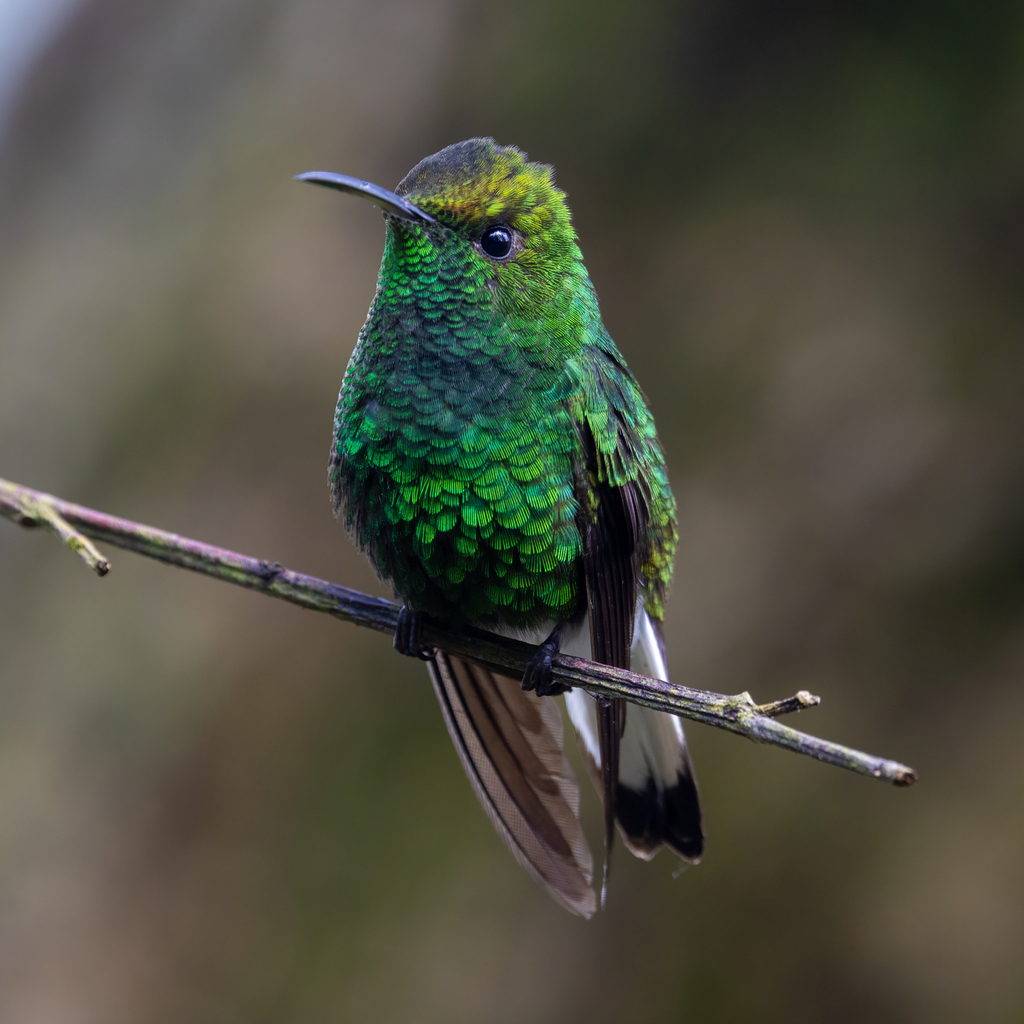
Coppery-headed Emerald
Photo © Dan Vickers
Photo © Dan Vickers — CC BY 4.0 — Source: iNaturalist photo #458657582Identification
The coppery-headed emerald is a diminutive hummingbird, measuring just 7.5 cm in length and weighing only 3.0 to 3.3 g. Both sexes sport a moderately decurved bill with a pinkish base on the mandible. The adult male is distinctive, featuring a dull coppery bronze crown contrasting with a bronze-green nape, back, and rump. Bright coppery bronze uppertail coverts are particularly striking, while the central tail feathers are bronze and the outer feathers are predominantly white with pale gray or black tips. The male's underparts gleam with bright yellowish metallic green plumage, accented by white undertail coverts. Notably, males in the far northern Cordillera de Guanacaste display a purple spot at the center of the breast. The adult female is more subdued, with metallic green upperparts and duller white to grayish-white underparts that brighten toward the vent, complemented by metallic green spots along the flanks.
Range & Habitat
This emerald is endemic to the highlands of northern and central Costa Rica, primarily inhabiting the Caribbean slope, though the far-northern populations also frequent the Pacific slope. The species occupies elevations from 300 to 1,500 m on the Caribbean side, but rarely descends below 1,200 m on the Pacific slope. Coppery-headed emeralds favour the edges and interior of moist to humid montane forest, where males typically forage in the canopy while females prefer the understory, though both sexes occur at all levels in semi-open areas and clearings.
Behaviour & Diet
These hummingbirds are highly specialized nectarivores, visiting a diverse array of flowering plants including genera such as Besleria, Cavendishia, Clusia, Guarea, Pithecellobium, Quararibea, Satyria, and Inga. Beyond nectar, they supplement their diet by gleaning small arthropods from foliage and capturing prey through aerial hawking from perches. Following the breeding season, which extends from October to March, birds descend to lower elevations. During breeding, males gather at leks where they sing from perches and chase rivals to court females. Females construct delicate cup nests from plant down and tree fern scales bound with spiderweb, typically placing them 1 to 3 m above ground in understory locations or forest edges. Each clutch consists of two eggs.
Best Time & Places to See It
The coppery-headed emerald is fairly common throughout its range and can be found in many protected areas across Costa Rica's highlands. The breeding season from October to March offers the best opportunity to observe males at their leks, where their characteristic "high, thin, twittering and warbling" song fills the montane forest. After breeding, birds move to lower elevations within their range, making them more accessible to travellers visiting mid-elevation cloud forests.
Photography Tips
Photographing this species requires patience and attention to light. The male's coppery crown and metallic underparts are highly reflective; position yourself to capture side-lighting that accentuates these iridescent features. Forest edge and semi-open clearings offer better photographic conditions than dense canopy. Early morning visits to flowering plants and shrubs will increase your chances of encounters. The bird's small size and rapid movements demand fast shutter speeds and careful focus tracking. Males at leks provide excellent opportunities for behaviour photography during the October-to-March breeding season.
Arenal Volcano National Park
Peñas Blancas, Costa Rica
+551 birds+21 mammals
Straddling the border between Alajuela and Guanacaste in northwestern Costa Rica, this national park rises dramatically around one of Central America's most active volcanic systems. The…
VIEW NATIONAL PARKBraulio Carrillo National Park
Las Horquetas, Costa Rica
+547 birds+18 mammals
Where the Caribbean slope descends from the central volcanic cordillera toward the humid lowlands of Heredia, Braulio Carrillo National Park preserves one of Costa Rica's most…
VIEW NATIONAL PARKGuanacaste National Park
Santa Elena, Costa Rica
+461 birds+17 mammals
Where the Pacific slopes of northwestern Costa Rica rise toward the Continental Divide, dry tropical forest gives way to cloud-laden peaks and misty ridges—a landscape that…
VIEW NATIONAL PARKVolcán Poás National Park
Toro Amarillo, Costa Rica
+237 birds+4 mammals
Where volcanic slopes rise sharply from the Central Valley floor, Volcán Poás National Park protects one of Costa Rica's most active and accessible volcanic systems. The…
VIEW NATIONAL PARKRincón de la Vieja National Park
Liberia, Costa Rica
+451 birds+30 mammals
Where volcanic slopes rise abruptly from the Guanacaste lowlands, Rincón de la Vieja National Park sprawls across a landscape shaped by geothermal drama and seasonal extremes.…
VIEW NATIONAL PARKTapantí Macizo de la Muerte National Park
Orosi, Costa Rica
+503 birds+18 mammals
Where montane cloud forest rises steeply from the Orosi Valley, Tapantí Macizo de la Muerte National Park enfolds a landscape of perpetual moisture and emerald complexity.…
VIEW NATIONAL PARKVolcán Tenorio National Park
Guatuso, Costa Rica
+480 birds+12 mammals
Where volcanic slopes rise through Costa Rica's northwestern borderlands, Volcán Tenorio National Park sprawls across terrain shaped by ancient lava flows and mineral-rich springs. The park's…
VIEW NATIONAL PARKNo community photos yet. Log in to add the first one.
No community observations of this species yet.