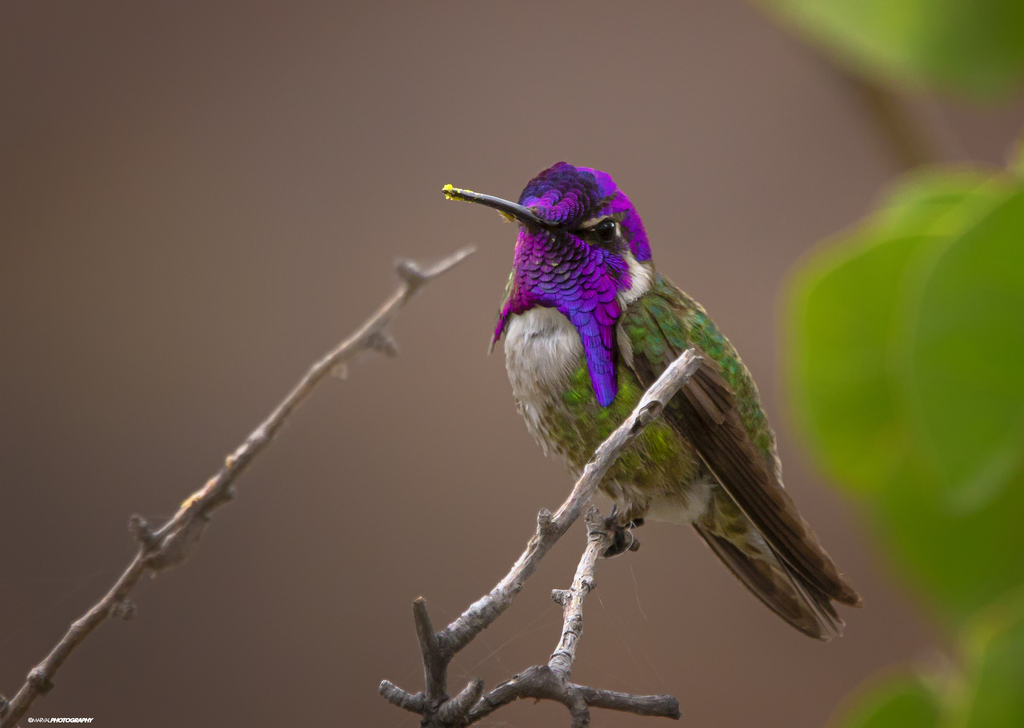
Costa’s Hummingbird
Photo © MarvalPhotography19
Photo © MarvalPhotography19 — CC BY 4.0 — Source: iNaturalist photo #364544963Identification
Costa's Hummingbird is a tiny species, measuring only 3–3.5 inches in length with an 11 cm wingspan and weighing around 3 grams. The male is unmistakable, sporting a vibrant purple cap and gorget (throat patch) with feathers that flare dramatically outward and back behind the head. Males display a mainly green back and flanks, contrasting with small black tail and wings, plus distinctive white patches below the gorget and tail. Females are far more subdued, presenting grayish-green upperparts with a white belly, making them challenging to distinguish from other small hummingbird species in the region.
Range & Habitat
Costa's Hummingbird breeds across the arid, semi-arid, and Mediterranean climate zones of the Southwestern United States and northwestern Mexico, with populations concentrated in Southern California and the Baja California Peninsula. The species is highly adaptable, thriving in both cultivated and wild habitats: you'll find them visiting backyard feeders and flowering gardens near human settlements, as well as in natural ecosystems including conifer and oak forests, chaparral, and high desert environments further inland. Pacific coastal areas are favored breeding grounds. During winter months, the species often migrates to western Mexico.
Behaviour & Diet
Males perform spectacular courtship displays featuring high-speed dives and arcing swoops, carefully angling their bodies to catch the sun and flash their iridescent purple gorget at prospective mates. These aerial maneuvers are accompanied by distinctive high-pitched vibrations produced by the tail feathers, followed by scratch-like vocalizations delivered from a perch. Females construct delicate cup-shaped nests from plant fibers, down, and spider silk, reinforced with lichen. A typical clutch consists of just two white eggs, incubated for 15–18 days, with young fledging after 20–23 days.
Like all hummingbirds, Costa's feeds primarily on flower nectar and small insects, hovering while foraging. The species exhibits torpor during cold nights, entering a hibernation-like state in which heart rate and respiration dramatically decrease, conserving precious energy reserves.
Best Time & Places to See It
Costa's Hummingbird is common in its range, making sightings reasonably reliable for travelers exploring the Southwestern deserts and Baja California during the breeding season. Backyard feeders and flowering gardens in Southern California offer the most accessible viewing opportunities. Desert habitats and chaparral regions attract birds seeking natural food sources, while protected areas within the species' range provide additional reliable locations for observation.
Photography Tips
The male's vibrant purple plumage is the primary photographic draw. Capture males during their dramatic courtship displays by positioning yourself with the sun behind or to the side—the angle of light is critical for showcasing the gorget's iridescent flash. High shutter speeds are essential to freeze the rapid wing beats and swift diving movements. Patient observers at feeders or flowering plants can obtain close, detailed shots. The female's subtle coloring demands careful exposure metering to retain detail in the pale underparts against darker backgrounds.
Big Bend National Park
Brewster County, United States
+345 birds+34 mammals
Where the Chisos Mountains rise abruptly from the Sonoran Desert floor, Big Bend National Park spans over 7,300 square kilometers of one of North America's most…
VIEW NATIONAL PARKSaguaro National Park
Rincon Valley, United States
+354 birds+40 mammals
Where the Sonoran Desert meets sky-island mountains, two geographically separated districts of Saguaro National Park sprawl across nearly two thousand square kilometers of Arizona's most iconic…
VIEW NATIONAL PARKPinnacles National Park
San Benito County, United States
+197 birds+33 mammals
Jagged volcanic spires thrust from chaparral-covered ridges across 222 square kilometers of central California's inner Coast Ranges, their pale stone crowns catching the afternoon light like…
VIEW NATIONAL PARKJoshua Tree National Park
Riverside County, United States
+221 birds+23 mammals
Across 5,610 square kilometers of Riverside County's high desert, a landscape of geological drama unfolds where granite monoliths pierce through bajadas of creosote scrub and Joshua…
VIEW NATIONAL PARKZion National Park
Washington County, United States
+244 birds+30 mammals
Towering sandstone cliffs in shades of crimson, rust, and cream rise abruptly from the Virgin River's winding canyon floor, their sculpted faces bearing witness to millions…
VIEW NATIONAL PARKYosemite National Park
Mariposa County, United States
+224 birds+28 mammals
Granite cliffs soar nearly a kilometer above the valley floor in this expanse of high Sierra wilderness, where glacial U-shaped valleys sculpt a landscape of dramatic…
VIEW NATIONAL PARKSequoia National Park
Tulare County, United States
+187 birds+27 mammals
Granite peaks rising above 3,600 meters dominate the southern Sierra Nevada, where Sequoia National Park sprawls across one of North America's most vertically compressed wilderness zones.…
VIEW NATIONAL PARKKings Canyon National Park
Fresno County, United States
+186 birds+20 mammals
Where granite peaks fracture the Sierra Nevada skyline and the Kings River has carved one of North America's most dramatic canyons, a landscape of extreme relief…
VIEW NATIONAL PARKDeath Valley National Park
Inyo County, United States
+339 birds+25 mammals
Across nearly 3.5 million acres of southeastern California's Inyo County, vast salt flats meet sculpted badlands and alluvial fans in a landscape so extreme it defines…
VIEW NATIONAL PARKEl Vizcaíno
Laguna San Ignacio, Mexico
+317 birds+29 mammals
Where the Baja California peninsula thins into a tapestry of salt lagoons and coastal desert, one of Mexico's most biodiverse reserves sprawls across half a million…
VIEW BIOSPHERE RESERVEChannel Islands National Park
Santa Barbara County, United States
+330 birds+15 mammals
A chain of eight volcanic islands rises from the cold Pacific waters off the California coast, their rugged sea cliffs and windswept terrain shaped by millions…
VIEW NATIONAL PARKGrand Canyon National Park
United States
+277 birds+35 mammals
A mile-deep chasm of rust-red rock and purple shadow cuts through the high desert plateau of northern Arizona, revealing nearly two billion years of geological history…
VIEW NATIONAL PARKCabeza Prieta National Wildlife Refuge
United States
+155 birds+6 mammals
Across southwestern Arizona's harshest terrain, where the Colorado River marks the border with Mexico, lies a sanctuary shaped entirely by heat and aridity. Cabeza Prieta National…
VIEW WILDLIFE SANCTUARYKofa National Wildlife Refuge
Yuma County, United States
+142 birds+10 mammals
Desert mountains rise in sculptured ridges across northwestern Arizona, where the Colorado River's distant influence fades into some of the most austere terrain in the American…
VIEW WILDLIFE SANCTUARYHavasu National Wildlife Refuge
Lake Havasu City, United States
+291 birds+8 mammals
Where the Colorado River widens into a vast reservoir in the Sonoran Desert, Havasu National Wildlife Sanctuary protects one of the most critical wetland ecosystems in…
VIEW WILDLIFE SANCTUARYImperial National Wildlife Refuge
La Paz County, United States
+222 birds+4 mammals
Where the Colorado River carves through the Sonoran Desert in southwestern Arizona, Imperial National Wildlife Sanctuary unfolds across a landscape shaped by water and aridity. The…
VIEW WILDLIFE SANCTUARYFarallon National Wildlife Refuge
San Francisco, United States
+384 birds+16 mammals
Windswept granite peaks rising abruptly from the Pacific, the Farallon Islands form a wildlife sanctuary of extraordinary seabird abundance and ecological significance just twenty-seven miles west…
VIEW WILDLIFE SANCTUARYSalton Sea National Wildlife Refuge
Imperial County, United States
+289 birds+4 mammals
Across the floor of California's inland desert, where summer temperatures soar and rainfall is measured in tenths of inches, lies an improbable oasis of shallow water…
VIEW WILDLIFE SANCTUARYNo community photos yet. Log in to add the first one.
No community observations of this species yet.