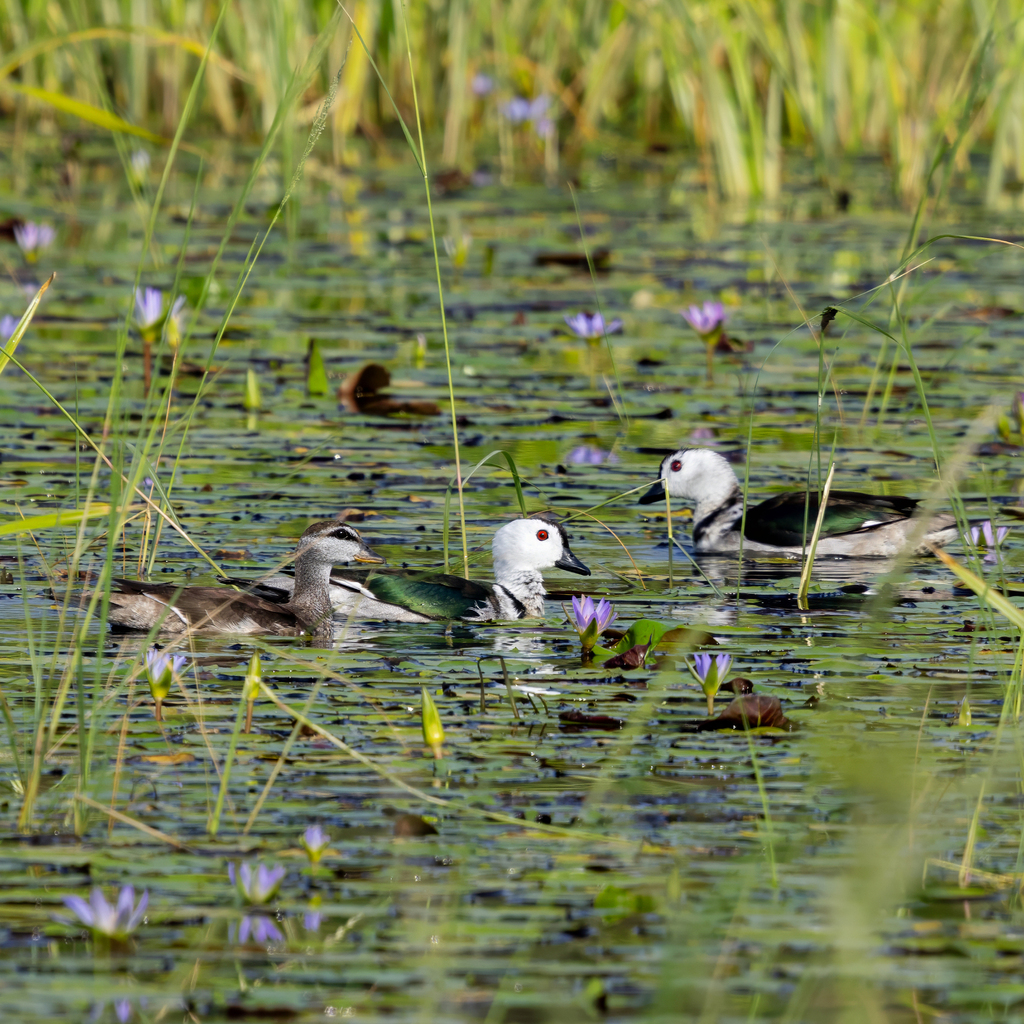
Cotton Pygmy Goose
Photo © Dan Vickers
Photo © Dan Vickers — CC BY 4.0 — Source: iNaturalist #341884270Identification
The cotton pygmy goose is among the smallest waterfowl in the world, with individuals weighing as little as 160 g and measuring just 26 cm in length. Males are distinctively marked with a dark brown forehead and crown, a blackish-green broad collar at the base of the neck, and whitish sides to the head and neck. The back and wing coverts are dark brown with a green and purple gloss. In flight, males display dark wings with white flight feathers tipped in black. Females are considerably duller, featuring a brown line through the eye, spots replacing the male's collar, and a flecked face. Both sexes have a red iris, black legs, and a short, deep goose-like bill. Non-breeding males resemble females but retain a broader white wing band.
Range & Habitat
This species is widely distributed across Asia, from India through Southeast Asia to Queensland, Australia, where they are sometimes called the white-quilled pygmy goose. Populations are highly mobile, moving in response to rainfall and water availability. Winter dispersal is particularly extensive, with individuals recorded as far west as Arabia and Jordan, and regularly on islands including the Maldives and the Andamans. In summer, some populations are found only seasonally in places such as Afghanistan.
Cotton pygmy geese favour small to large waterbodies with abundant aquatic vegetation, from lakes and ponds to village ponds in South Asia and lagoons in Australia. They are typically seen in pairs or larger groups of pairs, roosting and nesting in trees near water.
Behaviour & Diet
These ducks are strong, swift fliers, often flying low over water with agility sufficient to evade falcons. They are capable of taking flight directly from the water surface without the need to run or patter. Several pairs may forage in close proximity on a single waterbody, and large flocks form in winter—notably, a flock of nearly 6000 was recorded at Chilka Lake.
Cotton pygmy geese feed mainly at the water's surface, consuming small fishes, molluscs, crustaceans, and insect larvae, along with plant matter. They do not dive or up-end. Breeding occurs during the rainy season (June–August in India, January–March in Australia), when pairs nest in natural tree hollows, sometimes as high as five metres from the ground. Females lay 6 to 12 ivory-coloured eggs, and chicks leap from nests to follow their parents into the water.
Best Time & Places to See It
The cotton pygmy goose is most reliably encountered during the breeding season when pairs are actively nesting and feeding near waterbodies with emergent vegetation. However, large concentrations can be observed during winter months when flocks assemble on favoured lakes and ponds across their range. For visitors to South Asia, village ponds and larger lakes offer accessible viewing opportunities. Australian locations, particularly lagoons in Queensland, provide excellent chances to observe the slightly larger Australian subspecies. Winter dispersal to unexpected locations adds an element of discovery for dedicated birders.
Photography Tips
The cotton pygmy goose's small size and affinity for trees present both challenges and opportunities for photographers. Early morning light is ideal for capturing the subtle plumage details, particularly the glossy green and purple tones on the back and the white neck markings of breeding males. Patience is rewarded when photographing courting pairs, as males perform distinctive post-copulatory displays with arched necks and flared white feathers. Position yourself quietly near tree-lined waterbodies where these birds roost; their swift, low flights over water can be challenging to capture, but their agility and grace make for dynamic shots. In winter, larger flocking behaviour offers opportunities for broader landscape compositions, though individual portraits remain most striking given their striking sexual dimorphism.
Lunugamvehera National Park
Sri Lanka
+204 birds+14 mammals
Dry scrubland and shallow wetlands converge in Sri Lanka's southeastern lowlands, where Lunugamvehera National Park anchors one of the island's most ecologically vital landscapes. The park's…
VIEW NATIONAL PARKWasgamuwa National Park
Sri Lanka
+156 birds+8 mammals
Dry deciduous forest and open grassland sweep across the North Central lowlands where Wasgamuwa National Park protects one of Sri Lanka's largest remaining tracts of this…
VIEW NATIONAL PARKOrang National Park
Rangagarapathar, India
+298 birds+1 mammals
Where the Brahmaputra's floodplains meet the foothills of Assam, Orang National Park unfolds across a mosaic of riverine grasslands, forests and wetlands that pulse with the…
VIEW NATIONAL PARKRanthambhore National Park
Sawai Madhopur, India
+294 birds+20 mammals
Granite ridges and ravines carved through the Aravalli Range frame this protected landscape in eastern Rajasthan, where deciduous forest mingles with open scrubland and seasonal water…
VIEW NATIONAL PARKKhao Yai National Park
Prachantakham District, Thailand
+377 birds+46 mammals
Evergreen dipterocarp forest blankets the rolling terrain of this national park in eastern Thailand, where limestone hills rise abruptly from the forest floor and seasonal streams…
VIEW NATIONAL PARKDaintree National Park
Dedin, Australia
+362 birds+37 mammals
Daintree National Park is one of the world’s oldest and most biologically diverse tropical rainforests, protecting an extraordinary landscape where ancient forests meet the Great Barrier…
VIEW NATIONAL PARKKanha Tiger Reserve
Kanha Kisli F.V., India
+321 birds+23 mammals
Where sal forests give way to emerald meadows and crystalline streams carve through ancient valleys, one of India's finest wilderness reserves unfolds across the Maikal Range.…
VIEW NATIONAL PARKTadoba National Park
Palasgaon Singru, India
+270 birds+20 mammals
Where sal forests meet open grasslands and rocky outcrops rise from red laterite soil, central India's landscape unfolds in raw, untamed beauty. Ancient teak woodlands and…
VIEW NATIONAL PARKBandhavgarh National Park
Garhpuri, India
+285 birds+17 mammals
Where granite ridges rise dramatically above sal and bamboo forests, one of India's most pristine tiger reserves unfolds across the Vindhyan plateau. Ancient rock formations tower…
VIEW NATIONAL PARKPanna National Park
Badgadi Kalan, India
+271 birds+17 mammals
Where granite gorges slice through central India's Vindhyan plateau, a landscape of stark beauty unfolds across nearly six hundred square kilometers. The Ken River carves through…
VIEW NATIONAL PARKKaziranga National Park
Kohora, India
+422 birds+26 mammals
Dawn breaks over the floodplains of the Brahmaputra, where tall grasslands stretch endlessly beneath monsoon-heavy skies. This sprawling wilderness of northeastern Assam is a mosaic of…
VIEW NATIONAL PARKKeoladeo National Park
Shreenagar Rural, India
+326 birds+14 mammals
Where shallow wetlands shimmer beneath vast Rajasthani skies, one of Asia's finest bird sanctuaries pulses with extraordinary life. This former maharaja's hunting reserve, now spanning 29…
VIEW NATIONAL PARKBandipur National Park
Hirehalli, India
+302 birds+19 mammals
Where the Western Ghats descend into the Deccan plateau, ancient deciduous forests blanket a landscape carved by the Nugu River. Bandipur unfolds across 880 square kilometres…
VIEW NATIONAL PARKNagarahole Tiger Reserve
Nalkeri Forest, India
+323 birds+23 mammals
Where granite escarpments rise above dense deciduous forests and the Kabini River carves through pristine wilderness, one of India's most biodiverse landscapes unfolds across the Western…
VIEW NATIONAL PARKGir National Park
Asundrali, India
+258 birds+13 mammals
Dry deciduous forests cloak the rolling hills of western Gujarat where the Gir landscape rises as a final sanctuary for one of the world's rarest felids:…
VIEW NATIONAL PARKGreat Sandy National Park
Australia
+306 birds+40 mammals
Where coastal dunes rise inland from the Queensland coastline, Great Sandy National Park encompasses a landscape of remarkable ecological diversity shaped by subtropical humid conditions year-round.…
VIEW NATIONAL PARKPoyang Lake National Nature Reserve
Shangrao, China
+270 birds+7 mammals
Where the Yangtze River's massive floodplain spreads across central China, Poyang Lake National Nature Reserve encompasses one of the continent's most dynamic and water-rich wetland systems.…
VIEW NATURE RESERVEQinghai Lake National Nature Reserve
Hainan Tibetan Autonomous Prefecture, China
+243 birds+11 mammals
At 3,200 metres above sea level on the Tibetan plateau, where winter temperatures plunge far below freezing and snow blankets the landscape for half the year,…
VIEW NATURE RESERVENo community photos yet. Log in to add the first one.
No community observations of this species yet.