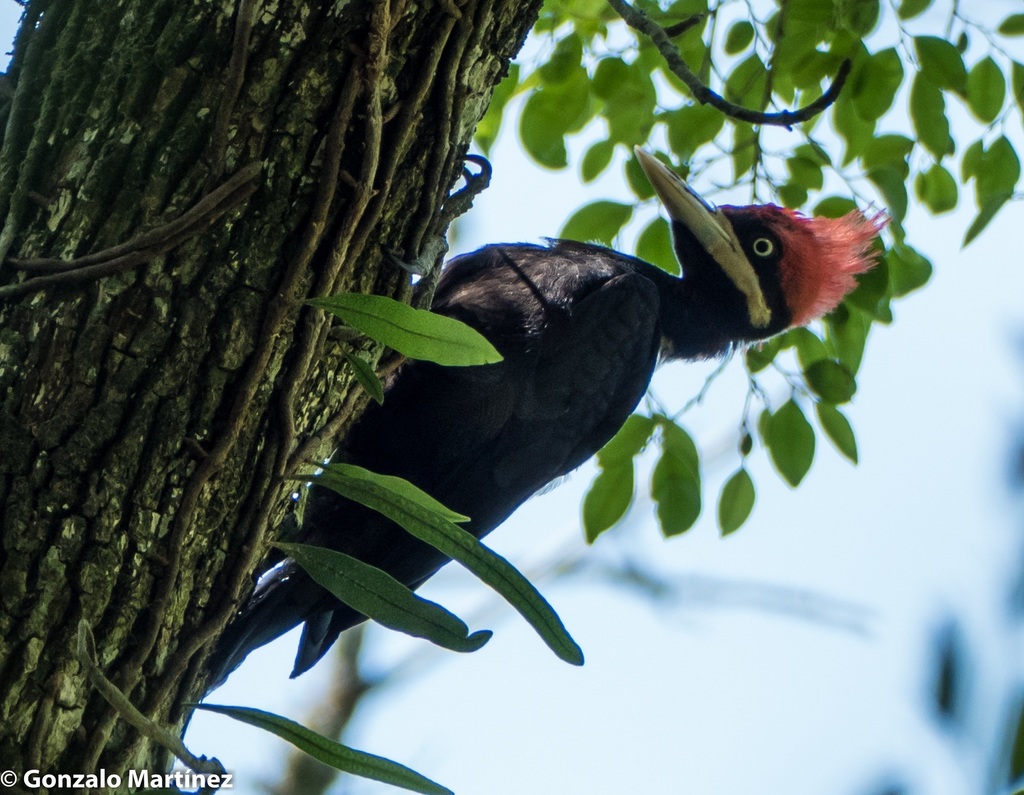
Cream-backed Woodpecker
Photo © Gonzalo Martinez
Photo © Gonzalo Martinez — CC BY 4.0 — Source: iNaturalist #83198617Identification
The cream-backed woodpecker is a large woodpecker measuring 28 to 30 cm in length and weighing 203 to 281 grams. Both sexes sport distinctive plumage that makes identification straightforward. Males display an entirely red head, crest, and neck, interrupted only by a small black and white spot on the ear coverts. Females are equally striking, with a longer crest than males and a creamy band extending from the bill to the ear coverts, bordered by black lines above and below. The most characteristic feature shared by both sexes is the cream or pale cinnamon-buff upper back contrasting sharply with mostly black underparts. In flight, pale cinnamon coloring is visible on the inner webs of flight feathers. The species has a long ivory-colored chisel bill, pale yellow iris, and gray legs. Juveniles are similar to adults but display less red coloration, appearing more orange instead.
Range & Habitat
The cream-backed woodpecker is found across south-central South America, ranging from north-central Bolivia and western and central Paraguay through southeastern Brazil's Rio Grande do Sul, down to north-central Argentina and northern Uruguay. This species inhabits the open and semi-open landscapes of the dry Gran Chaco region, favoring savannas, woodlands, transitional forests, pastures dotted with tree copses, and palm groves. It is remarkably adaptable to elevation, occurring from lowlands up to 2,500 meters.
Behaviour & Diet
The cream-backed woodpecker is a year-round resident throughout its range, never undertaking long-distance migrations. Its diet consists primarily of beetle larvae, which it obtains by hammering into wood—its principal foraging technique—and occasionally through pecking and probing. The species typically forages alone in tall, often isolated trees, though it will also investigate fallen logs. During breeding season, which begins in September and peaks in October and November, pairs excavate nest holes in trees or palms, typically 6 to 8 meters above ground. Both parents share the responsibility of feeding nestlings, though many aspects of their breeding biology remain poorly documented.
Best Time & Places to See It
The breeding season from September through November offers the best opportunity to locate this species, as pairs become more visible during nest excavation and parental activities. The cream-backed woodpecker's preference for tall, isolated trees in open landscapes makes it relatively conspicuous in suitable habitat. Travelers exploring the Gran Chaco region of Bolivia, Paraguay, Argentina, and Brazil should scan savannas and open woodlands for these birds. However, the species is poorly known and probably not common, so patience and persistence are essential.
Photography Tips
Photograph cream-backed woodpeckers in open habitats where tall trees stand isolated against clear backgrounds—these settings provide excellent compositional opportunities. The species' striking red and black head markings and cream-backed plumage create compelling subjects, especially when capturing the subtle differences between males and females. Listen for its distinctive "pi-ow" or "kwee-yaw" calls and the characteristic double-tap drum to locate birds. Early morning sessions during breeding season offer the best chance of encountering active pairs near nest sites.
El Palmar National Park
Distrito Sexto, Argentina
+244 birds+14 mammals
Across the Paraná River floodplain in northeastern Argentina, palms rise from wetland and grassland in a landscape shaped by water and time. El Palmar National Park…
VIEW NATIONAL PARKRío Pilcomayo National Park
Argentina
+271 birds+13 mammals
Where the Río Pilcomayo cuts through northeastern Argentina's subtropical lowlands, a sprawling mosaic of wetlands, grasslands, and seasonally flooded forests creates one of South America's most…
VIEW NATIONAL PARKEl Rey National Park
Municipio de Las Lajitas, Argentina
+317 birds+4 mammals
Where the eastern slopes of the Andes descend into northwestern Argentina's subtropical transition zone, El Rey National Park unfolds across 841 square kilometers of dramatically varied…
VIEW NATIONAL PARKCalilegua National Park
Municipio de Calilegua, Argentina
+288 birds+8 mammals
Where the eastern Andean slopes plunge into northwestern Argentina's humid subtropics, nearly 2,645 square kilometers of steep terrain and luxuriant forest compose one of South America's…
VIEW NATIONAL PARKSierra de las Quijadas National Park
Argentina
+168 birds+5 mammals
Sandstone cliffs and deeply incised canyons define this 1,137-square-kilometre expanse in San Luis Province, where the dry Chacoan landscape of central Argentina reveals an unexpected ecological…
VIEW NATIONAL PARKBaritú National Park
Argentina
+81 birds+2 mammals
Where the eastern slopes of the Serranías del Hornocal descend into cloud forest and subtropical ravines, Baritú National Park protects one of northwestern Argentina's most biodiverse…
VIEW NATIONAL PARKParque Provincial Pampa del Indio
Laguna Limpia, Argentina
+231 birds+4 mammals
Across the flat horizons of Chaco Province, where the Paraná River system spills into vast wetlands and grasslands, Parque Provincial Pampa del Indio protects one of…
VIEW NATURE RESERVEChaco National Park
Municipio de Presidencia de la Plaza, Argentina
+258 birds+7 mammals
Across the humid subtropical lowlands of northeastern Argentina, where the Paraná River basin feeds vast seasonal wetlands and gallery forests, Chaco National Park protects one of…
VIEW NATIONAL PARKNo community photos yet. Log in to add the first one.
No community observations of this species yet.