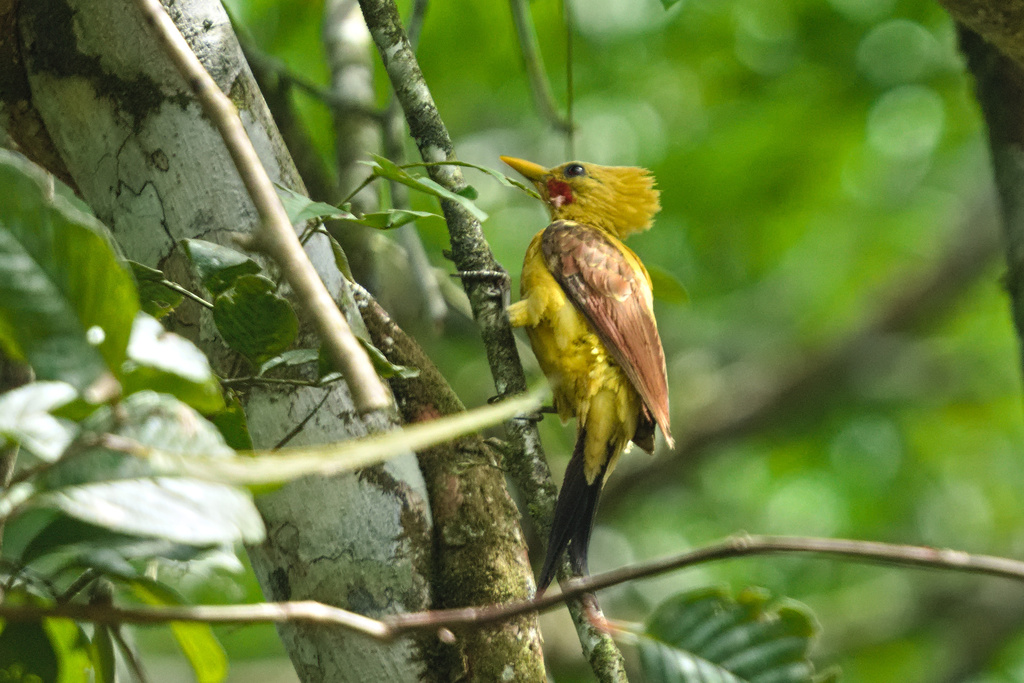
Cream-colored Woodpecker
Photo © Attila Oláh
Photo © Attila Oláh — CC BY 4.0 — Source: iNaturalist photo #531772700Identification
The cream-colored woodpecker is a medium-sized woodpecker measuring 24 to 27 cm in length. Its most striking feature is its predominantly yellowish plumage, which varies among individuals from pale creamy yellow to sulfur-yellow, and occasionally cinnamon-white. The bird sports a long crest and a contrasting black tail. Adult males are distinguished by a bright red malar stripe (cheek patch), while females lack this red marking. The bill is yellowish, the iris is red or red-brown, and the legs are dark gray to green-gray. Juveniles resemble adults but typically display buffier or cinnamon-buff tones. Subspecific differences exist primarily in size and wing coloration, with some populations showing more rufous-chestnut in the flight feathers while others display predominantly brown wings.
Range & Habitat
This species is distributed across most of mainland South America, excluding Argentina, Chile, Paraguay, and Uruguay. Four recognized subspecies occupy distinct ranges: the nominate form inhabits eastern Colombia, Venezuela, the Guianas, northeastern Brazil, and extending south through Ecuador to northern Bolivia; C.f. peruvianus occupies eastern Peru; C.f. tectricialis is found in Maranhão state in northeastern Brazil; and C.f. subflavus inhabits eastern and southeastern Brazil from Alagoas south to Espírito Santo. The cream-colored woodpecker favors humid forest landscapes, particularly the interior and edges of rainforest, várzea, and swamp forest. It also occurs in gallery forest, mangroves, deciduous woodland, secondary forest, and human-altered landscapes such as cacao plantations. The species typically remains below 400 meters elevation but ranges up to 700 meters.
Behaviour & Diet
The cream-colored woodpecker is a year-round resident throughout its range. Its diet consists primarily of ants and termites, supplemented by significant amounts of fruits and seeds. The bird forages at various levels—from the lower and middle forest strata to the canopy and ground—often breaking into arboreal nests to extract prey. While sometimes solitary, it more commonly feeds in pairs or small groups. The breeding season varies geographically; in Colombia it occurs between April and June, in Venezuela possibly earlier, and in Suriname includes February, though breeding biology remains poorly documented.
Best Time & Places to See It
As a year-round resident, the cream-colored woodpecker can be encountered throughout the year within its range, though specific seasonal peaks remain undocumented. The species is generally uncommon across most of its distribution but becomes very common in Venezuela. Several protected areas within its range provide reliable viewing opportunities. Look for this species in humid forest habitats near water, particularly in rainforest interiors and edges, várzea, and swamp forests. Early morning hours typically yield better sightings, as the bird forages actively during these periods.
Photography Tips
The cream-colored woodpecker's distinctive yellowish plumage and contrasting black tail make it visually distinctive in humid forest environments. Males are readily identifiable by their bright red malar stripe, offering a striking focal point for portraits. The bird's habit of foraging at multiple levels—from mid-canopy to ground—requires flexibility in positioning. Early light in tropical forests presents challenges; use faster shutter speeds to compensate for the dim understory conditions. Patient observation of feeding pairs or small groups may yield behavioral shots showing the bird's foraging technique, particularly when it breaks into arboreal nests. The long crest becomes most prominent when the bird is alert, so watch for moments of heightened awareness.
Amacayacu National Park
Amazônia National Park
Anavilhanas National Park
Bahuaja Sonene National Park
Campos Amazónicos National Park
Cantão State Park
Chapada dos Veadeiros National Park
Encontro das Águas State Park
French Guiana Amazonian Park
Nothing matches these filters.
No community photos yet. Log in to add the first one.
No community observations of this species yet.